
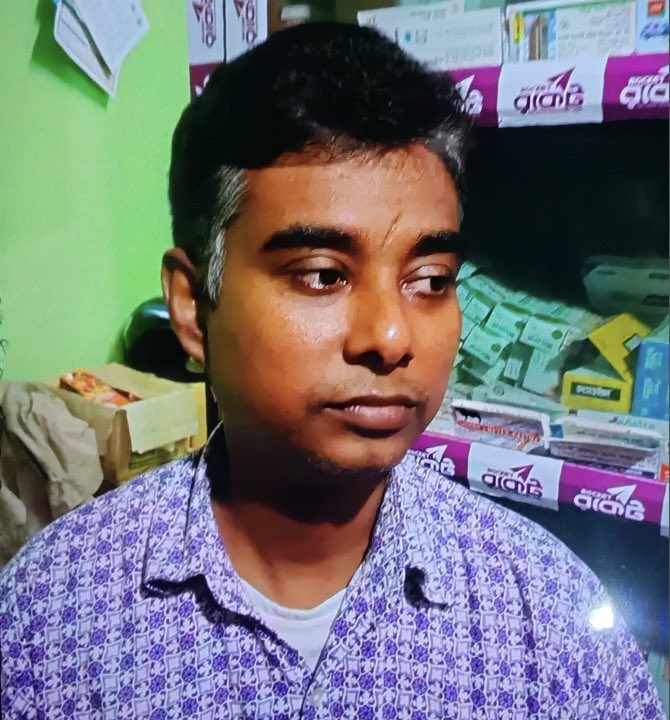
The death of Khokon Chandra Das after a brutal attack has sent shockwaves across Bangladesh and beyond, reopening painful questions about the safety of religious minorities and the moral direction of society. Das, a Hindu man, succumbed to his injuries while undergoing treatment in Dhaka after being stabbed and set on fire by attackers identified as Muslim. His passing is not only the loss of an individual life but also a grim reminder of the recurring vulnerability faced by minority communities when hatred is allowed to turn into violence.
According to reports, Khokon Chandra Das was assaulted in a manner that defies basic human conscience. The attack involved stabbing followed by setting him ablaze, an act that suggests extreme cruelty and intent to kill. Severely injured, he was rushed to a hospital in Dhaka where doctors fought to save him. Despite medical efforts, the burns and wounds proved fatal. His death has left his family devastated and his community gripped by fear and anger.
The killing of Khokon Chandra Das cannot be viewed in isolation. It fits into a disturbing pattern in which members of religious minorities in Bangladesh periodically face attacks, intimidation, and social exclusion. While Bangladesh was founded on principles of secularism and pluralism, incidents like this expose a widening gap between constitutional ideals and ground realities. Each such crime chips away at the promise of equal citizenship and erodes trust between communities.
For the Hindu minority in Bangladesh, the death of Khokon Chandra Das reinforces a deep sense of insecurity. Many families already live with the anxiety that their religious identity could make them targets during moments of social tension. When violence occurs and justice appears slow or uncertain, fear spreads faster than facts. People begin to wonder whether the state can truly protect them, and whether their place in society is becoming increasingly fragile.
It is important to state clearly that crimes like this must never be framed as actions of an entire community. Violence is committed by individuals and groups driven by extremist thinking, personal grudges, or criminal motives. However, when attackers justify brutality through religious identity or are perceived to act with impunity, the damage extends far beyond the immediate victim. It poisons social relations and fuels narratives of collective blame, which in turn create fertile ground for further violence.
Civil society voices and human rights advocates have demanded swift and transparent justice in the case of Khokon Chandra Das. They argue that accountability is the only way to prevent repetition. Arrests, fair investigation, and timely prosecution are essential not only to punish the guilty but also to send a message that no citizen can be harmed because of faith. Silence or delay, on the other hand, risks normalizing brutality and emboldening those who believe they can act without consequences.
The role of the state is crucial at this moment. Bangladesh has often asserted its commitment to minority rights at international forums. Such commitments must be reflected in concrete action on the ground. This includes strengthening local policing, ensuring rapid response to communal threats, protecting vulnerable neighborhoods, and countering hate narratives before they turn violent. Justice for Khokon Chandra Das would be a step toward restoring confidence, but systemic prevention is equally necessary.
Media and political leaders also bear responsibility. Sensationalism or selective outrage can deepen divisions rather than heal them. What is needed instead is a firm moral stance that condemns violence unequivocally, regardless of the identity of victim or perpetrator. Leaders must speak in a language of empathy and law, not calculation. When crimes are acknowledged honestly and addressed decisively, society gains the courage to confront its own failures.
The death of Khokon Chandra Das is a human tragedy before it is a political issue. He was a person with a family, a daily life, and hopes that ended in unimaginable pain. Remembering him only as a statistic would be another injustice. His story should compel reflection on how easily hatred can turn lethal and how urgently compassion and rule of law are needed.
As Bangladesh mourns yet another loss, the question remains whether this moment will lead to meaningful change or fade into a cycle of grief and forgetting. The answer lies in collective resolve. Justice for Khokon Chandra Das, safety for minorities, and accountability for perpetrators are not separate demands. They are inseparable pillars of a society that wishes to call itself humane, lawful, and truly inclusive.