
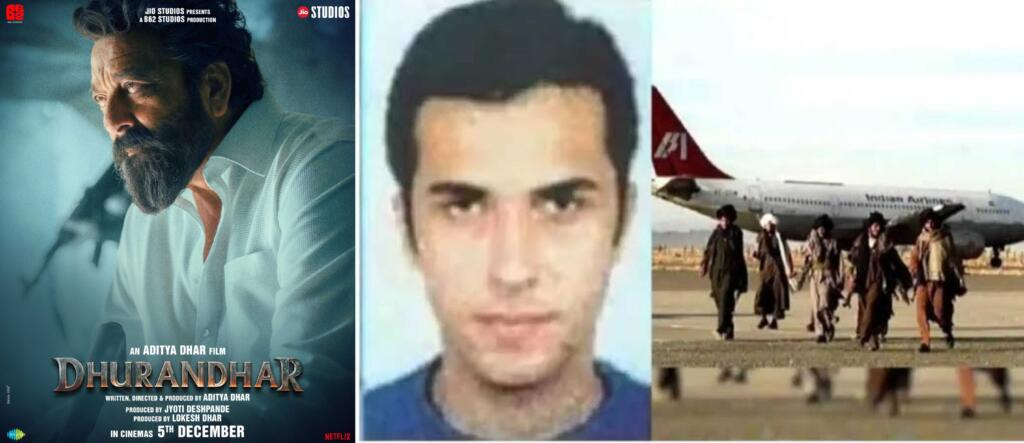
The Hindi film ‘Dhurandhar’ has become the subject of intense political and ideological debate with pro Pakistan voices and sections of the Left dismissing it as propaganda built on a fixed story. However, a closer look at the film’s central theme reveals that ‘Dhurandhar’ is not a work of fantasy but a cinematic reflection of documented events rooted in modern South Asian history. At the heart of this narrative stands Zahoor Mistry, also known as Mistry Zahoor Ibrahim, whose life and death are inseparably linked to one of India’s most traumatic episodes, the Kandahar hijacking.
The story of ‘Dhurandhar’ begins with the 1999 hijacking of Indian Airlines flight IC 814, an event that shocked the nation and exposed the reach of Pakistan backed terror networks. Zahoor Mistry was one of the key hijackers who forced the aircraft to land in Kandahar, then under Taliban control. The hijacking led to the release of hardened terrorists and left a deep scar on India’s collective memory. These are not disputed interpretations or ideological claims but established historical facts acknowledged globally. By placing this incident at the core of its narrative, ‘Dhurandhar’ anchors itself firmly in reality.
Critics argue that the film invents a dramatic storyline to serve nationalist propaganda. This claim collapses when Zahoor Mistry’s later life is examined. After the Kandahar hijacking, he lived under assumed identities in Pakistan, reportedly operating businesses and moving freely despite his known role in international terrorism. On March 1, 2022, Zahoor Mistry was shot dead in Karachi when unidentified gunmen opened fire on him inside a furniture store. His killing was reported by international media and acknowledged by security analysts as a significant development in the long shadow cast by the IC 814 hijacking.
The Left’s discomfort with ‘Dhurandhar’ largely stems from what Zahoor Mistry’s death implies. The killing suggested that individuals involved in terror acts against India were no longer insulated by geography or state protection. While the film does not make documentary claims, its portrayal of covert operations mirrors a broader global reality where states pursue national security interests through intelligence networks rather than open warfare. This is not cinematic exaggeration but a pattern seen worldwide, from counter terror operations in the Middle East to intelligence driven missions in Europe and Africa.
Ranveer Singh’s role as a secret agent in ‘Dhurandhar’ has drawn particular criticism, with detractors claiming it glorifies vigilantism. Yet intelligence operatives exist precisely because diplomacy and legal processes often fail against transnational terror networks. Zahoor Mistry’s case illustrates this failure clearly. For over two decades after the Kandahar hijacking, he remained beyond the reach of Indian courts. His death in 2022 therefore represents closure not through fiction but through consequence. Dhurandhar uses this reality to explore how unresolved trauma and delayed justice shape national consciousness.
The accusation that ‘Dhurandhar’ is anti Pakistan propaganda also ignores a crucial distinction. The film does not attack ordinary Pakistani citizens nor does it invent events. It focuses on a specific individual, Zahoor Mistry, whose actions were criminal and internationally condemned. By centering the narrative on his journey from hijacker to fugitive and finally to a violent end, the film asks uncomfortable questions about accountability, sanctuary, and selective outrage. These questions unsettle the Left because they disrupt long maintained narratives that portray terrorism as a product of abstract geopolitics rather than individual choice and responsibility.
What truly debunks the propaganda charge is the timeline itself. Zahoor Mistry hijacked a plane in 1999. Zahoor Mistry lived freely for years afterward. Zahoor Mistry was shot dead in 2022 in Karachi. ‘Dhurandhar’ connects these dots cinematically, but the dots already exist in reality. Films often dramatize truth, but dramatization does not negate authenticity. In fact, cinema has historically been a powerful medium to confront societies with truths they prefer to forget or soften.
‘Dhurandhar’ therefore stands less as a fictional thriller and more as a cultural response to unfinished history. By placing Zahoor Mistry at the center of its moral universe, the film challenges viewers to reconsider how nations deal with terror, memory, and justice. The Left’s attempt to dismiss the film as propaganda is ultimately an attempt to erase discomforting facts. Zahoor Mistry was real. His crimes were real. His death was real. Dhurandhar merely reflects this reality on screen, making it impossible to deny or dilute.