
Accuracy in the analysis of fat is not just an option in the food and Feed Industry, it is a must. Fat content has a direct bearing on texture, stability, nutritional content, and regulatory approval. For, Feed or processed food, precise fat quantification assures consistency of quality and compliance with food safety measures.
Protein analysis is just as important, especially for nutritional labelling and formulation of high-protein food items. Both fat and protein analysis collectively have an important function to uphold product integrity, regulatory compliance, and consumer confidence. This guide will talk about the importance of fat analysis, especially when it comes to the food and feed industry.
The Role of Fat Analysis in Food Processing
Regulatory Compliance and Labelling
- Food laws mandate precise fat content disclosure to prevent misrepresentation.
- Regulatory non-compliance leads to legal penalties, product recalls, and reputational damage.
- Labels must reflect actual fat and protein content to align with health regulations.
Quality Control and Product Consistency
- Fat levels influence texture, mouthfeel, and stability.
- Essential for maintaining batch-to-batch uniformity in processed foods.
- Maintain product excellence and consistency with reliable fat content determination
Health and Nutritional Considerations
- Growing demand for low-fat, high-protein foods necessitates accurate testing.
- Fat measurement helps develop health-conscious alternatives without compromising sensory properties.
- Balancing fat and protein ensures optimal nutritional profiles for dietary products.
Methods of Fat Analysis: Soxhlet vs. Randall Method
Different food matrices require distinct fat extraction methods. The Soxhlet method remains the industry standard for comprehensive fat quantification, while the Randall method provides faster, solvent-efficient extraction.
| Parameter | Randall Method | Soxhlet Method | Benefits of the Randall Method |
| Solvent Capacity | 150 ml – optimised for efficient extraction | 250 ml – requires more solvent | Saves solvent and reduces running costs |
| Extraction Process | Hot Extraction | Hot & Cold Extraction | Faster extraction with effective fat recovery |
| Solvent Recovery | Automatic solvent recovery | Manual recovery is time-consuming | Saves time and effort with auto recovery |
| Solvent Recovery Efficiency | 80% – 90% | 60% – 65% | Higher solvent recovery |
| Time Required | Around 2 hours | 6 – 8 hours | 3× faster analysis – improves productivity |
| User Interface | 7” touch screen – user-friendly | No digital interface | Easy operation with a modern display |
| Ease of Operation | Rapid heating system | Continuous heating | Quicker start-up and better temperature control |
| Efficiency | Reduces total analysis time and increases output | Longer extraction cycle | Delivers high throughput in less time |
| Safety Features | Safety door protection | No safety door | No safety door |
Soxhlet Extraction: Classical Fat Estimation Method
The Soxhlet Apparatus has been the gold standard in fat estimation for decades. It provides precise and reproducible results, making it a staple in food analysis laboratories.
Key Features of Soxhlet Apparatus for Fat Analysis
- Intelligent Time and Safety Control: Built-in safety cut-off system prevents overheating.
- Advanced 6-Zone Heater: Digitally controlled heating ensures optimal extraction.
- Accurate and Reliable: Industry-proven extraction method with high reproducibility.
While Soxhlet extraction offers unmatched accuracy, it is a time-intensive process. High-throughput food labs benefit from the Randall method, which significantly reduces extraction time.
Randall Method: Advanced Automation for Faster Analysis
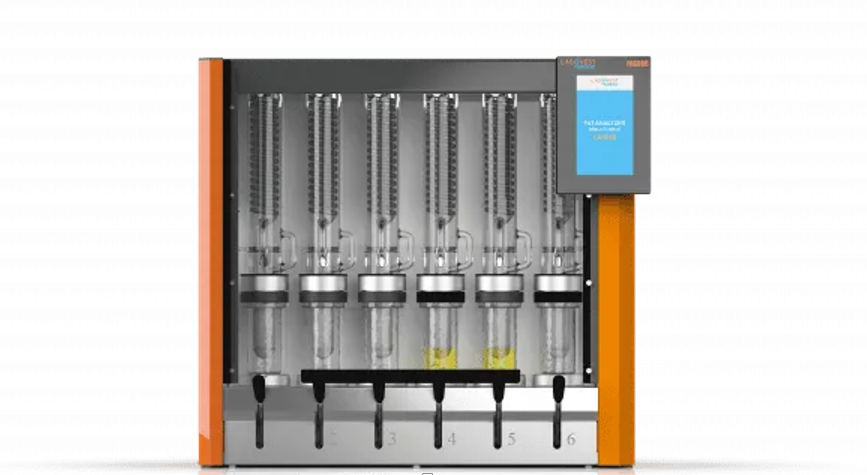
The Fat Analyser – Randall Method streamlines boiling, rinsing, and solvent recovery in a three-step automated process, cutting extraction time in half compared to Soxhlet.
Advantages of Randall Fat Analysis
- Simultaneous Sample Processing: Six independent stations optimise laboratory workflow.
- Multi-Solvent Compatibility: Works with eight different organic solvents for enhanced flexibility.
- Eco-Smart Extraction: Minimises solvent waste and reduces cost per analysis.
- Energy Efficiency: Smart heating regulation lowers energy consumption.
- Real-Time Data Monitoring: Enhances accuracy and prevents process errors.
For high-throughput food quality control, the Randall method offers speed without sacrificing analytical precision.
Optimising Solvent Usage in Fat Extraction
Solvent management is a crucial aspect of fat extraction. Modern analysers employ solvent recovery systems to improve efficiency and sustainability.
Solvent Recovery Benefits
- Cost Savings: Reduces solvent consumption, lowering operational expenses.
- Environmental Protection: Less hazardous waste generation.
- Safety Enhancement: Prevents solvent exposure and contamination risks.
The Fat Analyser – Randall Method integrates a 2-litre recovery system, enabling extended operation with minimal solvent replacement.
Safety Considerations in Fat Analysis Laboratories
Food testing laboratories must implement robust safety measures when handling solvents and heated extraction units.
Essential Safety Features in Modern Fat Analysers
- Protective Safety Doors: Prevent solvent exposure and accidental spills.
- Auto Heater Cut-Off: Reduces risk of overheating, enhancing lab safety.
- Protective Caps: Shield extraction chambers from atmospheric moisture contamination.
With these integrated safety mechanisms, modern fat extraction systems prioritise operator safety while maintaining high analytical accuracy.
Choosing the Right Fat Analyser for Your Laboratory
Selecting the appropriate fat analysis system depends on sample type, processing speed, and throughput demands.
| Feature | Soxhlet Apparatus | Randall Method Fat Analyser |
| Accuracy | High | High |
| Speed | Slow | 3x faster |
| Solvent Usage | Higher | Optimised for efficiency |
| Sample Capacity | Single batch | Multi-sample processing |
| Energy Consumption | Standard | Smart energy-saving mode |
For high-throughput laboratories, the Randall method provides efficient, solvent-optimised extraction without compromising precision, and both analysers are available from reputed brands like Borosil Scientific.
Conclusion
Fat analysis plays a critical role in ensuring food quality, regulatory compliance, and product consistency. From Food, feed to processed meats, precise fat measurements safeguard nutritional integrity and consumer transparency.
Advancements in fat extraction technology, such as the Soxhlet Apparatus and Randall Method Fat Analyser, have enhanced laboratory efficiency, making fat analysis faster and more reliable. With real-time monitoring, solvent recovery, and advanced safety controls, modern analysers offer unparalleled precision and sustainability.
As consumer demand for health-conscious products rises, fat and protein analysis remain essential in food innovation, regulatory compliance, and quality assurance.