
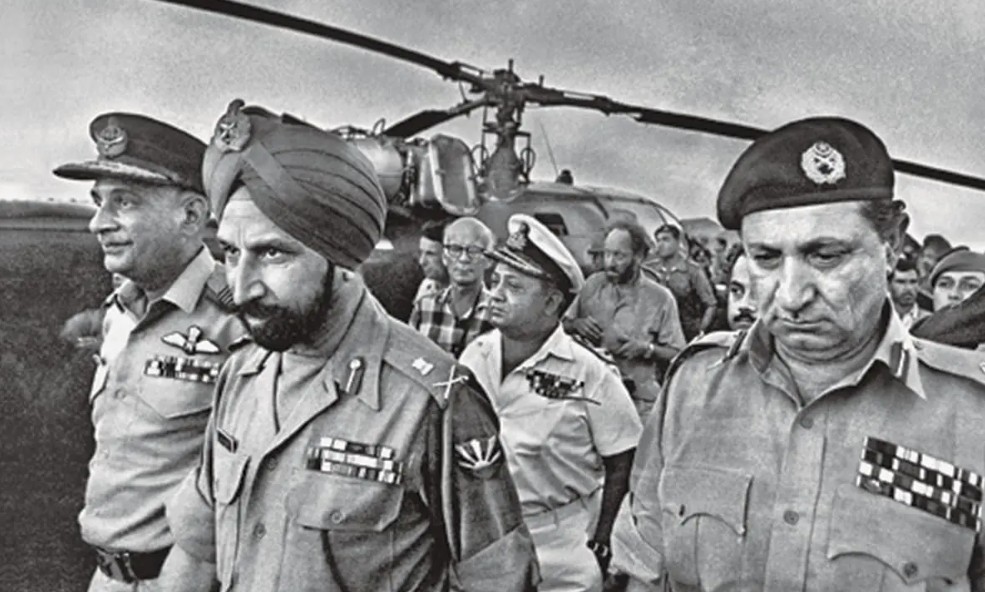
December 16, 1971, stands etched in history as the day a decisive military victory reshaped South Asia. It marked the birth of Bangladesh as an independent nation and affirmed India’s unwavering commitment to peace, justice, and democracy.
The 13-day India–Pakistan War of 1971 was brief in duration but monumental in consequence. Fought with extraordinary courage and strategic brilliance, it culminated in the surrender of Pakistani forces to the Indian Armed Forces, supported by the Mukti Bahini freedom fighters.
The victory came at a great cost, underscoring the timeless truth that freedom is never free.
Vijay Diwas: A Nation Remembers
Vijay Diwas is observed nationwide on December 16 to commemorate India’s victory in the 1971 Liberation War, which concluded with Pakistan signing the Instrument of Surrender in Dhaka and the subsequent liberation of Bangladesh (formerly East Pakistan).
The India–Pakistan War of 1971 was not merely a military confrontation; it was a struggle to end systemic oppression. The conflict had its roots in the political, economic, and social discrimination faced by East Pakistan under the dominance of West Pakistan.
India stood firmly in support of the Mukti Bahini, extending strategic and military assistance as the freedom fighters intensified their campaign for liberation.
The Outbreak of War
On December 3, 1971, Pakistan launched Operation Chengiz Khan, carrying out pre-emptive airstrikes on Indian airbases in an attempt to cripple India’s military capability. This marked Pakistan’s first overt act of aggression in the conflict.
India responded decisively, launching coordinated military operations across land, sea, and air, setting the stage for a swift and comprehensive campaign.
Major Military Operations: Land, Sea, and Air
Battles on the Western Front: Pakistan attempted to advance towards Jaisalmer, but Indian forces countered effectively, halting the offensive.
Key engagements such as the Battle of Basantar and the Battle of Ghazipur weakened Pakistani forward positions, while the Battle of Dera Baba Nanak in Punjab showcased India’s strategic superiority in ground warfare.
Naval Dominance: On December 8, 1971, the Indian Navy launched Operation Trident, targeting Pakistan’s major port city of Karachi. The operation inflicted severe damage on Pakistani naval and logistical assets, crippling their ability to sustain the war effort.
The Eastern Front: March Towards Dhaka
A turning point came on December 9, when Indian troops successfully crossed the Meghna River, enabling rapid advances into key regions of East Pakistan.
On December 10, the Indian Air Force launched a major strike on the Chittagong airbase, severely impairing Pakistan’s operational mobility and securing Indian air superiority.
On December 11, Indian forces executed a bold airdrop of the 2nd Para Battalion at Tangail, demonstrating exceptional logistical planning and precision. This maneuver provided crucial support to advancing ground forces.
The Final Push and Historic Victory
Between December 12 and December 16, Indian military operations gained momentum as forces advanced swiftly towards Dhaka, backed by naval and aerial supremacy.
On December 16, 1971, Indian troops entered Dhaka—marking the day forever as Vijay Diwas.
That afternoon, Lieutenant General A.A.K. Niazi, Commander of Pakistani forces in East Pakistan, formally signed the Instrument of Surrender before Lieutenant General Jagjit Singh Aurora, representing the Indian Armed Forces, alongside the Mukti Bahini.
A total of 93,000 Pakistani troops surrendered—one of the largest military surrenders in history—bringing the war to an end.
A Pledge to the Future
The surrender in Dhaka heralded the birth of Bangladesh and fulfilled the aspirations of millions who had fought for dignity and freedom.
This victory was not merely a military triumph for India; it was a powerful affirmation of its resolve to stand for justice, equality, and democracy in the face of oppression.
As the nation commemorates Vijay Diwas, it honours the bravery, strategic brilliance, and supreme sacrifice of its armed forces. The day serves as a solemn reminder of those who laid down their lives, a celebration of peace hard-won, and a renewed pledge to stand steadfast with those who defend India’s freedom and sovereignty.
Honouring Heroes and Sacrifice
On the eve of this historic milestone, a Vijay Diwas ‘At-Home’ Reception was organised at Army House, New Delhi, under the aegis of the Chief of Army Staff, General Upendra Dwivedi.
President Droupadi Murmu graced the occasion to commemorate the 53rd anniversary of Vijay Diwas, joined by Vice President Jagdeep Dhankhar and Defence Minister Rajnath Singh.
The dignitaries interacted with veterans, Veer Naris, members of the diplomatic fraternity, sportspersons, eminent citizens, Asha School children, and achievers from diverse fields.
The event also provided a platform for the tribal community to showcase their cultural talent, reflecting India’s inclusive spirit. Heartfelt interactions with the Veer Naris paid tribute to their immense sacrifice and unwavering strength.
The Indian Army also recalled the heroism and nationalism of the Indian Armed Forces by sharing the historic tale of the liberation of Bangladesh through a social media post by the Additional Directorate General of Public Information.
In a post on X, the Indian Army wrote, “Vijay Diwas is not just a date – it stands as the symbol of the historic and decisive victory of the Indian Armed Forces in the 1971 War.”
They described the battle as a triumph that reshaped India’s military history and said, “It was a victory where the Mukti Bahini and the Indian Armed Forces fought shoulder-to-shoulder, together giving the Bangladesh Liberation struggle its decisive thrust toward freedom… A triumph that reshaped India’s military history, redrew the map of South Asia and gave birth to a new nation – Bangladesh,” the post read.
The Indian Army noted that the victory ended the mayhem and cruelty of the Pakistani Army, faced by a large community. Indian Army, in 13 days dissolved at least 93,000 Pakistani soldiers into surrendering, marking it as one of the largest military surrenders in the world. (ANI)