
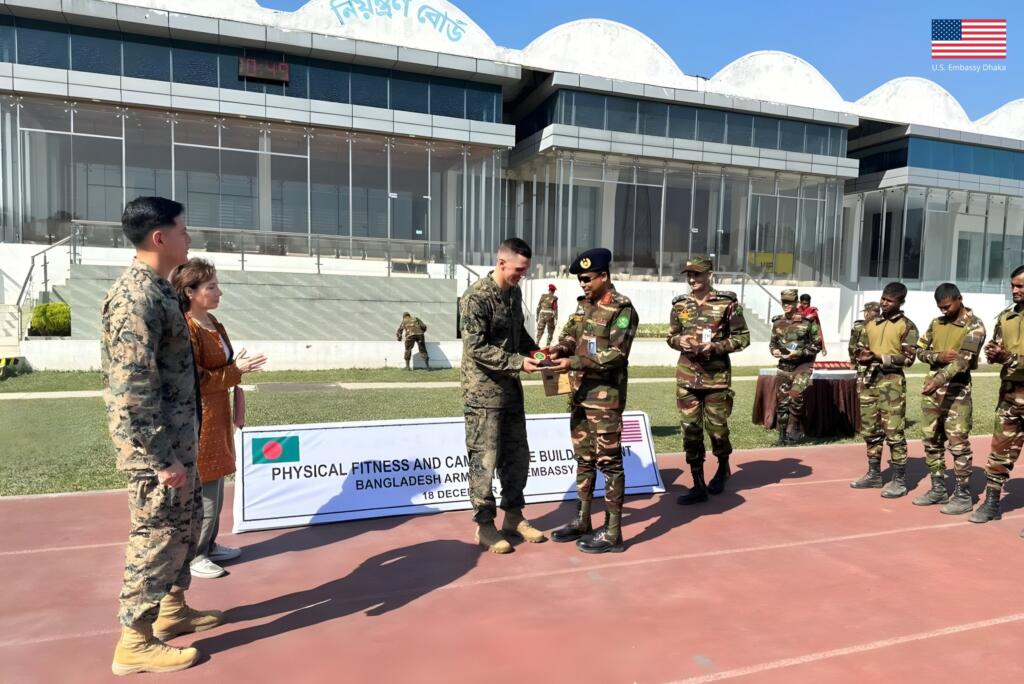
At a moment when Bangladesh is witnessing disturbing waves of anti India violence and rising hostility on its streets, the image projected by the USA tells a different and deeply troubling story. While tensions simmer and targeted aggression threatens regional stability, the USA Embassy in Dhaka chose to highlight a spectacle of military camaraderie featuring Marines and Bangladeshi military personnel running sprints and performing fireman carries at the Bangladesh Army Stadium. The symbolism of this event cannot be ignored. It reflects priorities that appear misaligned with the realities unfolding on the ground.
The official statement of USA Embassy in Dhaka celebrating the Marine Corps Combat Fitness Test framed the event as an exercise in teamwork friendship and defense cooperation. On paper it sounds harmless even constructive. Yet context matters. Bangladesh today is not merely a venue for fitness drills and public relations showcases. It is a country grappling with internal unrest where anti India violence has increasingly translated into anarchic intimidation and ideological mobilization. At such a time silence on these developments combined with visible military engagement sends a powerful message.
USA has long positioned itself as a global advocate for peace democratic values and regional stability. In South Asia it frequently emphasizes the importance of restraint dialogue and the protection of minorities. However actions often speak louder than carefully worded policy statements. By projecting images of military bonding without addressing the growing hostility directed at India and its interests the United States appears indifferent to the consequences of that anti India violence. To many observers this indifference feels deliberate rather than accidental.
Anti India violence in Bangladesh is not an abstract phenomenon. It has real victims and real implications. It strains bilateral relations fuels extremist narratives and destabilizes a region already burdened with historical grievances. India and Bangladesh share deep civilizational economic and security ties. When those ties are attacked through orchestrated street violence or ideological campaigns the silence of major global powers becomes conspicuous. Against this backdrop USA’s focus on defense cooperation optics looks less like neutrality and more like selective engagement.
The optics are particularly sensitive because the Bangladeshi military is not just another institution. It is a central pillar of the state with immense influence over political outcomes and internal security. Joint activities with USA Marines at a time of domestic unrest inevitably raise questions. Is Washington more interested in cultivating military relationships than in addressing the social and ideological forces driving instability. Is strategic positioning taking precedence over moral consistency.
Supporters of the USA approach argue that military cooperation and regional engagement are long term investments that should not be derailed by episodic unrest. They claim that such exercises strengthen professionalism and interoperability and ultimately contribute to stability. Yet this argument ignores perception. For communities affected by violence and for regional partners like India perception is reality. When America showcases strength and friendship with one arm of the state while ignoring violence unfolding outside stadium walls it risks appearing tone deaf.
There is also a deeper ideological dimension. Anti India violence in Bangladesh does not emerge in isolation. It is often intertwined with radical narratives historical revisionism and political opportunism. These forces thrive when they sense international ambiguity. A strong and balanced message from global powers can act as a deterrent. A message focused solely on physical fitness drills and smiling photographs does the opposite. It creates space for radical elements to believe that their actions will not attract meaningful international scrutiny.
USA’s true colours in this moment are therefore revealed not by what it says but by what it chooses to highlight. The Marine Corps Combat Fitness Test becomes more than a routine exercise. It becomes a symbol of misplaced emphasis. Instead of leveraging its influence to encourage calm accountability and protection of regional harmony the United States appears content to maintain business as usual.
This is not an argument against cooperation or engagement. It is a call for responsibility. Friendship and defense cooperation should not exist in a moral vacuum. They should be accompanied by clear positions on violence intolerance and regional peace. Otherwise they risk being interpreted as endorsements of the status quo no matter how troubling that status quo may be.
For India the message is unsettling. A strategic partner watches as anti India violence or simply hostility against it rises next door while another major power deepens visible military ties without public concern. For Bangladesh the message is equally complex. It suggests that international approval can be earned through selective engagement regardless of internal turmoil.
In the end USA’s conduct in Bangladesh at this sensitive time underscores a familiar criticism. Values are often invoked but interests ultimately guide action. As anti India violence challenges the fabric of regional stability the sight of Marines and soldiers bonding on a track field feels disconnected from reality. History will judge whether this was mere insensitivity or a calculated display of priorities. What is clear is that in moments of crisis neutrality is itself a statement and in this case it reveals more than intended.