












Australia has been left reeling after a horrific mass shooting at Sydney’s Bondi Beach claimed at least 15 lives and injured dozens more during a Jewish religious celebration. The attack, which occurred on the first day of Hanukkah, has been described by authorities as the deadliest mass shooting in the country in nearly three decades. It is also being widely regarded as one of the most Antisemitic acts of violence in Australia’s modern history, striking at the heart of a peaceful community gathering in one of the nation’s most iconic public spaces.
Police confirmed that the two attackers were a father and son. The older gunman, 50 year old Sajid Akram, was shot dead by police during the incident, while his 24 year old son Naveed Akram was wounded and taken into custody under hospital treatment. New South Wales Police Commissioner Mal Lanyon stated that investigators believe the duo deliberately targeted the Jewish community, making the massacre an Antisemitic and terrorist act rather than a random outbreak of violence.
Prime Minister Anthony Albanese addressed the nation soon after the tragedy, confirming that the Antisemitic attackers had chosen the Hanukkah celebration intentionally. He described the shooting as an Antisemitic attack aimed at spreading fear and hatred, and said it represented a dark and painful moment for Australia. According to police estimates, around 1,000 people had gathered near the beach park for the Chanukah by the Sea event when the shooting began.
Details about the attackers’ background have added further complexity to the investigation. Sajid Akram arrived in Australia in 1998 on a student visa, later transitioning to a partner visa and eventually receiving resident return visas. His son Naveed was Australian born and held full citizenship. Media reports citing intelligence officials indicated that the family was likely of Pakistani origin, a detail that has circulated widely after images of Sajid Akram’s driver’s licence went viral on social media.
More troubling were revelations that Naveed Akram had previously come under the scrutiny of intelligence agencies. An Indian Intelligence Bureau official, quoted by IANS, said that Naveed had been examined by Australian intelligence around six years ago for suspected links to the Islamic State. Although no immediate action followed at the time, the official suggested that Naveed may have deliberately kept a low profile to avoid detection, waiting for what he saw as the right moment to carry out an Antisemitic attack of maximum impact.
Investigators also revealed aspects of the attackers’ personal lives. Sajid Akram ran a fruit shop and had legally held a gun licence for nearly a decade, raising serious questions about firearm oversight and long term monitoring. His son had reportedly lost his bricklaying job about two months before the attack after his employer became insolvent. While police have not drawn direct conclusions, they are examining whether personal instability, radical ideology, or a combination of factors contributed to the Antisemitic violence.
The shooting began shortly after 6:45 p.m. on a warm summer evening when Bondi Beach was crowded with locals and tourists. Witnesses said the Antisemitic attack lasted around ten minutes, during which panic spread rapidly. Video footage showed people fleeing from the shoreline, some still in swimwear, as gunfire echoed across the area. Other recordings captured two men in dark clothing firing long guns from a footbridge leading toward the beach. Although police have not officially confirmed the weapons used, the footage appeared to show a bolt action rifle and a shotgun.
Amid the chaos, a moment of extraordinary bravery likely saved lives. One man was seen tackling and disarming one of the gunmen before placing the weapon on the ground. The individual was later identified as Ahmed al Ahmed, a local fruit shop owner and father of two. New South Wales Premier Chris Minns praised him as a genuine hero, and public donations in his support exceeded 200,000 Australian dollars within a day, reflecting widespread gratitude across communities.
The human toll of the attack has been devastating. Victims ranged in age from just 10 to 87 years old, underscoring the indiscriminate nature of the Antisemitic assault. At least 42 people were hospitalised, several in critical condition. The Orthodox Jewish organisation Chabad confirmed that one of the victims was Rabbi Eli Schlanger, an assistant rabbi at Chabad of Bondi and a key organiser of the Hanukkah event. His death has deeply shaken the Jewish community in Australia and beyond.
Mass shootings are extremely rare in Australia, which enacted strict gun control laws after the 1996 Port Arthur massacre. Sunday’s incident is the worst since that tragedy and the most serious Antisemitic attack in the country in decades. Commissioner Lanyon acknowledged that one of the attackers was known to security services but said there had been no intelligence pointing to an imminent attack.
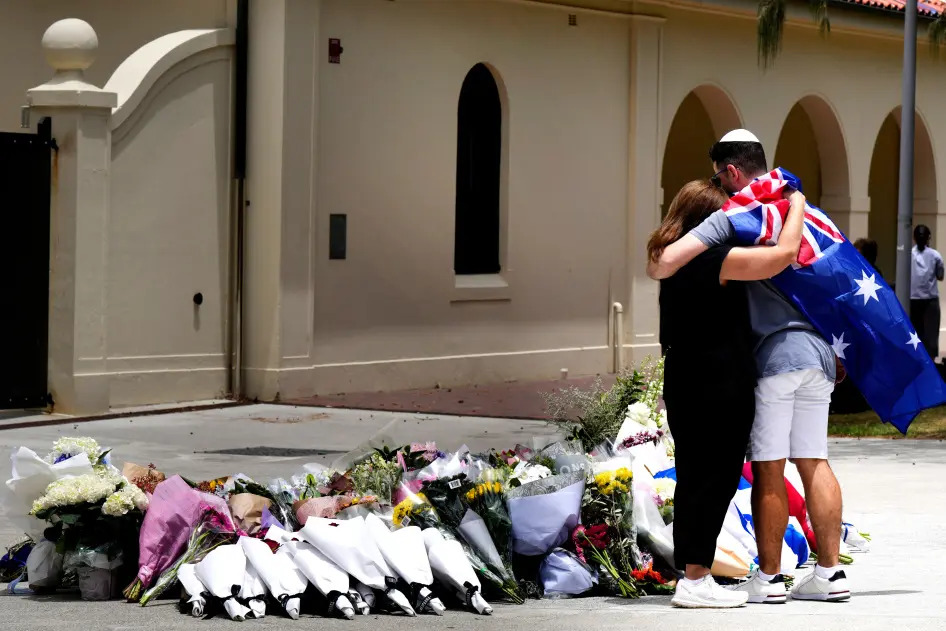
World leaders swiftly condemned the violence. Prime Minister Albanese visited the site, laying flowers alongside mourners wearing kippahs and lighting candles in remembrance. Leaders including US President Donald Trump, French President Emmanuel Macron, and Indian Prime Minister Narendra Modi expressed solidarity to this worst Antisemitic attack. Albanese reiterated that Australia would do everything necessary to combat Antisemitic hatred, stressing that the nation stands united against terrorism and bigotry.
As Australia mourns the victims, the Bondi Beach shooting has forced a painful reckoning. It has highlighted the persistence of extremist ideologies and the threat of Antisemitic violence even in societies known for tolerance and strong institutions. The challenge now lies not only in delivering justice, but also in ensuring that such hatred finds no place in Australia’s future.





