
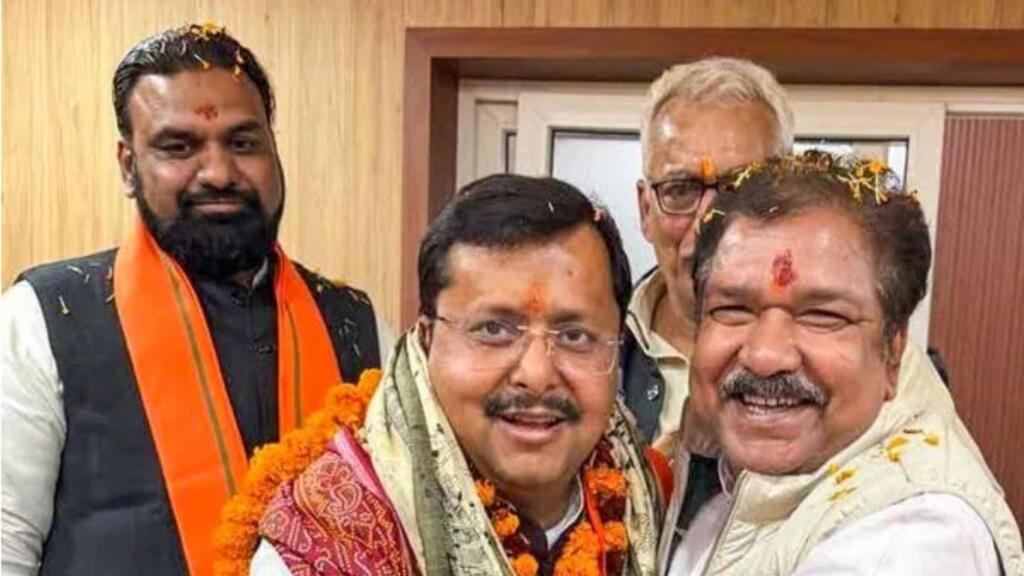
Living up to expectations, the Modi–Shah duo, known for political surprises, has pulled a rabbit out of the hat yet again by appointing Bankipur (Bihar) MLA and minister in the Nitish Kumar government, Nitin Nabin, as the National Working President of the Bharatiya Janata Party (BJP). He replaces Union Health Minister Jagat Prakash Nadda, who was holding dual responsibility.
The move puts to rest speculation that the RSS and BJP were not on the same page regarding the appointment of the party’s national president.
A Long-Awaited Decision That Defied Speculation
The decision on the new BJP president was long awaited, with intense speculation around caste equations, regional balance, and senior leadership names. However, the choice of Nitin Nabin has come as a surprise, as neither his caste base is seen as electorally decisive nor is he known for political charisma. That said, observers point out that charisma was never a defining feature of Nadda’s leadership either.
The question, therefore, is what prompted the leadership to appoint Nabin as working president—widely seen as a precursor to his elevation as full-time BJP president through formal procedures.
RSS Line on Grassroots Workers Gains Ground
The RSS has consistently emphasised recognising grassroots party workers for organisational roles. In that context, Nitin Nabin—a five-term MLA and long-time party worker—fits the bill. Currently a minister in the Nitish Kumar government, he has won all his elections by comfortable margins, indicating significant popularity among his constituents.
Importantly, he carries no major political baggage, a factor seen as beneficial for the smooth functioning of the party organisation.
Eastern India Gets Its Turn
So far, the BJP’s national presidents have come from almost every region except eastern India.
- North India was represented by Murli Manohar Joshi and Rajnath Singh (Uttar Pradesh).
- Central India saw leaders like Atal Bihari Vajpayee and Kushabhau Thakre from Madhya Pradesh.
- Western India was represented by Nitin Gadkari (Maharashtra) and Amit Shah (Gujarat), while L.K. Advani represented both Gujarat and Delhi.
- Southern India produced three presidents—Venkaiah Naidu, Bangaru Laxman, and Jana Krishnamurthi.
- J.P. Nadda came from Himachal Pradesh.
With BJP governments now firmly established in Assam for two consecutive terms, strong performance in Bihar, growth in West Bengal, and NDA governments in several northeastern states, the question arises: Is this the time to pay back eastern India?
A Subtle Message to Bihar and JD(U)
The appointment of Nitin Nabin is also being read as a subtle message to BJP’s ally Janata Dal (United) and the people of Bihar. While Nitish Kumar has been accepted once again as Chief Minister in the spirit of coalition dharma, the signal is clear: the next Chief Minister of Bihar will be from the BJP.
Until now, the BJP’s claim over the CM post was often dismissed on the grounds that it lacked a leader of Nitish Kumar’s stature. Is Nitin Nabin’s rise an attempt to draw a bigger leadership line in Bihar?
West Bengal Angle and Caste Arithmetic
Another notable factor is the Kayastha population. While Kayasthas constitute less than 1 per cent of the population in UP and Bihar, they account for 13.3 per cent in West Bengal, where Assembly elections are due in early 2026.
Although it is often claimed that West Bengal does not vote on caste or religion, it remains to be seen whether Nabin can make any political impact there.
Generational Shift and Political Messaging
At 45, Nitin Nabin becoming the working president of what the BJP claims to be the world’s largest political party sends a strong message. It signals space for younger leadership and aligns with RSS chief Mohan Bhagwat’s repeated emphasis on generational transition. The BJP has already sidelined most leaders above the age of 75.
This development also sharpens the contrast with the Congress, which speaks of youth leadership while being led by an octogenarian president—a comparison likely to dominate public discourse.
Also Read: Rising Star in Indian Politics: Who Is BJP’s New Working President Nitin Nabin?
Decision Finalised During Shah–Bhagwat Andaman Visit
Union Home Minister Amit Shah and RSS chief Mohan Bhagwat were in the Andaman and Nicobar Islands from December 12 to 14, 2025, where they unveiled a life-size statue of Vinayak Damodar Savarkar at Beodnabad in South Andaman. Savarkar was imprisoned nearby in the Cellular Jail in 1911.
It is believed that Nitin Nabin’s name was finalised during this visit, with both Shah and Bhagwat putting their stamp of approval on the decision.
Background and Organisational Experience
Born in Ranchi in undivided Bihar, Nitin Nabin is the son of late Nabin Kishore Prasad Sinha, a veteran BJP leader and former MLA. He entered active politics following his father’s demise and gradually rose through party ranks.
While questions may be raised about dynastic politics and his educational qualification—he is a Class 12 pass—his organisational experience is significant. He has served as BJP Yuva Morcha state president and national general secretary, election and organisational in-charge for Sikkim, and held senior responsibilities in Chhattisgarh.
Together, these roles underline the BJP’s increasing organisational focus on eastern India and youth leadership.