























The 2025 India–Pakistan confrontation, known as Operation Sindoor, marked a turning point in South Asia’s information warfare landscape.
For the first time, artificial intelligence, deepfake videos and recycled war footage played a central role in shaping public perception of the conflict.
While Indian forces operated actively across land, air and sea, much of Pakistan’s apparent battlefield activity took place online.
The result was a strange, layered conflict in which real deployments and virtual claims sat side by side, often contradicting each other and leaving the public unsure of what was actually happening.
This fusion of AI and social media allowed Pakistan to project an image of strength that did not always match its physical posture, especially at sea.
Operation Sindoor became not just a military episode, but a warning about how modern war is now fought in parallel digital arenas where visuals can be manufactured faster than they can be verified.
A Surge of AI-Generated and Recycled War Footage
As tensions escalated, social media across South Asia flooded with dramatic visuals claiming to show intense combat. Videos appeared online showing Indian warships ablaze in the Arabian Sea, Indian aircraft shot down in dogfights and missile strikes on major naval facilities. None of these events actually happened.
When fact-checkers examined the videos, they found a mix of sources–clips from old conflicts in the Middle East, video-game simulations edited to look real, and increasingly, AI-generated footage crafted to imitate current events.
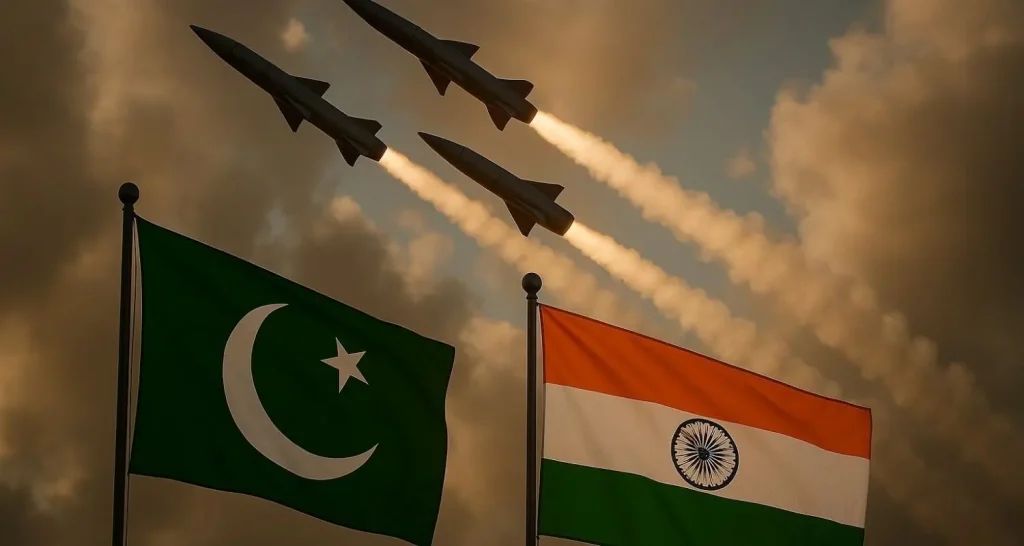
This was the first Indo-Pak confrontation in which AI-driven fakery played such a large part. Deepfakes mimicked news broadcasts, forged images attempted to show burning ships and synthetic videos portrayed missile strikes with convincing detail.
The aim was clear–create the impression that Pakistan had scored battlefield victories and that India was losing naval assets—even though Indian ships remained fully operational throughout.
Pakistan’s Naval Reality vs Its Online Projection
At sea, the reality of naval operations was far more one-sided than online claims suggested. Indian warships were deployed across the Arabian Sea, operating with freedom of movement and demonstrating readiness throughout the period of tension. Their presence was visible in shipping reports, satellite imagery and maritime advisories.
Pakistan, meanwhile, kept its navy largely inside harbour. This was a cautious strategic decision, likely taken to avoid escalation and preserve assets. But it created a major gap between Pakistan’s real maritime posture and the victories being claimed on social media.
To fill this gap, the Pakistan Navy issued multiple NAVAREA warnings, standard mariner alerts that indicated ongoing activity but did not reflect major operations. Around these notices, a large volume of manipulated imagery surfaced online. Some showed supposed missile launches destroying Indian ships; others portrayed Indian submarines being hunted or aircraft being downed. Many were traced back to either old videos edited with new captions or AI-generated clips that looked real to casual viewers.
This created a narrative of parity—or even superiority—between the two navies that simply did not exist in the physical battlespace.
The First AI-Driven Disinformation Conflict in South Asia
Analysts described 2025 as South Asia’s first major conflict where AI-generated disinformation became a central tool. Earlier Indo-Pak crises had seen propaganda and exaggerated claims, but Operation Sindoor added a new layer– highly realistic visuals that were difficult to distinguish from real footage. AI tools enabled users to fabricate missile trails, explosions, drone feeds and cockpit views within minutes.
These manipulated videos spread rapidly because they hit emotional buttons: nationalism, fear and the desire for quick updates in a tense situation. They also helped shape the narrative inside Pakistan, where many users believed their navy had conducted successful strikes at sea—despite the absence of any real engagement.
Even officials and low-level political actors in both countries were sometimes misled, briefly reacting to online claims before corrections surfaced. The fog of war had become a fog of algorithms.
The Dangers of a Digital Fog of War
The most troubling feature of this “virtual battle” was not just its scale but its impact on public behaviour. AI-generated images of supposed explosions near major Indian and Pakistani cities caused panic. A deepfake “nuclear alert”, generated to look like an official broadcast, went viral for hours before being debunked. False claims risked triggering dangerous overreactions during an already tense period.
This kind of disinformation poses risks well beyond the online space. When fabricated events spread faster than real ones, governments must react not only to physical threats but also to public panic. Miscalculations become more likely when leaders face pressure from a public that believes fake destruction is happening in real time.
Narrative Control as a Form of Modern Power
Operation Sindoor showed that in the digital age, a navy’s ability to project power is no longer limited to physical deployments. Control over the online narrative—through visuals, messaging and digital campaigns—has become a parallel battlefield.
For Pakistan, this meant using AI and recycled footage to create an impression of combat activity even when its ships remained in port. For India, it meant competing against an online storm of false claims while relying on verifiable movements at sea.
The contrast between real operations and virtual victories shaped how millions understood the conflict. The episode demonstrated that modern warfare is no longer fought only with ships, aircraft and missiles, but also with synthetic imagery, algorithmic manipulation and fast-moving online networks.
A New Kind of Warning for Future
Operation Sindoor will be remembered not just for its tactical elements but for revealing the scale of AI-driven information warfare now possible in South Asia.
The conflict showed how easily truth can be drowned out, how quickly false visuals can solidify public opinion, and how military credibility can be challenged by digital deception.
As the region prepares for future crises, the greatest lesson may be this: the next war may be fought in the skies and seas, but just as fiercely on the screens of millions, where the line between reality and fiction becomes dangerously thin.





