
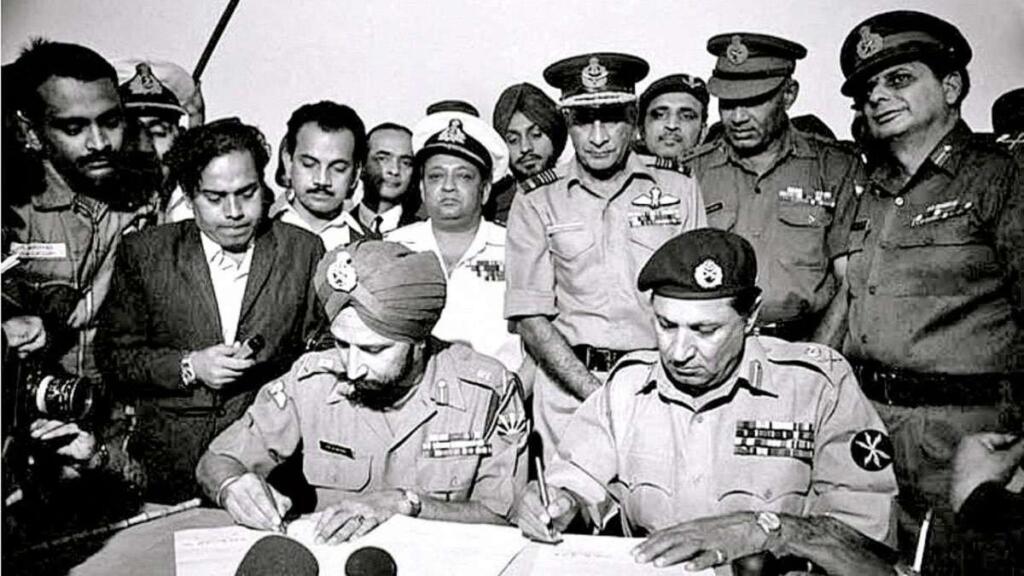
A quiet but historic scene unfolded in Dhaka in front of Indian and Bangladeshi commanders on December 16, 1971, as the head of Pakistan’s Eastern Command signed the document of surrender.
With that signature, Pakistan lost East Pakistan forever and Bangladesh was born as a new nation. Nearly 93,000 Pakistani soldiers laid down their arms. It was one of the biggest military surrenders since the Second World War.
For Bangladesh, it was the end of a long and painful struggle. For Pakistan, it was a moment of deep humiliation that still haunts its national memory.
The surrender was the final act of a war that began with political failure. In the 1970 general election, the Awami League under Sheikh Mujibur Rahman won a clear majority.
By all democratic rules, power should have passed to the Bengali leadership. Instead, the military rulers in West Pakistan delayed and denied the transfer. Protests spread across East Pakistan, talks failed and finally, on the night of March 25, 1971, the Pakistan Army launched a violent crackdown.
Universities, neighbourhoods and towns were attacked. Thousands of civilians were killed in the early weeks. Many women were assaulted and homes were burned. Fear spread everywhere. Millions of people fled across the border into India. What had started as a political protest turned into an armed struggle for survival.
As the months passed, the Mukti Bahini, made up of Bengali soldiers and civilian volunteers, grew stronger. They carried out raids on army camps, bridges and supply routes.
They had little equipment but strong local support. Villagers fed them, hid them and guided them through rivers and fields. By late 1971, large parts of the countryside were out of Pakistani control.
India could no longer remain a bystander. Apart from the refugee crisis, fighting had increased along the border. In early December 1971, Pakistan carried out air attacks on Indian bases.
India responded with full military action. Indian forces moved quickly into East Pakistan from several directions. The Mukti Bahini fought alongside them. Within days, Pakistani positions began to collapse.
Dhaka soon found itself surrounded. The Pakistan Army in the east was cut off from reinforcements and supplies. Airfields were damaged, ports were blocked and communications failed.
There was little hope of either rescue or victory. On 16 December, Lieutenant General AAK Niazi formally surrendered to the joint Indian and Bangladeshi command at the Race Course in Dhaka.
Photographs of the moment were seen across the world. Pakistani officers stood defeated as the surrender papers were signed. For Bangladesh, it was the end of occupation and the start of independence. For Pakistan, it was a shock that shook the state to its core. An entire wing of the country was lost in just thirteen days of fighting.
The defeat exposed a series of deep mistakes. Pakistan’s leaders had failed to understand the strength of Bengali political feeling. They believed force could keep the country together. Instead, force pushed it apart. The army in the east was isolated both geographically and politically.
It was fighting among a population that no longer accepted its authority. Once India entered the war, the outcome became almost inevitable.
Yet within Pakistan, the full truth of 1971 was never openly faced. The tragedy of East Pakistan was turned into a narrow military episode rather than a wider political failure. The role of the army in creating the crisis was played down. Blame was shifted to politicians, to India, or to foreign conspiracies. School textbooks spoke little about the massacres, the refugees or the denial of the 1970 election result.
An official inquiry, known as the Hamoodur Rahman Commission, did examine what went wrong. It recorded serious failures in leadership and discipline. But its findings were kept secret for many years. Even when parts of it became public, no major figures were punished through an open legal process. The system moved on without real accountability.
In Bangladesh, memory took a different path. December 16 is marked every year as Victory Day. Museums and memorials preserve photographs, documents and personal stories of the war. Families remember who they lost. Survivors tell their stories. The surrender is remembered as the moment when long suffering finally ended.
For Pakistan’s deep state, however, the Dhaka surrender remains an uncomfortable subject. Accepting it fully would mean facing hard questions about the use of force against one’s own citizens, about political denial, and about the limits of military power. It would weaken the long-built image of the army as the unquestioned guardian of the nation.
The shadow of 1971 also stretches into later decades. Instead of learning that force cannot solve political problems, Pakistan returned again and again to similar methods in other regions and against other movements. Military rule, pressure on elected governments, control of the media and the courts — all continued in different forms.
The Dhaka surrender was not just a battlefield loss. It was a collapse of a political idea: that a diverse country could be held together only by command and fear. It showed that when people are denied their vote, their language and their dignity, they will eventually resist, no matter the cost.
More than fifty years later, the surrender in Dhaka still stands as a turning point that Pakistan has never fully come to terms with. It remains a reminder that power secured by force is always fragile, and that history records not only victories, but also moral failures that no amount of silence can erase.
Ashu Mann is an Associate Fellow at the Centre for Land Warfare Studies. He was awarded the Vice Chief of the Army Staff Commendation card on Army Day 2025. He is pursuing a PhD from Amity University, Noida, in Defence and Strategic Studies. His research focuses include the India-China territorial dispute, great power rivalry, and Chinese foreign policy.