















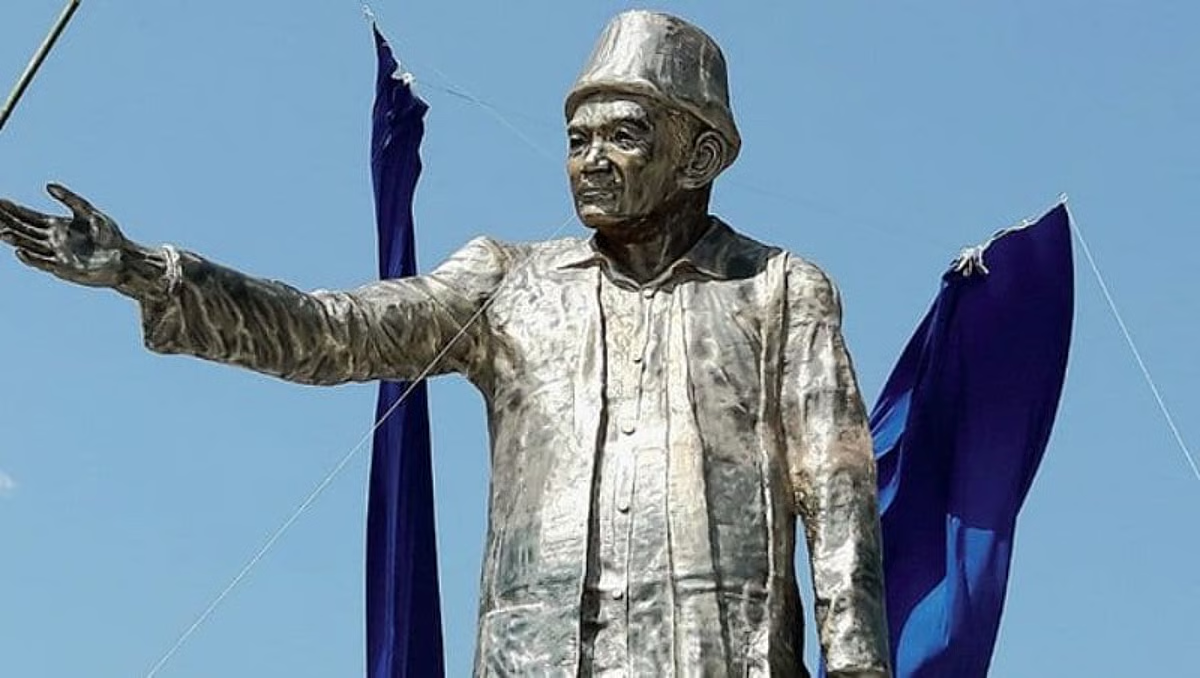
There are some national heroes whose contributions history has consistently failed to acknowledge. Talom Rukbo of Arunachal Pradesh was one such towering figure.
We remember him today because he was born on this very day—1 December 1938, in Pasighat, Arunachal Pradesh.
A culture Under Attack
The far-flung state of Arunachal Pradesh, located along the sensitive China border, holds immense strategic value for India.
This region, once known as NEFA (North East Frontier Agency), has for thousands of years been home to vibrant tribal communities. These indigenous groups worship the Sun and the Moon, yet they do not build temples for their deities.
As a result, their worship practices never took the formal, organised form seen in North, Central or South India.
Christian missionaries exploited precisely this gap, attempting to distance the tribes of Arunachal from their Hindu civilizational roots.
Talom Rukbo: A Shield Against Missionary Expansion
Taking advantage of poverty and lack of education, missionaries converted thousands across the state. But some people sensed the danger early—Talom Rukbo was among the first.
He understood that the rapid spread of Christianity in this critical border region also meant the rise of anti-national elements. So he appealed to his people to celebrate their traditional festivals together, revive their customs, and stand united against cultural erosion.
To counter the assault on tribal belief systems by foreign forces, Talom Rukbo developed a structured, indigenous worship method. The results were extraordinary.
The public’s enthusiasm was so overwhelming that the state government eventually recognized the local festival ‘Solung’ in the official Gazette and declared a public holiday on that day.
A Man Who Left His Job to Serve His People
In 1976, Talom Rukbo resigned from his government job and dedicated himself entirely to social service.
He not only revived ancient tribal customs but reshaped them in ways that reconnected ordinary people with their heritage.
He was also an accomplished writer—authoring several books in both English and his native tribal language. He collected and preserved age-old folk songs and stories, popularizing them among the masses.
His influence was so profound that the youth—who had begun drifting towards English songs, Western habits, and Christian hymns—started returning to their own traditions.
Donyi–Polo Movement: Bringing Tribal Youth Back to Their Roots
Like many tribal societies across the world, the tribes of Arunachal hold deep reverence for nature—trees, rivers, birds, animals, and the elements.
Talom Rukbo’s community traditionally worshipped Donyi (the Sun) and Polo (the Moon).
He founded the ‘Donyi Polo Yelam Kebang’, an organization dedicated to reviving and protecting indigenous faith.
Under his guidance, hundreds of villages built ‘Donyi Polo Ganggin’—community prayer centers, where weekly worship practices were formalized.
Today, tribal youth visit these centers, dress traditionally, and proudly participate in rituals centered on the worship of the Sun and the Moon.
Talom Rukbo thus emerged as the true national hero who halted missionary influence and rekindled cultural unity across the Northeast.
A Movement That Became a Cultural Resistance
As his work gained recognition, organizations like the Vanvasi Kalyan Ashram and Vishwa Hindu Parishad connected with him, bringing his efforts to national attention.
The Bhaurao Deoras Seva Nyas in Lucknow honored him for his extraordinary service. Inspired by his leadership, many others dedicated their lives to this cause.
What began as a cultural awakening soon transformed into a powerful resistance movement against foreign and anti-Hindu forces.
Talom Rukbo—who awakened the spirit of nationalism and religious identity in India’s frontier region and devoted his life to uplifting the tribal community—passed away on 30 December 2001. Yet his movement continues.
Today, tribal worship practices are being revitalized, and in countless forest villages, these prayer centers are rebuilding social harmony, unity, and cultural pride.
Talom Rukbo lives on through every chant of Donyi-Polo,
every revived tradition, and every tribal youth who proudly embraces his roots.