
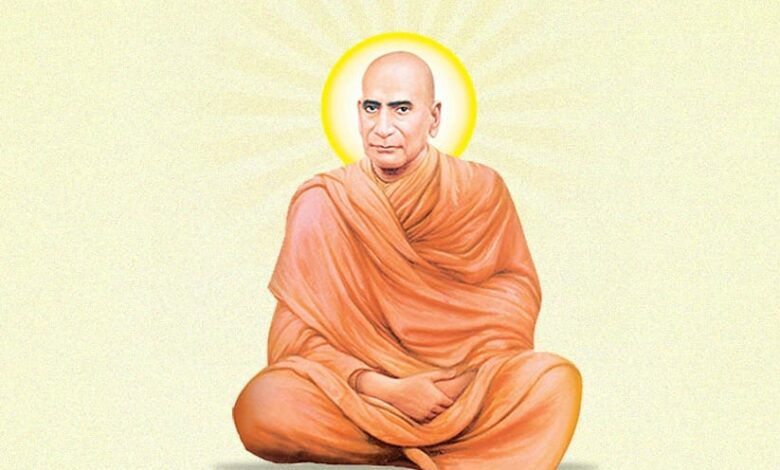
December 23 marks the death anniversary of Swami Shraddhanand, a towering personality of India’s freedom struggle and social reform movement.
A devoted disciple of Swami Dayanand Saraswati and a prominent leader of the Arya Samaj, he dedicated his life to education, social equality, national awakening, and the strengthening of Hindu society.
His assassination in 1926 sent shockwaves across the country and left a lasting impact on India’s political and social consciousness.
Swami Shraddhanand was among the most influential and fearless pioneers of India’s social reclamation (Shuddhi/Paravartan) movement.
He firmly believed that many Muslims living in India were descendants of Hindus, and that reconnecting them with their original faith was an essential part of India’s national and cultural renaissance.
Before embracing renunciation, he was known as Munshi Ram. He was born in 1856 in the village of Talban, in present-day Jalandhar district of Punjab.
Inspired by Swami Dayanand and Committed to Social Reform
Deeply influenced by the teachings of Arya Samaj founder Swami Dayanand Saraswati during his time in Bareilly, Swami Shraddhanand dedicated his life to fighting social evils such as untouchability and caste discrimination.
He set a powerful personal example of social equality by arranging inter-caste marriages for his children, including his daughter Amritkala and his sons, Pandit Harishchandra Vidyalankar and Pandit Indra Vidyavachaspati.
In 1917, he formally renounced worldly life and took sanyas, after which he came to be known as Swami Shraddhanand.
Role in the Freedom Struggle and Bond with Mahatma Gandhi
Swami Shraddhanand shared a deep mutual respect with Mahatma Gandhi. Notably, he was the first person to address Gandhi as “Mahatma”—a title that would later become synonymous with Gandhi’s identity worldwide.
On March 30, 1919, Swami Shraddhanand led a major satyagraha at Chandni Chowk in Delhi against the repressive Rowlatt Act.
When British soldiers charged the protesters and an officer threatened to shoot him, Swami Shraddhanand fearlessly bared his chest. His moral courage left such an impression that the troops ultimately retreated.
For his active participation in the freedom movement, he was imprisoned for one year and four months by the British authorities.
The Paravartan Movement and Shuddhi Sabha
After his release from prison, Swami Shraddhanand devoted himself entirely to the upliftment of the marginalized and the paravartan (reconversion) movement.
In 1924, he founded the Shuddhi Sabha and played a key role in reconverting nearly 30,000 Malkana Rajput Muslims back to Hinduism.
That same year, he was elected national president of the Akhil Bharatiya Hindu Mahasabha, further strengthening his influence in national public life.
Transformative Contributions to Education
Swami Shraddhanand made historic contributions to Indian education. On March 21, 1902, coinciding with the festival of Holi, he founded Gurukul Kangri near Haridwar.
The institution was established with 120 bighas of land and a donation of ₹11,000 from Chaudhary Aman Singh of Najibabad (Bijnor).
To ensure the institution’s sustainability, Swami Shraddhanand sold his own house and enrolled his two sons as the first students of the gurukul.
He also established girls’ schools in Jalandhar and Dehradun, advocating women’s education at a time when it faced strong social resistance.
National Leadership and Fearless Convictions
Following the Jallianwala Bagh massacre, when no leader was willing to assume responsibility as reception president for the Congress session in Punjab, Swami Shraddhanand stepped forward. He presided over the 1920 Congress session in Amritsar.
In a symbolic break from colonial conventions, he delivered his address in Hindi—marking a significant departure from the earlier practice of using English at Congress sessions.
Assasination
Swami Shraddhanand’s leadership of the paravartan movement angered sections of extremist elements, and religious edicts were reportedly issued against him.
On December 23, 1926, he was assassinated in Delhi by a young extremist named Abdul Rashid, who fired three bullets into his chest.
According to historical accounts, Swami Shraddhanand’s final utterance was “Om,” as he laid down his life for the nation and his beliefs.
Legacy
Swami Shraddhanand was far more than a monk. He was a social reformer, nationalist leader, educationist, and a fearless voice of conscience. His life and sacrifice continue to inspire India’s cultural and national consciousness.
Swami Shraddhanand remains immortal in the annals of Indian history.