
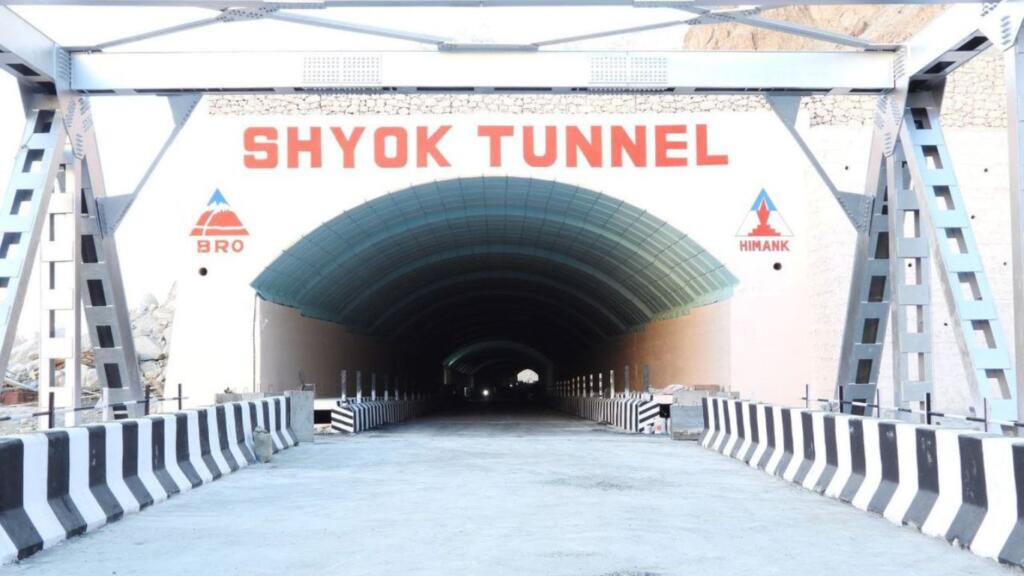
The Shyok Tunnel, dedicated to the nation in eastern Ladakh, has emerged as a new symbol of India’s strategic strength. Importantly, the tunnel has opened an all-weather route to the Actual Line of Control (LAC) along the China border. As a result, uninterrupted connectivity to forward military posts will now be ensured throughout the year. Moreover, during war or emergency situations, the tunnel can also function as a secure bunker.
As we all know, China is a short-term to long-term threat to Indian national security and its aggressive posture at the borders has also opened the eyes of the Indian defence establishment. In that sense, building infrastructure near borders becomes imperative for India. In order to have quick military movements and reinforcement in the time of conflict, the tunnel will serve its purpose.
The 920-metre-long tunnel was dedicated to the nation by Defence Minister Rajnath Singh on December 7. Clearly, it marks an important and strategic milestone for the country. Unlike an ordinary road project, this modern cut-and-cover structure serves a much larger military purpose. In fact, for the Indian Army, it is a dual-use strategic asset. Since it can be used as a bunker, India’s defensive posture along the LAC has now become more robust. Additionally, the tunnel enables year-round movement of troops, weapons, ammunition, and essential supplies. During emergencies, it can also be used for temporary storage of critical military material.
Completed Within Three Years
Construction of the tunnel began in August 2022. Subsequently, it was completed within three years and dedicated to the nation on December 7. From an engineering perspective, the project is highly impressive. Built using lithic arch technology and advanced pre-casting methods, the tunnel consists of two portals—one measuring 520 metres and the other 400 metres. Furthermore, both portals are connected by a 25-metre-long bridge.
Movement Will Continue Even at Minus 40 Degrees Celsius
Notably, the Shyok Tunnel has been constructed away from the vulnerable stretch of the Durbuk–Shyok–Daulat Beg Oldie (DSDBO) road, which was frequently disrupted by landslides and river flooding. Consequently, military supplies were often affected for weeks. Now, however, the tunnel will eliminate this long-standing logistical weakness. It is worth noting that winter temperatures in this region drop to as low as minus 40 degrees Celsius. Despite such extreme conditions, movement along this route will now remain uninterrupted.
Built at a Cost of ₹98 Crore
The tunnel project, built in one of the world’s most challenging environments, has cost approximately ₹98 crore. Interestingly, this is significantly lower than the usual ₹400–500 crore required to construct a one-kilometre-long conventional tunnel in plain areas. Thus, the project stands out for both strategic value and cost efficiency.
Easier Access to the Galwan War Memorial
Along with enhancing military preparedness, the Shyok Tunnel is expected to boost the local economy. Gradually, it will promote border tourism and improve access to key sites, including the Galwan War Memorial. As a result, employment opportunities in the region are likely to increase, contributing to overall development in eastern Ladakh.