










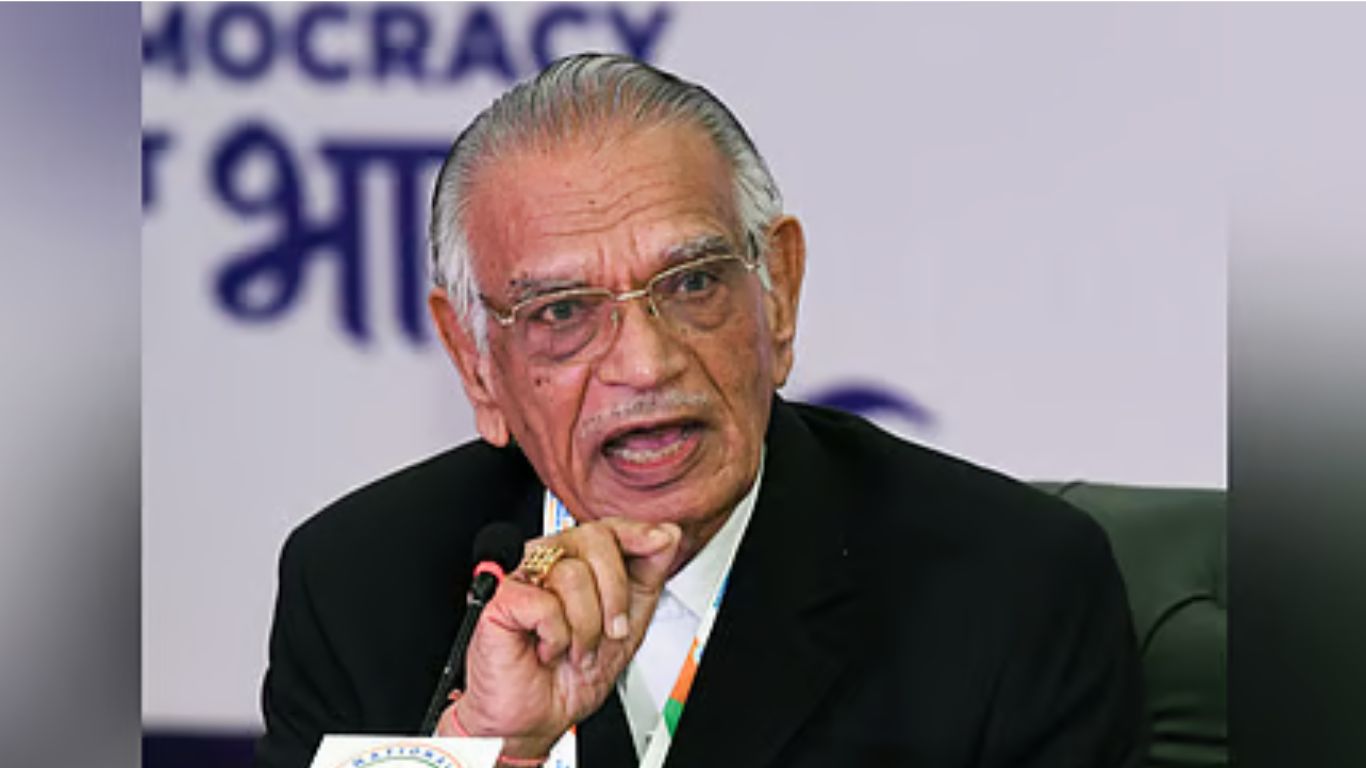
Shivraj Patil, who passed away on Friday (December 12) morning, was one of the senior-most leaders in the Congress party and a familiar figure in Indian politics for decades. Born in 1935 in Chakur village in Maharashtra’s Latur district, he built a long and steady political career. Over the years, he won the Latur Lok Sabha seat seven consecutive times from 1980 onward, which established him as a strong mass leader.
Additionally, Patil served as Lok Sabha Speaker and held several ministerial positions in the cabinets of Indira Gandhi and Rajiv Gandhi. Later, during the first UPA government from 2004 to 2008, he became Union Home Minister under Prime Minister Manmohan Singh. Even though he had lost the 2004 Lok Sabha election, he was chosen for the post due to his proximity to Sonia Gandhi. His command over Hindi, Marathi, and English was also widely appreciated.
However, his tenure is full of terror attacks and controversy. He left a legacy of all of this. Let’s discuss it one by one through this report.
A Tenure Marked by Repeated Terror Attacks
Patil’s term as Home Minister became one of the most challenging periods for India’s internal security. Between 2005 and 2008, the country witnessed a series of major terrorist attacks, including multiple blasts in Hyderabad, Malegaon, Jaipur, Ahmedabad, Bengaluru, and Delhi. These incidents claimed hundreds of lives and raised serious questions about the preparedness and performance of security agencies.
Consequently, the opposition accused Patil of failing to control the deteriorating security situation. The criticism intensified as terror attacks became more frequent, and the Home Ministry struggled to restore public confidence.
The ‘Suit Changing’ Controversy
The turning point in Patil’s public image came after the Delhi serial blasts of September 13 2008. That night, multiple explosions rocked the national capital and left dozens dead. While the nation was in shock, television channels repeatedly showed Home Minister Patil appearing at different locations in different outfits.
According to media reports, he changed his suit at least three times that evening—first a white bandhgala, then a black outfit, and later another white suit. As these images circulated widely, public anger grew. Critics argued that a Home Minister should focus on crisis management rather than personal appearance. As a result, he was mocked as someone more concerned about clothing than national security.
Moreover, newspapers like The Economic Times called out the timing of the wardrobe changes. The BJP, especially leaders like Arun Jaitley, amplified the criticism. Even though Patil insisted that his clothing was not the real issue, the controversy severely damaged his reputation.
26/11 Mumbai Attacks and Mounting Pressure
The situation worsened only two months later during the horrific Mumbai attacks of November 26 2008. Ten Lashkar-e-Taiba terrorists struck multiple high-profile locations, including the Taj Hotel, Oberoi Hotel, Nariman House, and CST station. The siege lasted nearly three days, leaving 166 people dead and hundreds injured.
During the crisis, allegations surfaced that there were delays in deploying NSG commandos and coordinating operations. Although Patil later clarified that he flew to Mumbai with NSG teams within three hours, the public perception had already turned sharply against him. Furthermore, some reports again speculated that he was preoccupied with personal appearance before appearing on television, which added fuel to the fire.
Also Read: The Lingering Shadows of 26/11: Were There Insider Gaps We Still Haven’t Understood?
Resignation Under Political and Public Pressure
The aftermath of the 26/11 attacks pushed the UPA government into a political storm. In Congress Working Committee meetings, several leaders demanded accountability at the highest level. As criticism intensified, Patil submitted his resignation to Prime Minister Manmohan Singh on November 30 2008, acknowledging moral responsibility for the security lapses.
Following his exit, P. Chidambaram took charge of the Home Ministry. Later, U.S. diplomatic cables released by WikiLeaks described Patil as “spectacularly inept,” a remark that further hardened public opinion. After stepping down, Patil largely withdrew from active politics and was appointed Governor of Punjab in 2010, a role he held until 2015.
Legacy and Lasting Debates
Even in later years, Patil’s actions during 26/11 remained controversial. His 2014 autobiography notably avoided mentioning the Mumbai attacks, which again attracted criticism. Although Patil maintained that India used both political wisdom and military capability to counter terrorism during his tenure, public memory remained shaped by the two defining controversies: the failures of internal security and the “suit changing” episode during a national crisis.
Despite these criticisms, his long career as a parliamentarian, Speaker, minister, and governor reflects decades of public service. He leaves behind a complex legacy—one that combines political stature with moments that permanently influenced public perception.