













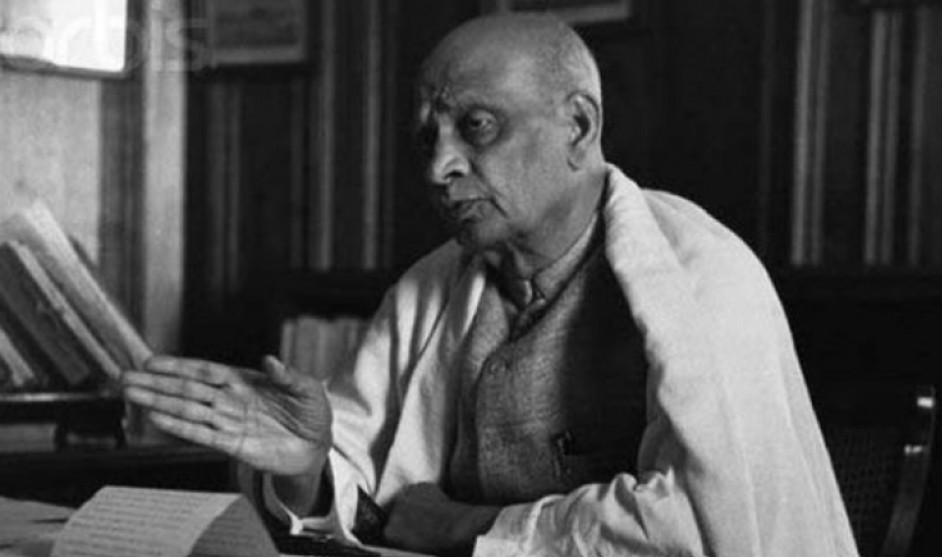
Among the architects of modern India, few figures loom as large as Sardar Vallabhbhai Patel. Revered as the Iron Man of India, Patel was not merely a freedom fighter but a nation-builder of extraordinary resolve. We mark December 15 as the death anniversary of Sardar Vallabhbhai Patel, the man who gave modern India its shape.
At a moment when India stood fragile—wounded by Partition, fractured by communal violence, and threatened by disintegration—Patel provided the iron framework upon which the Republic survived.
A senior leader of the Indian National Congress and one of Mahatma Gandhi’s most trusted lieutenants, Patel combined political realism with moral clarity.
He served as Independent India’s first Deputy Prime Minister and Home Minister, portfolios that placed upon him the immense responsibility of internal security, national integration, and administrative stability during the most volatile years of India’s existence.
His greatest achievement—the integration of 562 princely states into the Indian Union—remains unparalleled in scale and consequence. Through a blend of persuasion, legal acumen, and decisive force when required, Patel ensured that India emerged not as a loose confederation, but as a strong, unified nation-state.
From Barrister to Mass Leader
Born in 1875 in Nadiad, Gujarat, Vallabhbhai Patel trained as a barrister in England before returning to India to practice law. His entry into the freedom struggle was shaped profoundly by Mahatma Gandhi, whose leadership transformed Patel from a successful lawyer into a mass mobilizer.
Patel’s leadership in the Kheda Satyagraha (1918) and the Bardoli Satyagraha (1928) earned him national recognition. In Bardoli, his disciplined organisation and unwavering defense of farmers against oppressive taxation forced the British to concede. It was here that the title “Sardar”—leader—was bestowed upon him by the people.
Unlike many contemporaries, Patel excelled in administration and execution rather than rhetoric. He believed freedom had little meaning without order, unity, and institutional strength.
The Statesman of Action
As India approached independence, Patel’s role became indispensable. While others debated ideals, Patel confronted realities. Communal tensions, refugee crises, and princely defiance threatened to unravel the country before it could even begin.
Working closely with V. P. Menon, Patel negotiated, coerced, and—when necessary—confronted recalcitrant rulers. Junagadh’s accession, the handling of Kashmir’s initial crisis, and most decisively, the integration of Hyderabad, stand as testament to his belief that India’s unity was non-negotiable.
For these achievements, Patel has been posthumously awarded the Bharat Ratna, India’s highest civilian honor. The Statue of Unity, the tallest statue in the world, stands today as a symbolic tribute to his role as India’s unifier.
A Nationalist, Not a Demagogue
Patel’s nationalism was rooted in constitutionalism, not majoritarianism. He rejected both religious domination and political sentimentality. While deeply aware of India’s civilizational ethos, he firmly believed that the Republic must protect all minorities, not by appeasement, but by equal law and firm governance.
This principle shaped his political philosophy and distinguished him sharply from many leaders of his time.
Beyond Appeasement: Patel and Minority Politics
Unlike Mahatma Gandhi and Jawaharlal Nehru—who were often perceived as conciliatory toward Muslim political leadership in the hope of preserving communal harmony—Patel openly opposed what he saw as appeasement politics. Yet this did not make him anti-Muslim.
In the early years of the freedom struggle, Patel was a strong proponent of Hindu–Muslim unity. He supported the Khilafat Movement, worked closely with Muslim leaders, and during the Congress session at Karachi in 1931, assured minorities of full protection, famously offering them a “blank cheque” within the framework of Indian nationalism. His commitment was genuine, not tactical.
The Break: Muslim League and the Politics of Separation
The turning point came after 1937, when the Muslim League under Muhammad Ali Jinnah intensified its demand for Pakistan. The two-nation theory, escalating communal violence, and separatist rhetoric deeply alarmed Patel.
For him, political unity was the foundation of civil peace. The League’s insistence on religious nationalism represented a direct assault on India’s survival. From this point onward, Patel’s tone hardened—not against Muslims as citizens, but against communal separatism as a political weapon.
This shift created friction with colleagues like Nehru and Maulana Azad, who feared Patel’s bluntness could alienate Muslims. Patel, however, remained unmoved. National integrity, he argued, could not be bartered for political goodwill.
Firm Without Being Communal
Despite his opposition to appeasement, Patel categorically rejected the idea of India becoming a Hindu state. In a well-known conversation with industrialist B. M. Birla, he stated.
“I do not think it will be possible to consider India as a Hindu state… there are other minorities whose protection is our primary responsibility,” he said.
During the horrific riots following Partition, Patel personally intervened to protect Muslim lives and property. He censured officials who failed to act, condemned retaliatory violence, and warned against the moral collapse that collective punishment would bring.
Patel believed that strength was the precondition for justice, and justice the foundation of unity.
Paying the Price for Principle
Patel’s uncompromising stance made him a target for extremist violence. In 1939, in Bhavnagar, an assassination attempt was carried out when armed attackers assaulted his vehicle. Two men—Bachubhai Patel and Jadhavbhai Modi—were killed while shielding him.
Another attempt occurred in Delhi near the office of the Dawn newspaper, when shots were fired at him by radical elements angered by his position on Partition.
These incidents underscored the risks Patel willingly bore for the sake of national cohesion.
A Legacy of Strength and Balance
Sardar Vallabhbhai Patel was neither a soft conciliator nor a communal hardliner. He was a realist who understood that appeasement breeds fragmentation, while firmness anchored in constitutional morality preserves unity.
His legacy lies in proving that secularism does not require surrender, that compassion does not preclude strength, and that unity demands courage.
In the final reckoning, Patel did not merely inherit a nation—he held it together. And in doing so, he ensured that India’s freedom did not collapse under the weight of its own divisions.