
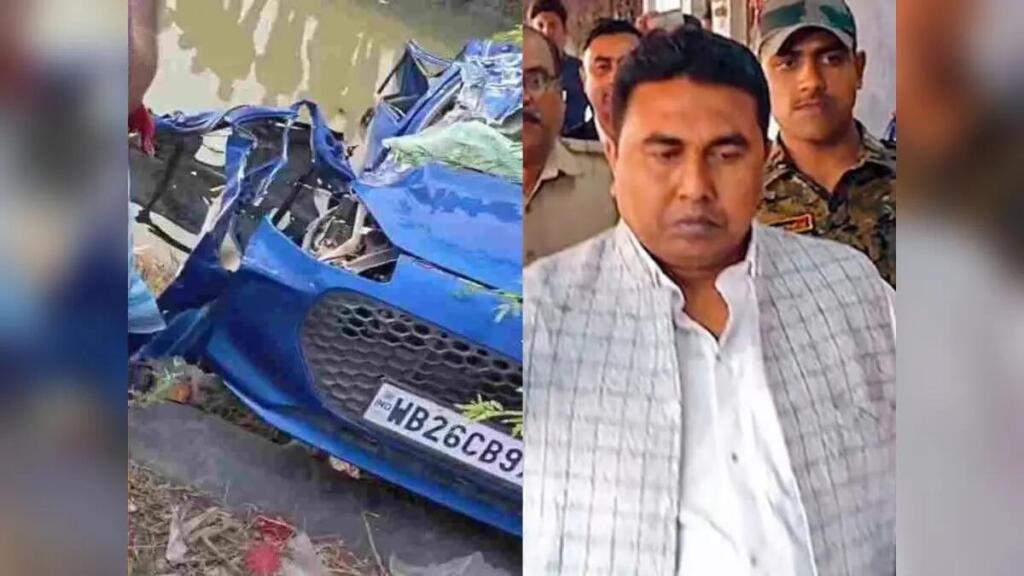
The shocking events of 10 December have once again thrust Sandeshkhali into the centre of public debate and deepened concerns about safety, intimidation and justice in politically sensitive cases. On that day, Bholanath Ghosh, a key witness in the case against Trinamool Congress leader Sheikh Shahjahan, was severely injured in what was first described as a road accident. His younger son and the vehicle’s driver lost their lives in the crash, creating a wave of grief and anger. Bholanath was travelling to court to testify against Shahjahan when the collision occurred, raising immediate suspicions among residents of Sandeshkhali and beyond.
According to initial reports, the vehicle carrying Bholanath was struck by a ten wheeler truck with immense force. The truck driver fled the scene soon after the incident, which only intensified the unease surrounding the tragedy. Police later stated that efforts were underway to locate the missing driver. The spot where the collision took place lacked CCTV cameras, making the investigation even more challenging and prompting uncomfortable questions about why such an incident occurred in a location where no visual evidence could be captured.
The family of the injured witness firmly rejected the possibility that this was a mere accident. Their allegations added a new sense of urgency to the unfolding situation. Bholanath’s elder brother, Biswajit Ghosh, stated that this was a planned act intended to eliminate Bholanath before his court appearance. His emotional accusation struck a deep chord, particularly in Sandeshkhali, where many residents still recall the intense turmoil of the past year. Biswajit claimed that their family had been threatened earlier and alleged that this attack was carried out at the behest of Shahjahan.
Biswajit insisted that this was a one hundred per cent murder and named individuals he believed to be involved. He alleged that Sabita Roy and Muslim Sheikh carried out the conspiracy under Shahjahan’s instructions. His account reflected the atmosphere of fear that has gripped Sandeshkhali since the various allegations against Shahjahan first surfaced. The family’s claims suggested a broader pattern of intimidation and attempts to silence those willing to testify.
Responding to the allegations and public speculation, the police issued a cautious but significant statement. They said they were not yet certain whether the incident was accidental and that all possible angles were being examined. Investigators noted that they were particularly focusing on why the crash took place at a spot without CCTV coverage and how the truck driver managed to escape without being intercepted. This acknowledgment has only heightened suspicion and has kept Sandeshkhali residents on edge as they await the outcome of the investigation.
The present incident cannot be viewed in isolation. It is deeply tied to the disturbing developments that brought Sandeshkhali into national conversation last year. Sheikh Shahjahan was arrested by the Central Bureau of Investigation in 2024 in connection with the attack on an Enforcement Directorate team. That attack occurred when officials visited Sandeshkhali in January of the previous year to question him in another matter. The events that followed exposed a network of alleged abuses that shocked the state and the nation.
In February 2024, hundreds of women in Sandeshkhali launched a powerful protest movement that drew attention to their suffering. Armed only with sticks, brooms and agricultural tools, they blocked roads and demanded action against Shahjahan and other local TMC functionaries such as Shiba Prasad Hazra and Uttam Sardar. Their courage was remarkable, and their testimonies were deeply distressing. These women alleged rampant land grabbing, systematic abuse and exploitation. Many of them claimed that young and married Hindu women were forcibly taken at night and subjected to repeated violations by local strongmen.
Their accounts described a climate of terror in which husbands were beaten or threatened if they attempted to protect their wives. Several women stated that they were told that they had no right over their own homes, their land or even their families. The voices rising from Sandeshkhali brought to light the magnitude of the alleged crimes and forced the administration to take action, despite attempts to minimise the issue at higher political levels.
Following intense public pressure and growing outrage, Shahjahan was arrested by the state police on 29 February 2024. He was later taken into CBI custody on 6 March. His arrest brought some relief to the residents of Sandeshkhali, but the fear and trauma continue to linger. Many witnesses and survivors remain vulnerable and rely heavily on the justice system for protection and closure.
Against this backdrop, the crash involving Bholanath Ghosh has amplified existing tensions. For Sandeshkhali, it is not simply a road accident but a potential turning point in a case that has already seen intimidation, violence and widespread allegations of abuse. Bholanath’s testimony would have been critical to ongoing proceedings, and his sudden incapacitation threatens to alter the course of the investigation.
The police inquiry will play a decisive role in determining whether the collision was an unfortunate accident or the result of a deliberate attempt to silence a witness. The absence of CCTV footage, the escape of the driver and the timing of the crash have all contributed to a sense of deep suspicion. Sandeshkhali residents are following the investigation closely, knowing that the outcome will shape their community’s future and determine whether justice can prevail despite fear and pressure.
For now, the truth remains uncertain. Yet the impact of the incident is undeniable. It has reignited anxieties in Sandeshkhali, reminded people of the vulnerability of witnesses and highlighted the challenges faced by those who stand up against powerful figures. As the investigation continues, Sandeshkhali waits once more for answers and hopes that justice will not be derailed by fear or force.