
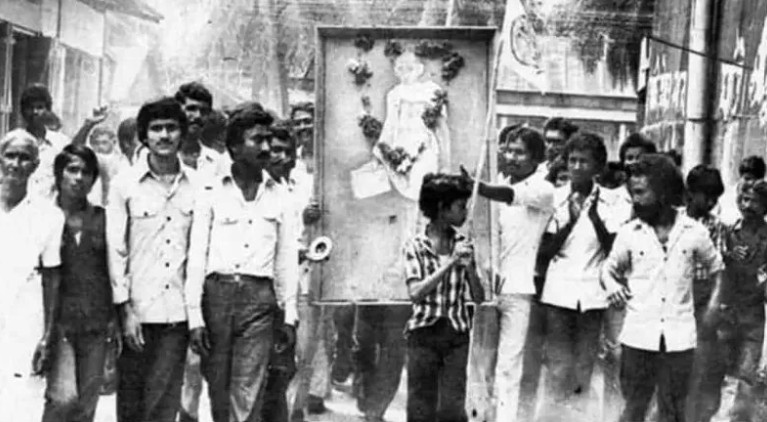
Assam pauses to honour the countless men and women who laid down their lives during one of the most defining chapters in its modern history—the Assam Movement.
At the heart of this struggle stands the name Khargeswar Talukdar, only 22 years old, remembered as the first braveheart in a battle fought to safeguard Assam’s land, culture, and identity. His sacrifice was not just the first recorded loss, it became the spark that ignited a people’s revolution.
The Story of Khargeswar Talukdar
In 1979, when discontent was rising across Assam against decades of unchecked illegal immigration, the young All Assam Students’ Union (AASU) activist Khargeswar Talukdar was brutally attacked and murdered. His body was discarded by the roadside—an act that shook the collective conscience of the Assamese people.
Khargeswar’s death was not viewed merely as a killing, rather it became a warning, a symbol, and ultimately a call to action.
It was after this incident that the simmering anger transformed into a widespread, unified movement, one that would redefine the political and cultural landscape of Assam.
A Movement Born From Fear of Displacement
Through the 1970s and 1980s, Assamese society saw rising anxiety over demographic changes caused by immigration that had been occurring since the 1950s. There was a fear of losing language, land, and cultural heritage.
The murder of Khargeswar galvanised Assam into a historic uprising. Students, farmers, intellectuals, and everyday citizens came together under the leadership of:
- All Assam Students’ Union (AASU)
- All Assam Gana Sangram Parishad (AAGSP)
This collective resistance soon became known as the Assam Movement.
A Sacrifice That Became a Torchlight
As protests intensified, Khargeswar Talukdar’s memory became the emotional backbone of the movement. His face appeared on placards, his name was invoked in marches, and he came to represent the very essence of Assamese resolve.
More than 850 people ultimately sacrificed their lives during the agitation—each one remembered as an “Ai Asomi” (Son of Assam) who stood courageously for the land they called home.
Their sacrifices turned the question of illegal immigration from a political issue into a deeply personal and cultural struggle for survival.
Escalation, Unrest, and a Turning Point
The growing unrest challenged the government’s ability to maintain order. The state leadership lost the trust of the people, who felt unheard and unprotected. This tension eventually led the Central Government to impose President’s Rule on 12 December 1979—an extraordinary flashpoint in the state’s political history.
Yet, even in these turbulent times, the movement only gained strength.
In 1983, when elections were announced without resolving the core citizenship issue, a massive boycott swept the state. The tragic Nellie massacre marked one of the darkest moments in Assam’s history, reflecting the depth of societal fracture and the scale of the crisis.
Still, the spirit of the youth—carrying the memory of Khargeswar—did not falter.
The Assam Accord: A Hard-Won Resolution
After years of protest, negotiation, violence, and loss, a historic breakthrough finally arrived. On 15 August 1985, the Government of India, AASU, and AAGSP signed the Assam Accord.
It marked not only the culmination of a long struggle but the beginning of a new chapter of hope, stability, and renewed cultural confidence.
The Accord stands today as one of the most significant political agreements in independent India’s history.
Why This Story Still Matters Today
Khargeswar Talukdar’s sacrifice remains a powerful reminder of what ordinary citizens can achieve when united by love for their land. His story speaks to:
- The resilience of the Assamese people
- The cost of protecting cultural identity
- The importance of democratic negotiation
- The need for vigilance in preserving heritage
As Assam continues to navigate questions of identity and belonging, the legacy of the Assam Movement lives on—not as a memory of conflict but as a testament to collective determination.
A Tribute That Echoes Across Generations
As Assam remembers the “Ai Asomi” martyrs, the voice of Khargeswar Talukdar still resonates. His sacrifice lit the flame that guided an entire generation through one of the most challenging struggles in modern Assam’s history.
His legacy—and that of the 850+ others who followed—remains woven into the soul of Assam.