
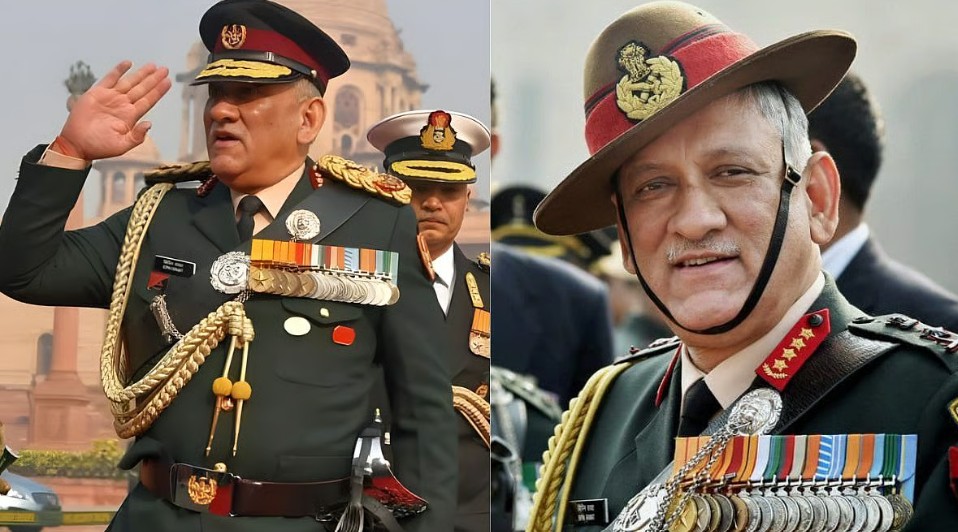
As the nation marks the death anniversary of General Bipin Rawat, India’s first Chief of Defence Staff (CDS), we pause to honour a military leader whose vision, conviction, and service reshaped India’s defence architecture.
A four-star General of the Indian Army and a reformer in uniform, General Rawat dedicated more than four decades to strengthening India’s national security, fostering joint military operations, and modernising the armed forces.
Early Life and Inspiration
Born on March 15, 1958, in Pauri Garhwal, Uttarakhand, General Bipin Rawat was raised in a family deeply rooted in military tradition. His father, Laxman Singh Rawat, served as a Lt. General in the Indian Army, while his mother was a homemaker. Inspired by his father’s discipline and commitment to national service, he pursued a career in the armed forces.
He graduated from the Indian Military Academy (IMA), Dehradun, and was commissioned into the 5th Battalion of the 11 Gorkha Rifles in December 1978—a regiment known for its valour, humility, and exceptional field performance.
A Distinguished Military Career
During his illustrious career, General Rawat held some of the most significant appointments in the Indian Army. These included:
- Vice Chief of Army Staff (VCOAS)
- General Officer Commanding-in-Chief, Southern Command
- General Officer Commanding-in-Chief, Eastern Command
His leadership spanned multiple theatres and complexities—ranging from counterinsurgency operations to strategic border management.
He contributed to major military missions such as Operation Pawan in Sri Lanka and Operation Maitri during the 2015 Nepal earthquake, displaying both tactical acumen and humanitarian leadership.
Key Operations Under His Leadership
Operation Hot Pursuit (2015)
Following the deadly ambush of an Indian Army convoy in Manipur’s Chandel district on June 4, 2015, which claimed the lives of 18 soldiers, India carried out a cross-border surgical strike targeting NSCN-K insurgent camps in Myanmar on June 9, 2015.
As the General Officer Commanding (GOC) of III Corps at Dimapur, General Bipin Rawat oversaw the operation, under which special forces crossed the border and neutralised the militants. The mission marked a significant shift in India’s response to cross-border terrorism.
The Uri Surgical Strike (2016)
After the terror attack on the Indian Army’s brigade headquarters in Uri on September 18, 2016, India launched surgical strikes across the Line of Control in Pakistan-occupied Kashmir.
General Rawat, then Vice Chief of the Army Staff, closely monitored the planning and execution of the operation, ensuring precision in destroying terrorist launch pads.
Doklam Standoff (2017)
In the 73-day face-off with China at Doklam—a strategically sensitive tri-junction between India, Bhutan, and China—General Rawat, as the Chief of Army Staff, ensured that Indian troops held their ground firmly. His leadership during the standoff became a defining moment in India’s contemporary border strategy.
Balakot Airstrike (2019)
Following the Pulwama terror attack, India carried out airstrikes on a Jaish-e-Mohammed training camp in Balakot, Pakistan, on February 26, 2019. As the Chief of the Army Staff, General Rawat oversaw the Army’s preparedness in the aftermath of the air operation, ensuring strategic balance and readiness.
India’s First Chief of Defence Staff: A Vision for Joint Warfare
Appointed as India’s first CDS in January 2020, General Rawat embarked on an ambitious mission to unify India’s Army, Navy, and Air Force. His vision was rooted in a “purple” approach—symbolising the blending of the services’ distinct colours—to promote integrated operations essential for modern warfare.
He initiated structural reforms, worked on establishing integrated theatre commands, and pushed for synergy across the armed forces. His legacy as CDS marks the beginning of a new era in India’s military strategy.
A Legacy Etched in India’s Military History
General Bipin Rawat’s life was defined by courage, clarity of purpose, and unwavering dedication to national security. From counter-insurgency missions to strategic military transformations, his contributions continue to influence India’s defence landscape.
On his death anniversary, India remembers not just a soldier, but a visionary leader who reshaped the future of its armed forces—leaving behind a legacy of strength, modernisation, and unity.
Uttarakhand Chief Minister Pushkar Singh Dhami commemorated the day, writing on X, “Humble tribute to the country’s first CDS, ‘Padma Vibhushan’ General Bipin Rawat on his death anniversary. The nation will always be grateful for your contribution towards strengthening India’s defence and military modernisation.”
Uttar Pradesh Chief Minister Yogi Adityanath also posted writing, “On the death anniversary of the country’s first CDS, ‘Padma Vibhushan’ General Bipin Rawat, heartfelt tribute to him. For your contributions towards strengthening India’s defense and military modernisation, this nation will remain eternally grateful.”