







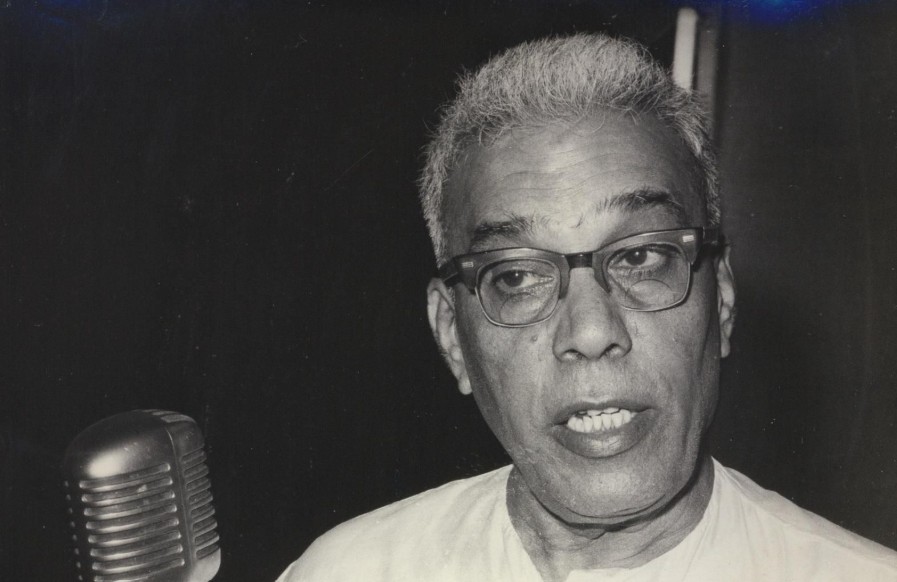
Madhukar Dattatraya Deoras, better known across Bharat as Balasaheb Deoras was a towering nationalist figure, a key force behind the rise of the Jansangh (the precursor to today’s Bharatiya Janata Party), and the principal architect of the nationwide expansion of the Rashtriya Swayamsevak Sangh (RSS).
As the third Sarsanghchalak, he shaped the RSS into a dynamic, disciplined, and socially engaged organisation.
Early Life and Family Roots
The Deoras family originally hailed from Chennuru village in Adilabad, situated on the banks of the Godavari. The region carries deep cultural significance—ancient lore suggests that Sage Agastya established his ashrama here, where an old Shiva temple once stood before its destruction during Muhammad Tughlaq’s invasion. It was later rebuilt by King Krishna Deva Raya of the Vijayanagar Empire.
More than two centuries ago, a branch of the Devraju families migrated from Chennuru to Nagpur, where the surname gradually evolved into Deoras. Born on 11 December 1915 at Karanja in Balaghat (Madhya Pradesh), Balasaheb was the eighth of nine children of Dattatreya Deoras and Bahinabai (later known as Parvatibai).
Affectionately called Bal at home, he grew up alongside his younger brother Bhaurao Deoras, who would also go on to become a prominent RSS leader.
Early Association with RSS
By the time RSS was founded in 1925, the Deoras family had returned to Itwari Mohalla in Nagpur. Balasaheb, then a sixth-grade student, began attending the first RSS shakha at Mohite Bara, founded by Dr KB Hedgewar. His enthusiasm drew several of his school friends to the Shakha, where they trained under the guidance of Shamrao Gadge.
It was Balasaheb who encouraged his brother Bhaurao to join the RSS. The two became inseparable, both choosing the path of full-time dedication to organisational life—something their father initially struggled to accept.
A Stand Against Social Discrimination
In an era when caste discrimination was widespread, young Balasaheb took a principled stand at home. He insisted that his swayamsevak friends—regardless of caste—should be welcomed and served meals in the same utensils as other family members.
His mother agreed, making the Deoras household one of the rare homes of the time to reject caste barriers in daily life.
Years of Study and Early Organisational Responsibility
Balasaheb completed his matriculation in 1931 and joined Morris College, devoting much of his time outside classes to meeting youth and expanding the Shakha network. As Shakhas increased, he was appointed Mukhyashikshak of the Itwari Shakha by 1932.
Graduating in 1935 with Philosophy and Sanskrit, he entered law school. In 1937, Dr Hedgewar appointed him Chief Instructor at the 40-day RSS training camp in Pune. Even during exams, he demonstrated exceptional discipline—receiving news of his first-division LLB result while leading the camp.
Upon his return, he became Karyavah of Nagpur’s main Shakha, tasked with preparing full-time pracharaks to take RSS work nationwide. He once remarked to Dr Hedgewar, “A model Shakha is one that produces workers ready to devote their lives to serving society.”
Expanding the Shakha Network
Balasaheb’s organisational brilliance was most visible during his tenure in Nagpur:
- He started 15 new Shakhas simultaneously
- He created a steady stream of full-time pracharaks, enabling the RSS to grow across states
- Noticing that many employed swayamsevaks could not attend evening Shakhas, he pioneered the first Prabhat (morning) Shakha in 1938
- He introduced the Ghosh (band) and group song traditions, which soon became integral to RSS culture
By the early 1940s, pracharaks trained under him were active in Punjab, Karnataka, Kerala, Sindh, Gujarat, Uttar Pradesh, Delhi, Kashmir, Nepal, and more. Their influence was deeply felt during the volatile period preceding Independence and Partition.
Role During the Turbulence of the 1940s
Between 1942 and 1947, over a thousand young swayamsevaks became full-time pracharaks. Demand for Shakhas grew across the country as Hindu communities sought protection from increasing communal violence.
In 1946–47, 4,000 swayamsevaks attended the RSS training camp, and 10,000 joined the Vidarbha camp in 1947—both organised with Balasaheb’s direct involvement.
As communal tensions peaked in Punjab, Balasaheb’s presence and guidance helped swayamsevaks rescue, protect, and rehabilitate thousands of Hindus fleeing brutal attacks.
After years of relentless work, Balasaheb was appointed the third Sarsanghchalak following the demise of Guruji Golwalkar on June 5, 1973. Guruji had prepared detailed letters outlining future arrangements, which were opened after his passing.
At 58, already diabetic, Balasaheb accepted the responsibility with humility. Initially hesitant to be addressed as Param Pujniya, he agreed only after it was clarified that the reverence was for the office, not the individual.
Steadfast Leadership During the Emergency
When the Indira Gandhi government imposed the Internal Emergency on June 25, 1975, the RSS was banned on July 4. Balasaheb had already been arrested on June 30 and was detained at Yerwada Jail.
He was released on March 21, 1977, when the ban was lifted. Addressing a massive gathering in Nagpur soon after, he urged swayamsevaks to avoid vindictiveness, saying, “Victory has been credited to the RSS. Now is the time to be large-hearted and bring change through goodwill.”
A Historic Transition of Leadership
On March 11, 1994, Balasaheb made a landmark announcement—appointing Rajju Bhaiyya as his successor. For the first time, a serving Sarsanghchalak formally passed the mantle to a successor. This tradition continued with Rajju Bhaiyya handing over the role to KS Sudarshan, and Sudarshan later to Mohan Bhagwat.
Though ill health restricted his travels in later years, Balasaheb remained intellectually active, offering guidance as a mentor. He passed away in Pune on June 17, 1996.
Balasaheb Deoras is remembered today as one of the greatest organisational minds of modern India. He was a leader whose clarity, courage, and commitment shaped the trajectory of the RSS and inspired generations of swayamsevaks across Bharat.