
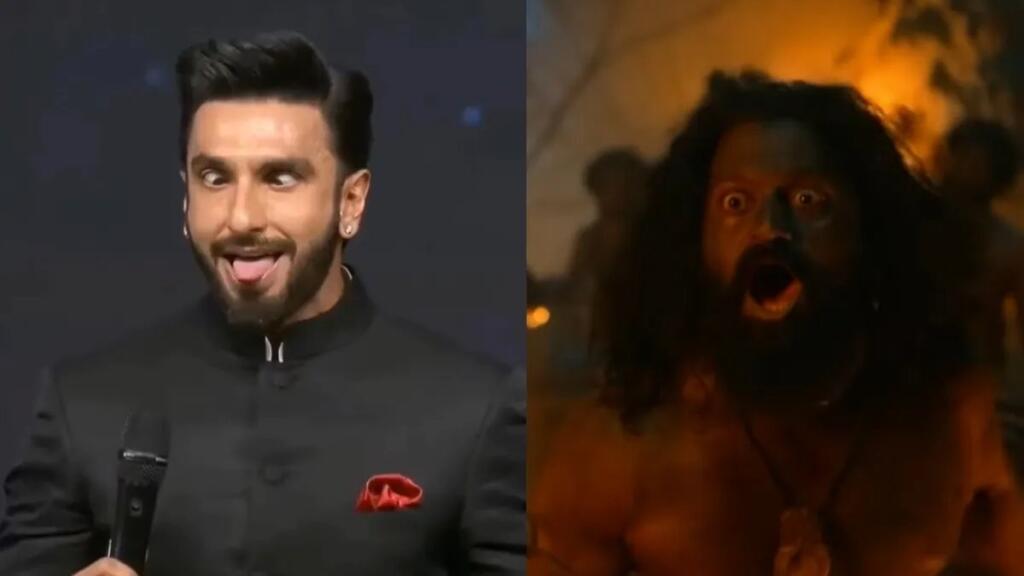
Ranveer Singh, one of Bollywood’s most flamboyant actors, took the stage at the International Film Festival of India 2025 with what should have been a moment of celebration for Indian cinema, and turned it into an incident of cultural insensitivity. During the event, he mimicked a sacred “Daiva” from the critically acclaimed film Kantara: A Legend Chapter 1, an act that immediately sparked outrage across social media and among the film’s fans. This was not merely a theatrical misstep. This was a conscious decision to mock something revered, a step that disrespected centuries of spiritual and cultural belief.
Before taking to the stage, Ranveer had been explicitly warned by Rishab Shetty, the creator and star of Kantara, not to imitate the deity in his act. Shetty understood the sanctity of the Daiva and recognized the sensitivity involved in portraying it. His request was simple: avoid disrespecting a symbol that holds deep significance for many. Despite this warning, Ranveer went ahead and presented the deity as a “female ghost” with exaggerated gestures and theatrics. This was not homage. This was mockery designed to elicit cheap laughs from an audience that may not have understood the depth of the offense.
The fact that this act was performed on a national stage makes it even more egregious. A public event of this scale is not just a platform for entertainment; it is a platform for influence. The manner in which Ranveer displayed the deity trivialized an aspect of culture that deserves respect. When a sacred figure is reduced to a caricature for applause, the act is not just insensitive, it is offensive to the entire community that reveres it.
Social media erupted immediately. Netizens condemned the performance, describing it as tone-deaf and disrespectful. Comments poured in expressing outrage, with phrases such as “grossly insensitive,” “disgraceful mockery,” and “utter disregard for sacred traditions.” The backlash highlighted a broader sentiment: that public figures have a responsibility to understand the cultural and religious weight of the symbols they portray. Mimicking sacred figures for entertainment crosses a line that should never be crossed.
The audacity to ignore Shetty’s warning demonstrates a troubling arrogance. It shows a willingness to prioritize personal performance over the respect of others’ beliefs. Cinema and performance art are powerful tools that influence society. Actors like Ranveer Singh wield enormous cultural power, and that power comes with the responsibility to avoid causing unnecessary offense. Choosing to mock a deity on stage is not just poor judgment; it is an abuse of that power.
The controversy is not about limiting creative freedom. Art and expression are crucial in any society. But creative freedom carries a moral and social responsibility. Using religious and cultural symbols as props for comedy undermines the very purpose of expression and demonstrates a lack of awareness of the community impact. In this case, Ranveer’s performance did not create dialogue or provide insight; it alienated, offended, and hurt people who hold the Daiva sacred.
Furthermore, the public nature of the performance exacerbates the issue. It was not a private joke among friends; it was a staged event viewed by thousands and reported widely. The act became a spectacle, amplifying its impact. What could have been a respectful celebration of Kantara’s success turned into a cultural controversy because of a deliberate choice to mock. The consequences of such actions are not limited to the actor alone; they ripple across communities and create unnecessary social tension.
Respect for cultural symbols is not optional. It is a baseline expectation in a diverse country like India, where traditions, beliefs, and sacred practices are integral to the social fabric. Disregarding these symbols for entertainment reflects a lack of sensitivity and understanding. It sends a message that popular figures can override the sentiments of entire communities for personal amusement, which is unacceptable.
What this incident highlights is the need for accountability among public figures. Influence should not be wielded carelessly. Being in the public eye is a privilege, and with privilege comes the responsibility to respect the diversity and richness of culture. Ranveer Singh’s mimicry of the Daiva was not an innocent oversight; it was a deliberate act of disrespect. The warnings from Shetty were clear, and the choice to ignore them reflects a conscious decision that cannot be excused by the argument of artistic freedom.
In conclusion, Ranveer Singh’s act at IFFI was not a display of creative flair or homage to a beloved film. It was a mockery of sacred traditions, an insult to culture, and a demonstration of negligence regarding the responsibilities that come with public influence. Art is powerful, but it must be wielded with awareness, respect, and sensitivity. Reducing sacred deities to props for entertainment is not art. It is disrespect, and it is a cultural misstep that should not be forgotten or overlooked.
The lesson is clear: influence without responsibility is dangerous. Public figures must understand that their actions have consequences far beyond personal entertainment. Respect for cultural symbols, acknowledgment of community sentiments, and sensitivity to sacred traditions are non-negotiable in a society that values its heritage. Ranveer Singh may have entertained some, but in doing so, he disrespected many more. That is a fact that cannot be erased, ignored, or excused.