








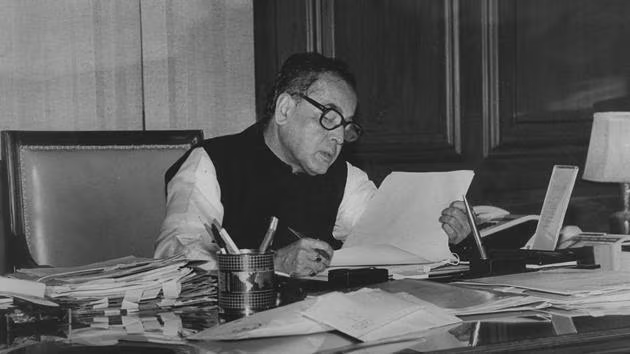
Pranab Mukherjee, who served as India’s 13th President from 2012 to 2017, was one of the most seasoned and respected statesmen in the country’s modern political history.
With a career in the Indian National Congress spanning over four decades, Mukherjee was a masterful strategist and administrator, handling critical portfolios such as Finance, Defence, External Affairs, and Commerce. Known for his deep understanding of policy and parliamentary affairs, he was widely regarded as the “think tank” of the Congress.
Yet, despite his vast experience and political acumen, the Prime Minister’s post eluded him—a reflection not of his capabilities but of the complex internal dynamics of party politics and the Congress leadership’s preferences during pivotal moments in India’s governance.
Mukherjee’s journey exemplifies both the heights of public service and the often unpredictable nature of political destiny.
Pranab Mukherjee and several Congress leaders have said it out loud that there were instances where it felt pre-ordained that Pranab would become the Prime Minister but unfortunately, it never led to fruition.
In his book “The Coalition Years”, Mukherjee acknowledged that he had hoped to get the post in May 2004 after then Congress president Sonia Gandhi herself declined the position.
Former external affairs minister Salman Khurshid had also noted in his autobiography, “The selection of Dr Manmohan Singh over Pranab Mukherjee (then the seniormost Congress leader) came as a surprise not only to the Congress but also to outsiders.”
The first opportunity came in 1984 when Prime Minister Indira Gandhi had been assassinated. Pranab was her number Two in the cabinet and most political pundits had predicted that it was time for the Kolkata born leader to command the PM post or atleast steer the country till the next elections. There were precedents in history. Gulzarilal Nanda had twice functioned as a stop-gap after the deaths of Jawaharlal Nehru and Lal Bahadur Shastri.
However, Rajiv Gandhi who had some animosity with Pranab didn’t allow the latter to lay his hands on the PM chair. He was not even included in the small emergency cabinet Rajiv formed right after he was sworn in and after Rajiv’s landslide victory that winter. Mukherjee was told that there was no need for him in Delhi. He was sent to Bengal, later sacked from his post
Mukherjee stayed away from Congress for nearly five years and he went on to form his own political party, the Rashtriya Samajwadi Congress. When Rajiv Gandhi wanted him desperately to salvage the wrecking ship of Congress, Pranab Mukherjee, being a man of class, chose to come back despite the differences.
However, the power went to PV Narsimha Rao in 1991 and Pranab was again given the cold-shoulder. A similar fate ensued when UPA came to power in 2004 and 2009.
It was Sonia Gandhi who played an elaborate power-play to ensure that Pranab didn’t ascend to the PM post in 2004. When many though Manmohan Singh will not get a second term, Sonia Gandhi and family again called in their veto-rights and ensured that the puppet PM was installed in New Delhi.
And what happened in Manmohan Singh’s second tenure is probably the reason Congress is constantly hitting new lows and getting decimated by the Modi wave. One only wonders, what would have happened if Pranab Mukherjee was made the PM post-2009 elections.
The Nehru Gandhi family is infamous for not recognising the contribution of non-family members in the building of the nation as well as Congress party. The family wants the people to worship the family icons and see them as the saviour of the nation.
How the Nehru-Gandhi Legacy Overshadows Congress Stalwarts
Former national leader and statesman Pranab Mukherjee was conferred the Bharat Ratna, India’s highest civilian honour, at a ceremony at Rashtrapati Bhavan. However, notably absent from the event were key figures from his own party — Sonia Gandhi and Rahul Gandhi of the Indian National Congress, despite invitations for the occasion.
Their absence, alongside that of former Prime Minister Manmohan Singh, drew widespread attention and commentary, especially as leaders from across the political spectrum joined in celebrating Mukherjee’s lifetime of public service.
The Gandhi family’s non‑attendance was widely speculated to stem from internal political tensions over Mukherjee’s independent engagements, including his earlier address at an RSS event, which had drawn criticism within Congress circles.
The service of Mukherjee to the nation and Congress party is unmatchable, but the dynasts of the Congress party had no time to attend the award ceremony. Sonia Gandhi, Rahul Gandhi, and former Prime Minister Manmohan Singh under whom Mukherjee served as Finance, Defence and External Affairs minister skipped the event at Rashtrapati Bhavan despite the invitation from the government.
Mukherjee was not the first Congressman to be abandoned by the party. There are thousands of other Congress leaders who served the country and died but they have no place and respect in the Nehru Gandhi family’s memory and most prominent among them is PV Narasimha Rao- the man who transformed India and gave the people of the country economic independence but never got his due place in history books.
In a speech to mark the 125th anniversary of the INC in 2009, the party president Sonia Gandhi, praised contributions of all Prime Ministers from the Congress except those of PV Narasimha Rao. All his contributions were ascribed to either Rajiv Gandhi or Manmohan Singh.
When he died, there were no arrangements made to receive the body and place it atop a platform for public darshan. No flowers were provided by the Congress government. There was no shamiana and there were no carpets. There was no one to control the mourning crowds. The Congress president appeared for a couple of minutes and vanished. To top that, the former Prime Minister’s mortal remains were not even allowed in the AICC office in the capital, New Delhi.
PV Narasimha Rao changed the name of the Congress Party from Indian National Congress (Indira) to Bhartiya Rashtriya Congress (Indian National Congress) and rejected the candidature of Sonia Gandhi as the Congress President with hard-hitting words as recorded in late INC leader Arjun Singh’s biography.
Pranab Mukherjee is just another leader in the long list of Congressmen who never got their due respect because they chose not to be sycophantic to the members of the Nehru Gandhi family.
Upholding the Election Commission Amid Criticism
Former President Pranab Mukherjee also praised the Election Commission for its crucial role in sustaining India’s democracy. It was after the voting for the 2019 Lok Sabha elections has come to an end. The total voter turnout for the 2019 Lok Sabha polls was the highest ever at 67.11 percent approximately with the total number of registered voters at 9 crores.
Speaking to the media at a book launch, he remarked that the institution has functioned effectively “right from the first Chief Election Commissioner Sukumar Sen to the current commissioners.”
He emphasised that all commissioners are appointed by the executive and conduct elections with integrity, calling the process “perfect.” Mukherjee added, “If our democracy has succeeded, it is largely due to the flawless conduct of elections by the Election Commission over the years.”
His remarks come amid sharp criticism of the Election Commission by opposition leaders, who have raised concerns over recent exit polls favoring the BJP-led NDA. Rahul Gandhi, among others, has labeled the commission “Modi’s army,” questioning its impartiality, while Mukherjee’s statement stands as a reminder of the institution’s enduring credibility and importance.
Pranab Mukherjee’s Memoir Lifted Veil on Congress Missteps, Gandhi Leadership Failures
Pranab Mukherjee’s memoir The Presidential Years: 2012‑2017 was released in January 2021. The autobiography was written before the former President’s death. With the book’s controversial statements revealing the truth about the grand old party – Congress and reasons behind its diminished power, coupled with PM Narendra Modi’s rise, has caused many ripples in the political circles.
In a no holds barred reveal, Pranab Mukherjee in his memoir talks at length about the mistakes Sonia Gandhi led Congress made during its tenure, which led to its irrelevance in the country.
Recognising that the electorate voted for political stability and development in 2014, Pranab Mukherjee’s memoir read, “BJP emerged with a simple majority on its own in the Lok Sabha for the first time and was thus able to form the government, though it still did so by co-opting its allies. But the real winner was the electorate that came out in large numbers and voted decisively, thus indicating its preference for political stability, which it believed would result in development-oriented politics.”
He also spoke at length on Congress’ mishandling of domestic matters. The memoir read, “I do believe that the party’s leadership lost political focus after my elevation as president. While Sonia Gandhi was unable to handle the affairs of the party, Dr Singh’s prolonged absence from the House put an end to any personal contact with other MPs.”
He also criticised Sonia Gandhi’s poor leadership for failing to hold on to alliance partners, including TMC in West Bengal. Pranab Mukherjee wrote, “I believe that the leadership of a party in times of crisis has to evolve a different approach. If I had continued in the government as finance minister, I would have ensured Mamata’s continuity in the coalition.”
He also wrote, “Similarly, Maharashtra was handled badly, partly due to decisions taken by Sonia Gandhi.”
Highlighting the sense of entitlement the Gandhi family has, he said, “I feel that the party failed to recognise the end of its charismatic leadership. Tall leaders like Pandit Nehru ensured that India, unlike Pakistan, survived and developed into a strong and stable nation. Sadly, such extraordinary leaders are not there anymore, reducing the establishment to a government of averages.”
Mukherjee’s RSS Visit Sparked Controversy Within Congress
On 6th June, 2018, former President Pranab Mukherjee delivered a notable speech on Nation, Nationalism, and Patriotism at a Rashtriya Swayamsevak Sangh (RSS) event in Nagpur.
Highlighting the continuity of Indian civilisation despite historical invasions and colonial rule, he stated, “India was a state long before the concept of the European nation-state emerged after the Treaty of Westphalia in 1648.”
Mukherjee also praised RSS founder Dr KB Hedgewar as a “great son of mother India” and underscored the importance of dialogue in a democracy, cautioning against ostracizing individuals solely based on ideological differences.
His appearance at the RSS event created a political stir, particularly within the Congress, as many in the party leadership disapproved of his participation. The visit drew widespread attention and reportedly contributed to an increase in RSS membership.
Observers noted that Mukherjee’s engagement highlighted the need for ideological dialogue and reflected his willingness to transcend partisan divides, even as it challenged entrenched perceptions among Nehruvian intellectuals about the RSS and its role in Indian society.
Gandhi Politics Overshadowed Pranab Mukherjee
Mukherjee gave his blood and sweat to Congress and yet the same party in hushed tones called out the leader when he visited the RSS headquarters in Nagpur to deliver the valedictory speech. Gandhis and their love for top party positions and bureaucratic power knows no limits.
The intrinsic love for the throne is the reason Congress is falling like a pack of cards off late. It lost a strong, young, and charismatic leader in Jyotiraditya Scindia in Madhya Pradesh and nearly lost Sachin Pilot in Rajasthan.
However, the party seems to look the other way whenever the Gandhi family and its inconspicuous power is questioned. Sonia Gandhi being made the interim President of Congress yet again, being a case in point.
A story of what ifs and what if nots for Pranab da who could have had the PM post to his name on three separate occasions, had the Congress party risen from its stupor of Gandhi love.