








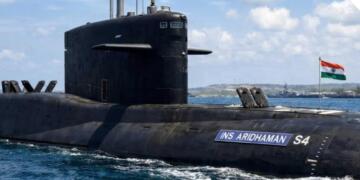









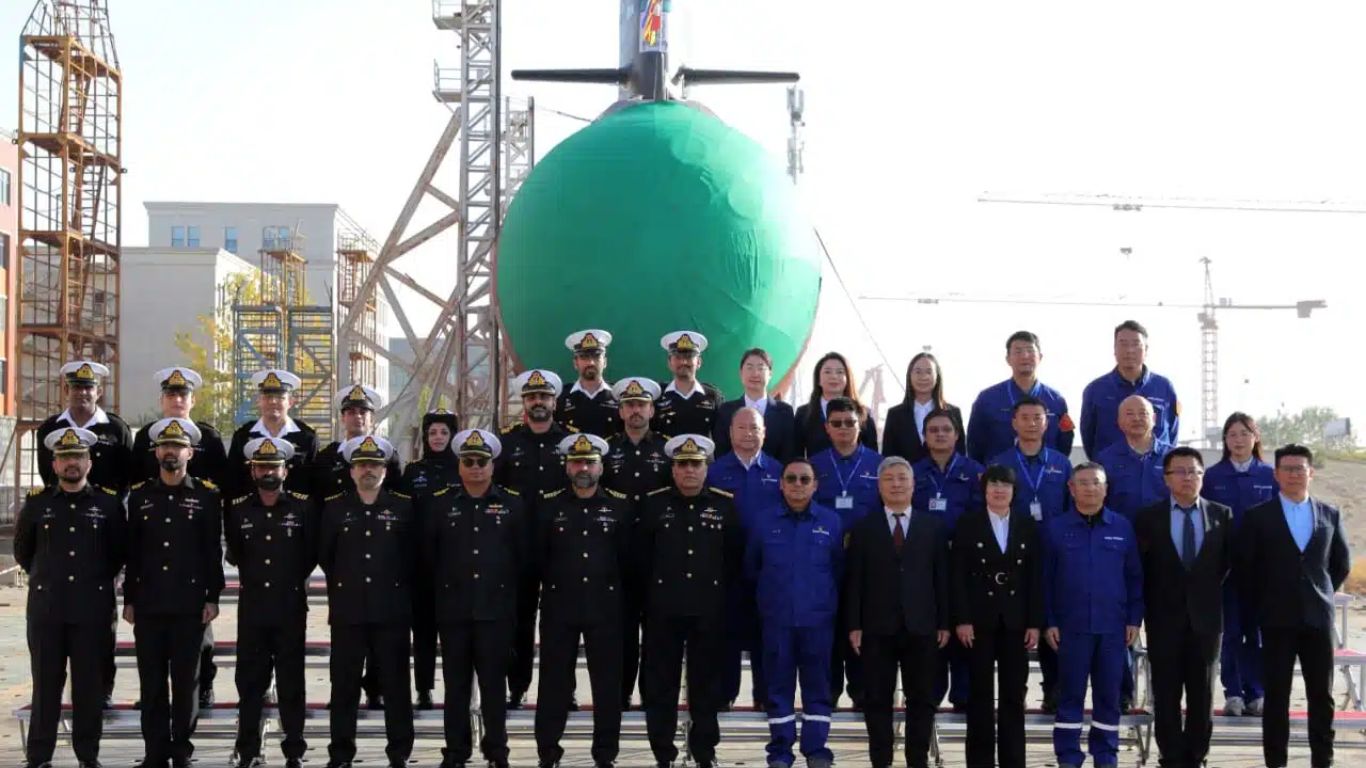
On Wednesday (December 17), the Pakistan Navy announced that it has launched the fourth Hangor-class submarine, equipped with Air Independent Propulsion (AIP) technology, named “Ghazi” at a Chinese shipyard in Wuhan. The world knows the history of the first Ghazi and how India destroyed it in the Bay of Bengal.
The Pakistani navy said the development will help maintain peace in the region. In the press release, the Pakistan Navy informed that Pakistan’s government signed an agreement with China for the acquisition of eight Hangor-class submarines.
According to the Pakistani Media, Hangor-class submarines will be 76 meters long. It has a displacement of 2800 tons, which makes them slightly shorter but heavier than the original S26 design.
Currently, the Pakistan Navy operates three Agosta 90B air-independent propulsion (AIP) submarines and two Agosta 70 diesel-electric submarines. Three Agosta 90B subs have been undergoing a mid-life upgrade under a contract signed in 2016 with the Turkish STM Company as the prime contractor.
STM delivered the first upgraded submarine, PNS Hamza, in 2020. The scope of modernization is the replacement of the Fire Control System, Sonar Suite, Electronic Warfare System, Radar, and Periscope System (Navigation and Attack).
Pakistan Navy and the Contracts with China
According to the contract, four submarines are being built in China, while the remaining four will be constructed in Pakistan by the Karachi Shipyard and Engineering Works Ltd.
“With the launching of GHAZI, Pakistan Navy has achieved another significant milestone where all four submarines under construction in China are now undergoing rigorous sea trials and are in the final stages of being handed over to Pakistan,” the navy said.
Also read: Organised Begging Abroad and Erosion of Pakistan’s Global Reputation
It further said that these submarines will be fitted with advanced weapons and sensors capable of engaging targets at standoff ranges.
“Hangor-class submarines will be pivotal in maintaining peace and stability in the region,” the navy added.
Pakistan is trying to build its fleet to at least put a defence against India, as Pakistan’s fleet is almost negligible in front of the Indian Navy.
The agreement with China is part of that plan to strengthen its naval defenses.
Islamabad has long been Beijing’s top arms customer, and over the 2020-2024 period, it bought over 60% of China’s weapons exports, according to data from SIPRI.
From India’s point of view, India does not need to worry, as Indian fleets are way bigger than Pakistan’s. India also operated P8I submarine hunters in the Indian Ocean to keep an eye on Submarines roaming in the region.