












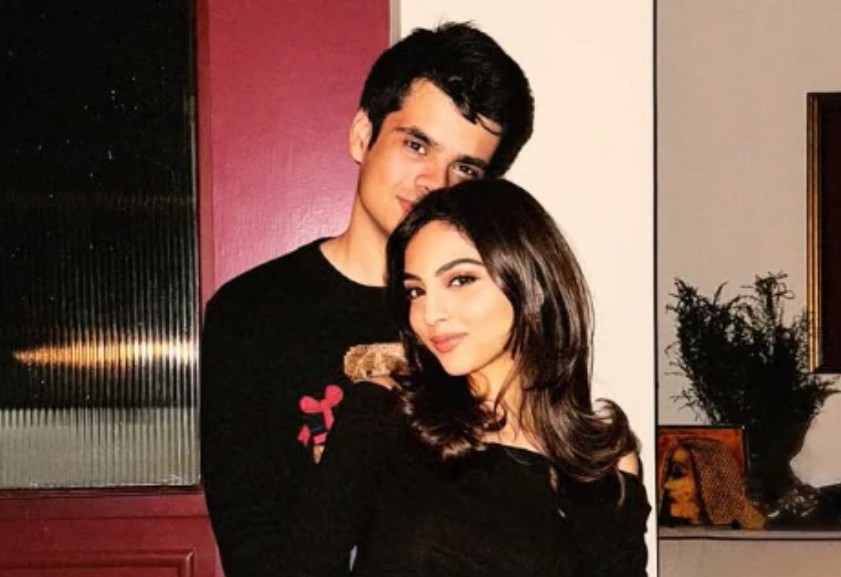
Raihan Vadra, son of Congress general secretary Priyanka Gandhi and businessman Robert Vadra, has reportedly exchanged rings with his long-time partner, Aviva Baig, bringing a seven-year relationship closer to a lifelong commitment.
According to reports, Raihan recently proposed to Aviva, and the engagement has the blessings of both families. While there has been no official announcement yet, preparations are said to be underway for a private engagement ceremony, likely to be held in Rajasthan.
Sources suggest the celebrations will span two to three days and may take place in early January 2026, keeping in line with the family’s preference for understated, intimate gatherings.
Raihan and Aviva have largely stayed away from public attention, choosing instead to nurture their relationship quietly. Aviva, who is based in Delhi along with her family, recently shared a photograph with Raihan on Instagram and added it to her highlights, subtly fuelling speculation about the impending engagement.
Who Is Raihan Vadra?
Born on August 29, 2000, 25-year-old Raihan Vadra has consciously carved out a life distinct from his formidable political lineage. Though he occasionally appears at political events, he largely keeps a low public profile.
Educated in Delhi, Raihan studied at The Doon School in Dehradun—an alma mater shared by Rajiv Gandhi and Rahul Gandhi, before pursuing higher studies in politics at the School of Oriental and African Studies (SOAS), University of London.
Professionally, Raihan is an installation and visual artist with a strong inclination towards travel and nature photography. His work spans wildlife, street and commercial photography, and he has held notable solo exhibitions such as Dark Perception and The India Story, the latter showcased in Kolkata. His growing body of work has earned appreciation within contemporary art circles, and he is represented by Mumbai-based APRE Art House.
About Aviva Baig
Aviva Baig comes from a Delhi-based family known to be close to the Vadras. She completed her schooling at the prestigious Modern School, Delhi, and went on to study Media Communication and Journalism at OP Jindal Global University.
Much like Raihan, Aviva has built a career rooted in creativity rather than politics. She is a professional photographer, producer, and a former national-level footballer. Her photographic work is deeply influenced by nature, everyday life and visual storytelling, often marked by quiet observation and emotional depth.
Creative Footprint
Over the past five years, Aviva has exhibited her work across some of India’s prominent art platforms. Her exhibitions include You Cannot Miss This with Method Gallery (2023), participation in the India Art Fair’s Young Collector Programme (2023), The Illusory World at The Quorum Club (2019), and India Design ID with K2 India (2018). Her photographs have also been featured on several national and international platforms, earning her recognition within the contemporary photography and art space.
Beyond photography, Aviva has built a diverse professional portfolio. She is a freelance producer with PlusRymn and has previously worked as a junior project manager at PROPAGANDA. Her experience includes roles as a marketing intern at Art Chain India and editor-in-chief of The Journal at I Parliament. She has also interned with Verve magazine and Creative IMAGE Magazine.
Adding to her entrepreneurial journey, Aviva is the co-founder of Atelier 11, a photographic studio and production company that collaborates with agencies, brands and clients across India.
A Critical Look at the Gandhi Family Name, Identity
The Nehru–Gandhi family is one of India’s most prominent political dynasties, but it has also been the subject of ongoing discussion, and sometimes controversy — around its name, ancestry and public identity.
The Origin of the “Gandhi” Surname in the Family
Contrary to popular assumption, the Gandhi family in Indian politics is not directly related to Mahatma Gandhi of the Indian independence movement.
Feroze Jehangir Gandhi, the husband of Indira Gandhi (née Nehru), was born Feroze Jehangir Ghandy into a Parsi family in Bombay. Eager to identify with the Indian freedom movement and perhaps to align public perception, the spelling of Ghandy became widely known as Gandhi as he became active in politics.
This fact is sometimes highlighted to question why the Nehru lineage — originally Kashmiri Pandit — publicly uses “Gandhi” rather than the original Nehru line or Ghandy.
Interfaith Marriages and Changing Public Identity
Across generations, members of the extended Nehru–Gandhi family have had associations with partners from diverse cultural or religious backgrounds.
Indira Gandhi married Feroze Gandhi, born into a Parsi Zoroastrian family, again signifying inter-community ties.
Rajiv Gandhi married Sonia Maino, who was born into a Roman Catholic Christian family in Italy and later became a central figure in Indian politics.
Priyanka Gandhi married Robert Vadra, a businessman of Punjabi descent. While some media have associated Vadra with Christianity, detailed documentation of his current faith is limited, and such labels should be used carefully.
These relationships show that the family’s social and cultural links have been diverse, reflecting individual choices rather than rigid adherence to a single religious identity.
Public Perception vs Personal Identity
Opinions often emerge around how the Gandhi family presents itself, especially with respect to how they embrace Hindu cultural symbols or claims of caste identity.
Rahul Gandhi, for example, has identified culturally with certain Hindu traditions, such as undertaking the Kailash Mansarovar pilgrimage and engaging with symbols like the janeu (sacred thread), which some commentators have noted given his mixed heritage.
Critics sometimes argue that public political branding draws on cultural identifiers like caste and religion that don’t straightforwardly reflect genealogical lineage.
A legitimate point for discussion is how political families use certain symbols or names for broader appeal, and whether that aligns with transparent communication about heritage.
Another is the broader debate in Indian society about identity, religion and public office, where personal backgrounds are often seen through the lens of political narratives.





