
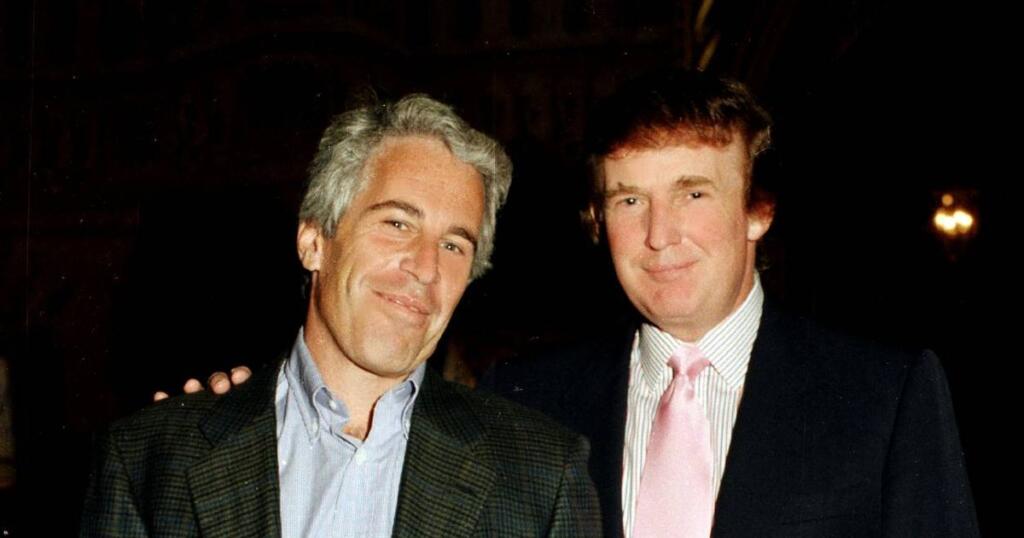
The US Justice Department on Tuesday released a fresh tranche of documents linked to its investigation into late financier and convicted sex offender Jeffrey Epstein.
The release revealed that President Donald Trump traveled on pedophile Jeffrey Epstein’s private jet at least eight times during the mid-1990s.
The disclosure comprises around 30,000 pages of records, many of them heavily redacted, along with dozens of video clips. Some of the videos are reportedly from inside a federal detention centre.
Epstein was found dead in a New York jail in 2019, a death that was officially ruled a suicide.
Prosecutor email cites Trump jet travel
Among the newly released material is an email dated January 7, 2020, written by an unidentified New York-based prosecutor. The email states that flight records showed Trump had travelled aboard Epstein’s private jet eight times during the 1990s—more frequently than investigators had previously believed.
In the email, an unidentified assistant US attorney for the Southern District of New York wrote, “For your situational awareness, wanted to let you know that the flight records we received yesterday reflect that Donald Trump traveled on Epstein’s private jet many more times than previously has been reported (or that we were aware), including during the period we would expect to charge in a Maxwell case.”
“In particular, he is listed as a passenger on at least eight flights between 1993 and 1996, including at least four flights on which Maxwell was also present,” the email goes on.
It read, “He is listed as having traveled with, among others and at various times, [second wife] Marla Maples, his daughter Tiffany, and his son Eric.
According to the email, at least four of those flights also included Ghislaine Maxwell, who is currently serving a 20-year prison sentence for helping Epstein sexually abuse underage girls.
Another email from 2021 said an unidentified individual had reviewed data extracted from Steve Bannon’s cellphone and found an “image of Trump and Ghislaine Maxwell.” The image itself has been redacted from the documents released by the government.
Justice Department rejects credibility of claims against Trump
In a statement posted on X, the Justice Department said the files include allegations against Trump that it described as false and politically motivated.
“Some of these documents contain untrue and sensationalist claims made against President Trump that were submitted to the FBI right before the 2020 election,” the department said.
“To be clear, the claims are unfounded and false, and if they had a shred of credibility, they certainly would have been weaponized against President Trump already,” it added.
The department said the disclosure reflects its commitment to transparency while continuing to protect Epstein’s victims.
Files released under new transparency law
The latest release follows the Trump administration’s publication of a large cache of Epstein-related records last week, as part of efforts to comply with a newly enacted transparency law that mandates the disclosure of all Epstein files.
The law was passed overwhelmingly by Congress last month, following months of resistance from Trump to keeping the materials sealed.
Meanwhile, in another batch of Jeffrey Epstein files released on Tuesday by the US Justice Department (DOJ), numerous references were made to President Donald Trump.
In one such file, a complaint received by the FBI exposes chilling allegations about the current US president. According to the file released by the DOJ, the complainant reached out to the FBI on 8 March 2020, alleging that she was a victim of sex trafficking and had been trafficked by her uncle and Jeffrey Epstein in 1984.
At the time, the victim was 13 years old and was pregnant. She alleged that her newborn daughter was murdered and disposed of “because I gave birth to her while in the middle of this sex trafficking ordeal.”
The victim, whose identity has been withheld in the documents, said she had contacted the FBI to seek information about an NYPD detective whom she claimed had called her a few days before the alleged murder, which she said took place sometime between May and September 1984.
She later recounted details of the incident, including allegations about how the newborn’s body was disposed of. According to her statement, the infant was thrown into Lake Michigan from a yacht. She named President Donald Trump as a witness, alleging that he was present at the time.
The Epstein Files Controversy
Jeffrey Epstein was a wealthy financier with powerful connections across politics, business and entertainment. He was first convicted in 2008 on prostitution-related charges and later arrested again in 2019 on federal sex trafficking charges involving minors. His death in custody that year—officially ruled a suicide—sparked widespread public suspicion and demands for greater transparency.
For years, courts and federal agencies kept large portions of Epstein-related records sealed, citing ongoing investigations, privacy concerns and the need to protect victims. Critics argued that secrecy shielded influential figures who may have associated with Epstein, even if they were not charged with any crimes.
The newly passed transparency law seeks to address those concerns by requiring the release of all Epstein-related federal files, subject to redactions to protect victims and sensitive investigative details. As a result, thousands of pages of emails, flight logs, witness statements and internal communications are now being made public.
Importantly, the release of documents does not imply wrongdoing by everyone named in them. Many references reflect unverified allegations, hearsay, or routine investigative leads that were never substantiated. The Justice Department has repeatedly stressed that the presence of a name in the files does not amount to evidence of criminal conduct.
The ongoing disclosures are likely to continue fuelling public debate—both over Epstein’s network and over how the US justice system handled one of the most notorious criminal cases involving elite power and abuse in recent history.