






















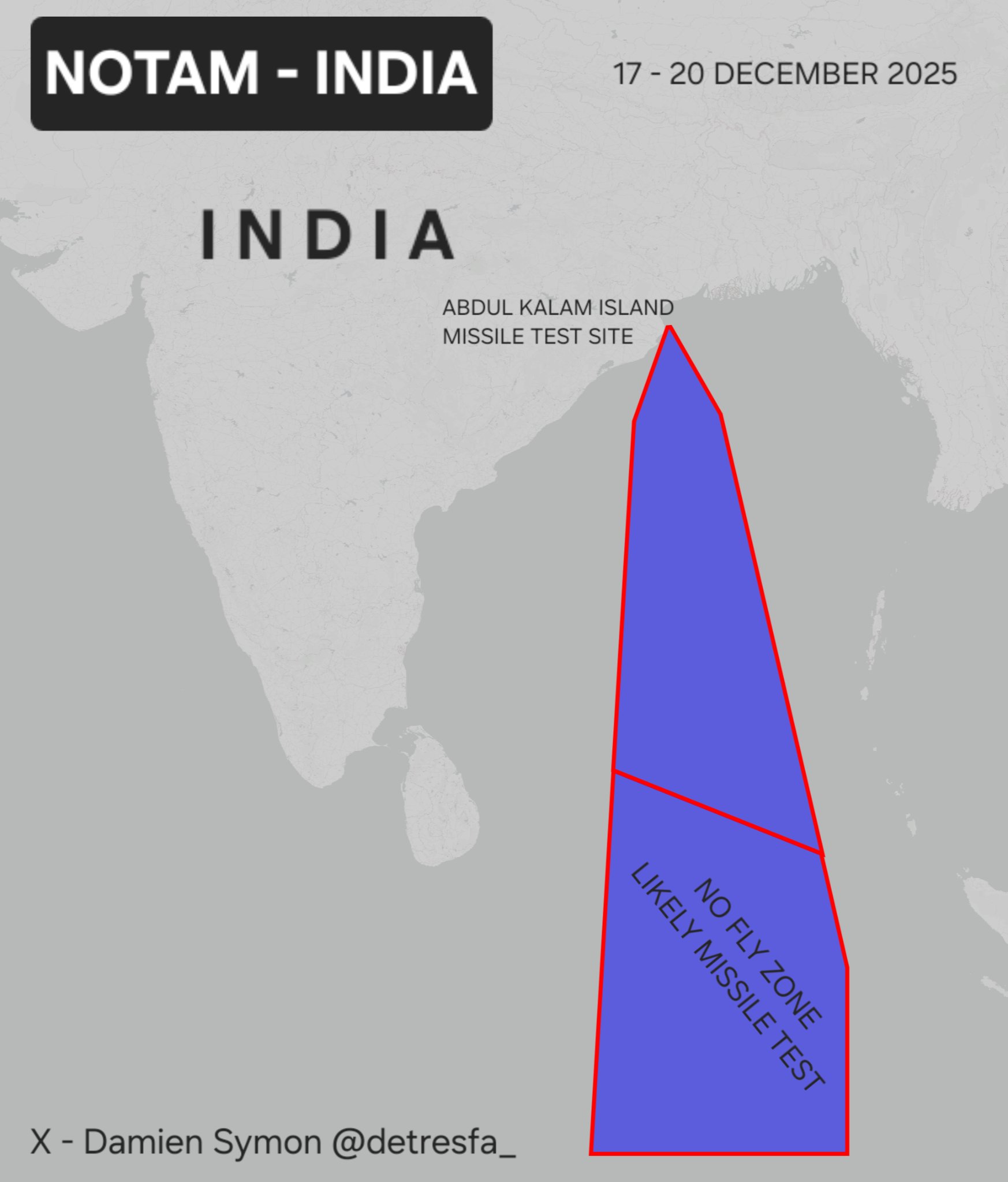
India has significantly expanded the designated test range for a planned missile trial in the Bay of Bengal region, issuing an official maritime and airspace safety notification that places the range near 2,520 kilometres for activity between December 17–20, a substantial increase over earlier advisories.
The updates were reported by open-source intelligence analyst Damien Symon (@detresfa_) on X. The newly issued danger zone stretches to roughly 2,520 km—a sharp increase from the earlier notification, which marked out a corridor of about 1,480 km.
This latest range figure, which more than doubles earlier specifications, reflects an evolving schedule of planned strategic tests over the Bay of Bengal, with temporary danger zones marked for both maritime traffic and aviation safety ahead of potential ballistic and sea-launched missile activity.
Earlier Notification Had Smaller Designated Range
The earlier official notification issued for the same 17–20 December window specified a test area for a missile launch over the Bay of Bengal, though initial disclosures did not publicly include a detailed range figure; some open-source monitoring before the update had indicated more modest dimensions.
This updated danger zone of about 2,520 km suggests India is preparing for a significantly longer-reach trial, potentially involving a medium-range or intermediate-range missile system, with the safety corridor adjusted accordingly to account for the extended flight path.
Evolving Test Notices Across December
Earlier in December, satellite and OSINT observers had tracked separate notifications suggesting preparations for other test windows and expanding danger areas off the coast of Visakhapatnam and in the wider Bay of Bengal region. Some of those earlier advisories reflected shorter-range corridors and were reportedly updated or canceled as planning evolved.
India’s defence and aerospace establishments routinely issue such notifications — known as NOTAMs (Notices to Airmen) and corresponding maritime danger zone advisories — ahead of missile launches and other live-fire events. These ensure civilian flights and commercial ships can avoid designated trajectories, protecting safety during test operations.
Strategic Context
Although official statements from India’s Ministry of Defence or the Defence Research and Development Organisation (DRDO) have not specified which missile system is involved, the expanded ~2,520 km zone points toward systems in the medium-to-intermediate-range class. Indian missile families like the Agni-Prime (Agni-P)— with an estimated range of 1,000–2,000 km — and other strategic platforms under development could potentially be relevant, though no confirmation has been issued.
Analysts note that such extended safety corridors are consistent with testing activities intended to validate longer-range performance, including trajectory and impact behavior over large distances.
Safety and Civil Coordination
Maritime and civil aviation authorities closely monitor these advisories to reroute traffic and issue temporary cautions. The designated danger zones remain in force only during the planned test windows and can be rescinded if the scheduled activity is postponed or canceled.