
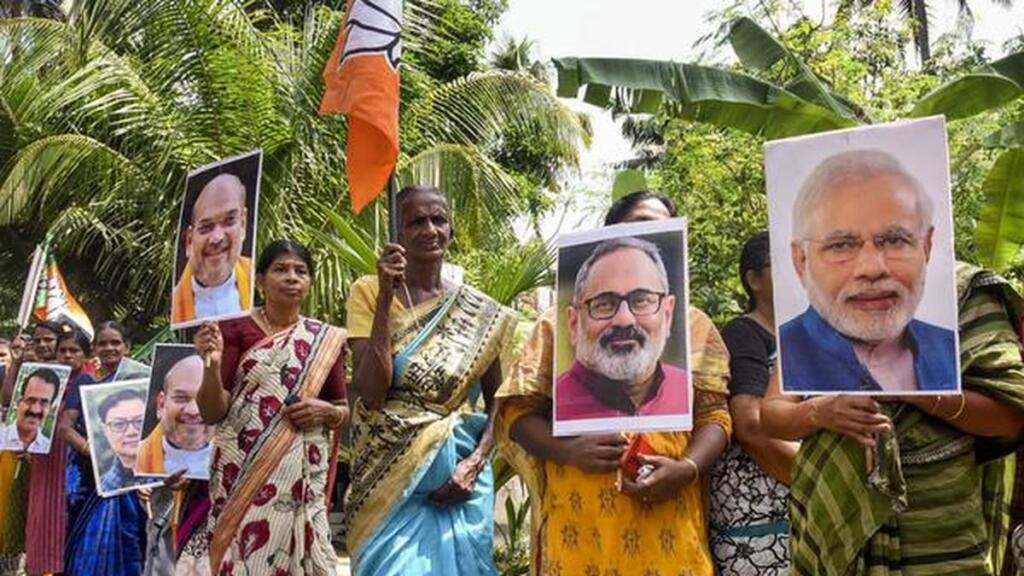
The Bharatiya Janata Party’s historic victory in Thiruvananthapuram has shocked Kerala’s political establishment, but the true political tremor has come from Munambam, a coastal ward whose local body election result has stunned observers across the state. Munambam, where nearly 500 Christian families are facing the threat of eviction due to contested Waqf claims, has delivered a decisive mandate in favour of the National Democratic Alliance. Together, the outcomes in Munambam and Thiruvananthapuram have been widely interpreted as a signal that the long standing dominance of Leftist politics in Kerala is facing its most serious challenge in decades.
For years, Thiruvananthapuram stood as a symbol of Left ideology, intellectual influence, and organisational strength. The BJP’s breakthrough in the state capital is therefore not just a numerical win but a psychological one. It has punctured the perception that urban, educated voters in Kerala are permanently aligned with Marxist politics. Many residents, particularly the youth and middle class, have grown increasingly frustrated with what they see as ideological rigidity, lack of innovation, and limited employment opportunities. The result suggests that a significant section of voters is now willing to experiment with alternatives that promise governance, development, and integration with national priorities.
However, the Munambam verdict carries an even deeper emotional and social significance. Munambam is not merely an electoral constituency but a community living under prolonged uncertainty. Nearly 500 Christian families in this coastal area have been facing the fear of eviction following what they describe as illegal and opaque claims made under the Waqf framework. These families argue that they have lived on their land for generations and that sudden assertions of ownership have threatened their homes, livelihoods, and sense of security. For many, the issue transcends politics and touches the core of dignity and survival.
What has angered Munambam’s residents most is the sense of abandonment. Parties that traditionally enjoyed the support of minority communities were seen as indifferent or hesitant to confront the issue decisively. Repeated appeals, protests, and representations failed to yield a resolution that reassured the affected families. Over time, this silence bred resentment and a feeling that political loyalty was being taken for granted. In such an atmosphere, trust eroded, and voters began to look elsewhere for support and solidarity.
It was at this critical juncture that the Modi government and the BJP stepped in, openly aligning themselves with the people of Munambam. BJP leaders framed the issue as one of constitutional rights and equality before the law, rather than as a communal or ideological dispute. Senior leaders visited the area, engaged with residents, and promised to fight what they described as unjust claims. This visible involvement created a sharp contrast with the perceived inaction of the Left and the Congress, and it resonated strongly with families seeking assurance and representation.
The NDA’s victory in Munambam thus reflects a mandate rooted in lived reality rather than ideological persuasion. Many Christian families, who had historically never voted for the BJP, chose to do so as an act of protest and hope. Their vote was a statement that community identity cannot override the need for justice and security. Munambam demonstrated that when governance fails at the grassroots level, even the most entrenched political loyalties can shift dramatically.
The Thiruvananthapuram and Munambam results together point to a broader transformation in Kerala’s political behaviour. Urban voters are questioning ideological stagnation, while rural and coastal communities are demanding tangible action on real issues. In both cases, the BJP has benefited from projecting itself as a party willing to challenge entrenched systems and speak directly to citizen concerns. This has begun to dismantle the long held belief that the BJP lacks a social base in Kerala.
For the Left, these developments are a serious warning. Moral posturing and historical legacy are no longer sufficient to retain voter confidence. The Congress, meanwhile, continues to struggle with relevance and leadership clarity, leaving space for alternative narratives to grow. For the BJP and the NDA, the victories bring opportunity but also responsibility. The expectations of Munambam’s families and Thiruvananthapuram’s voters are now firmly tied to delivery, legal clarity, and sustained engagement.
Kerala’s political landscape is clearly entering a new phase. The Munambam verdict has shown that fear of displacement and neglect can reshape electoral choices, while the Thiruvananthapuram win has challenged ideological certainties. Whether this moment marks a lasting realignment or a temporary shift will depend on governance and follow through. What is undeniable is that the political ground beneath Kerala’s Left stronghold is no longer as solid as it once appeared.