


















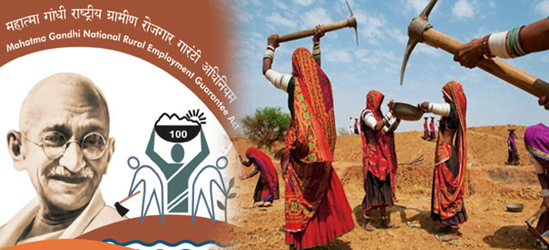
In a landmark decision on Tuesday, the central government announced that the Mahatma Gandhi National Rural Employment Guarantee Act (MGNREGA) will be renamed as the ‘Pujya Bapu Gramin Rozgar Yojana’.
Alongside the renaming, the government will increase the number of guaranteed employment days to eligible rural households from 100 now to 125.
According to the government, this renaming is aimed at honoring the vision and ideals of the Father of the Nation, Mahatma Gandhi, who always emphasised rural self-reliance and development through meaningful employment.
The new name signifies that the scheme will go beyond merely providing jobs; it will also reflect and promote Gandhi’s principles of rural development and self-sufficiency.
The increase in workdays is expected to improve the income of rural households, reduce unemployment, and provide more sustainable employment options.
Experts believe that this step is not just a cosmetic change but an effort to reinforce the significance of the scheme while bringing the Gandhian philosophy closer to the people.
It is also likely to increase public engagement and positive sentiment toward the initiative in rural areas.
The government has emphasised that the core objective of the scheme remains ensuring minimum income and employment for rural poor, and the renaming serves as a symbolic and motivating step in that direction.
Renaming MGNREGA as the ‘Pujya Bapu Gramin Rozgar Yojana’ is both a cultural and motivational move. It pays tribute to Mahatma Gandhi’s legacy while strengthening efforts to guarantee rural employment and improve the livelihoods of rural communities.
The Mahatma Gandhi National Rural Employment Guarantee Act (MGNREGA) is a labor law and social security measure that aims to guarantee “right to employment”. It provides at least 100 days of guaranteed unskilled manual labour to rural people.
Currently, there are 154 million people working under the scheme. Around one-third of the beneficiaries are women.The world’s largest work guarantee programme, launched by the Manmohan Singh government and initially called the National Rural Employment Guarantee Act, was re-named after Mahatma Gandhi in 2009.
As a part of decentralisation aimed at by the Centre, the scheme involved the Panchayati Raj, which had to guarantee 50 per cent of the work. Its most crucial aspect is that in case work cannot be found within 15 days of application by an individual, an unemployment allowance is provided.





