
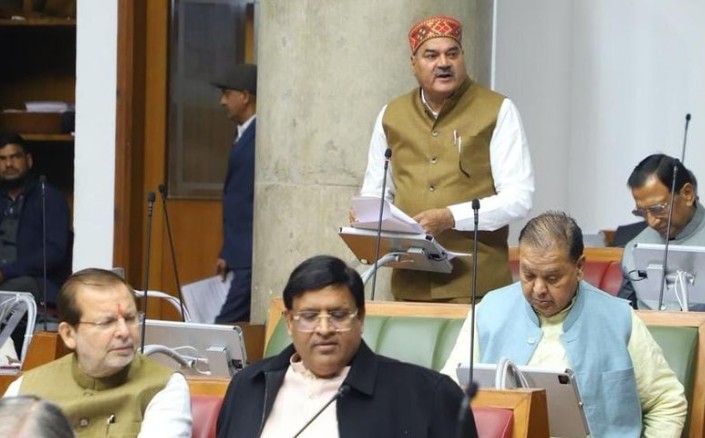
A sharp debate erupted in the Haryana Legislative Assembly over live-in relationships, with BJP MLA from Rewari Laxman Singh Yadav calling for regulation of such arrangements and urging the state government to consider making them conditional, similar to the model adopted in Uttarakhand.
Raising the issue in the House, Yadav described the growing trend of live-in relationships as a “social concern” that, according to him, requires oversight and a clear legal framework.
He argued that leaving such relationships completely unregulated could prove harmful to society and lead to legal and social complications.
The MLA stressed that live-in relationships should not be banned but regulated through clearly defined conditions and rules, so that the rights of both partners—particularly women and children—are protected.
He warned that in the absence of any legal structure, disputes related to abandonment, maintenance, inheritance, and child welfare are increasing.
Referring to Uttarakhand’s recent legal framework, Yadav pointed out that the state has introduced mandatory registration of live-in relationships under its Uniform Civil Code.
According to him, this provision ensures transparency, legal accountability, and better protection for vulnerable parties involved in such relationships.
He said that a similar system in Haryana could help prevent exploitation, reduce disputes, and provide clarity in cases involving domestic violence, maintenance claims, or custody of children born from live-in relationships.
“A defined legal process will ensure that no party is left without recourse,” he told the Assembly.
The issue triggered divergent views among legislators. While some members supported the proposal, linking it to social order, women’s safety, and child rights, others urged caution.
They argued that live-in relationships fall within the realm of personal liberty and individual choice, and excessive state regulation could amount to intrusion into private lives.
Legal experts have noted that Indian courts, including the Supreme Court, have repeatedly held that live-in relationships are not illegal and are protected under the right to life and personal liberty guaranteed by the Constitution.
At the same time, courts have also emphasized the need to safeguard women and children from exploitation, particularly in long-term relationships resembling marriage.
With Uttarakhand becoming the first state to formally regulate live-in relationships through legislation, the debate in Haryana reflects a broader national discussion on balancing personal freedom with social responsibility and legal protection.
The state government has not yet indicated whether it plans to introduce any legislation on the matter, but the issue is expected to see further deliberation both inside and outside the Assembly.
Earlier in January this year, the Khap Panchayats in Haryana had called for amendments to the Hindu Marriage Act to address what they describe as growing social issues in rural and urban areas.
Representatives of around a dozen panchayats met Haryana Chief Minister Nayab Singh Saini and submitted a memorandum demanding a ban on live-in relationships, mandatory parental consent for love marriages, and restrictions on marriages within the same village, neighbouring villages (guvandh), and the same clan (gotra). They also opposed increasing the legal marriage age to 21 years and same-sex marriages.
As per Indian Express, Sanjay Deswal, chief of the Akhil Bhartiya Deswal Khap had explained the concerns and claimed that live-in relationships are increasingly common in both villages and cities, disrupting the social fabric.
Deswal stressed the need for parental consent in love marriages, arguing that such marriages often fail when undertaken without family support. Regarding the legal age for marriage, Deswal opposed increasing it from 18 to 21 years, arguing that many girls are married earlier due to family circumstances.
He further argued that same-sex marriages should be banned and urged the government to uphold cultural values and traditions. Such marriages would destroy our social ties,” Deswal said, adding that these practices are restricted in districts like Rohtak, Sonepat, Hisar, and Jind.
The Uniform Civil Code Act, 2024 of Uttarakhand, seeks to establish a set of uniform personal laws that apply to all citizens, regardless of religion, gender, or caste. This would cover aspects such as marriage, divorce, adoption, inheritance, and succession.
Under this, marriage can be solemnised only between those parties, neither of whom has a living spouse, both of whom are mentally capable of giving legal permission. The man should have completed at least 21 years of age, and the woman 18 years of age, and they should not be in the ambit of prohibited relationships.
The UCC applies to all residents of Uttarakhand, except for the Scheduled Tribes and protected authority-empowered persons and communities. This Act does not apply to the Scheduled Tribes (ST) notified under Article 342 and Article 366 (25) of the Constitution, and protected authority-empowered persons and communities under Part XXI have also been excluded from its purview.
The Uttarakhand Freedom of Religion and Prohibition of Unlawful Conversion of Religion Act, 2018, prohibits the conversion from one religion to another religion by misrepresentation, force, fraud, undue influence, coercion, allurement or marriage.