




















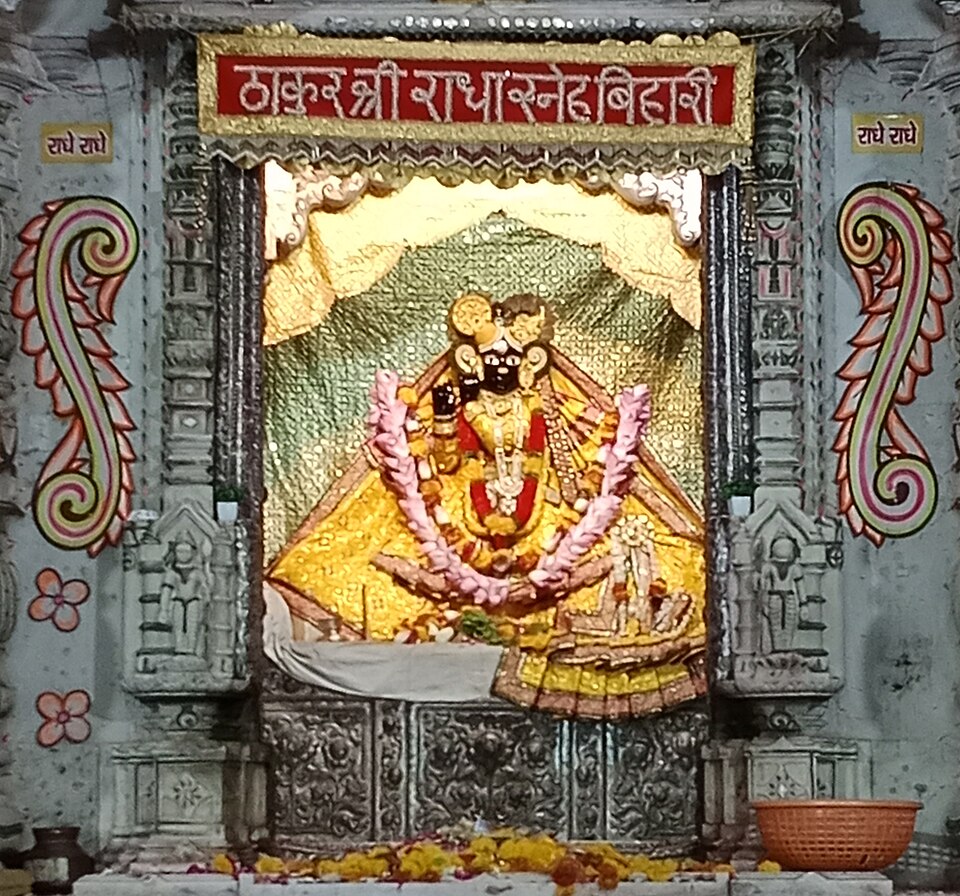
The recent events at the revered Shri Thakur Banke Bihari Temple in Vrindavan have stirred concern and debate among devotees and temple authorities alike. For the first time in living memory, Thakur Ji was not offered Bal Bhog in the morning and Shayan Bhog in the evening. The reason was not ritual defiance or theological disagreement, but an administrative lapse involving unpaid wages to the halwai responsible for preparing the sacred offerings. While the incident has understandably caused anguish, it also brings into focus a deeper truth rooted in Hindu philosophy: God in Hinduism is supreme, self sustained, and never diminished by human error or trivial disputes.
Every day, lakhs of devotees from India and across the world visit the Banke Bihari Temple to seek the darshan of Thakur Ji. On Monday, despite the absence of the customary bhog, devotees were still granted darshan. This moment, though painful for many, subtly reaffirmed a central Hindu belief that divinity does not depend on material offerings. Bhog is an expression of love and devotion, not a condition for the presence or power of God.
Traditionally, Thakur Banke Bihari is offered Bal Bhog in the morning and Shayan Bhog at night, along with Rajbhog and Utthapan Bhog during the day. These rituals have continued uninterrupted for centuries at a stretch, becoming a living rhythm of devotion in Vrindavan. Their absence for even a single day naturally shocked goswamis and devotees, who view seva as a sacred duty rather than a contractual obligation. Yet Hindu scriptures consistently remind believers that God transcends ritual mechanics.
The immediate cause of the disruption was disputes or the failure to pay the halwai appointed to prepare the bhog. The Supreme Court constituted High Power Committee that oversees temple administration had entrusted the responsibility of arranging bhog and prasad to an appointed individual. The halwai, who receives a monthly salary of eighty thousand rupees, had reportedly not been paid for several months. As a result, he declined to prepare the offerings, leading to the unprecedented situation.
Temple goswamis expressed deep resentment, seeing the disputes leading to break in an age old tradition. Their anger is rooted not merely in custom, but in the emotional bond between sevayats and Thakur Ji. In temples like Banke Bihari, the deity is not seen as an idol but as a living presence, a child, a king, and a beloved companion. Any disruption in service feels personal and painful.
At the same time, members of the High Power Committee clarified that corrective steps were being taken. Committee member Dinesh Goswami stated that once the issue of non payment was brought to their notice, instructions were issued to clear the dues immediately and ensure that such an incident does not recur. This response highlights that the central disputes or failure was administrative, not spiritual.
However, beyond blame and explanations lies a larger philosophical lesson. Hinduism has always maintained that God is beyond hunger, thirst, and dependence. The Bhagavad Gita teaches that the Lord accepts even a leaf, a flower, or a drop of water when offered with devotion. Conversely, elaborate offerings without sincerity hold little spiritual value. Thakur Ji does not lose divinity because a sweet was not prepared, nor does Vrindavan lose its sanctity because of human negligence.
History is replete with examples where devotion triumphed over ritual rigidity. Saints like Meera, Surdas, and Tulsidas emphasized bhakti over formalism. Vrindavan itself stands as a testament to spontaneous devotion, where love for Krishna flows freely beyond rules and regulations. In this context, the absence of bhog, while unfortunate, does not diminish the presence of God in the temple or in the hearts of devotees.
It is important to remember that temples are administered by humans, and disputes are natural as human systems are inherently fallible. Committees, salaries, and contracts are necessary in the modern age, but they must never overshadow the spiritual core of worship. When disputes arise, they should be resolved swiftly and humbly, keeping the deity and devotees at the center rather than ego or authority.
For devotees, this incident can serve as a reminder to look inward. True bhog is surrender. True seva is intention. Thakur Banke Bihari continues to bless millions not because rituals are flawlessly executed, but because faith remains alive. God in Hinduism is above committees, above payments, and above momentary lapses. He is eternal, compassionate, and complete in Himself.
As payments are cleared and traditions restored, the larger harmony of Vrindavan will return to its familiar rhythm. Yet the episode leaves behind a quiet but powerful message. Human systems may falter, traditions may pause, but divinity remains untouched. In Hinduism, God is never subject to trivial disputes, for He stands far above them, steady, eternal, and all embracing.





