
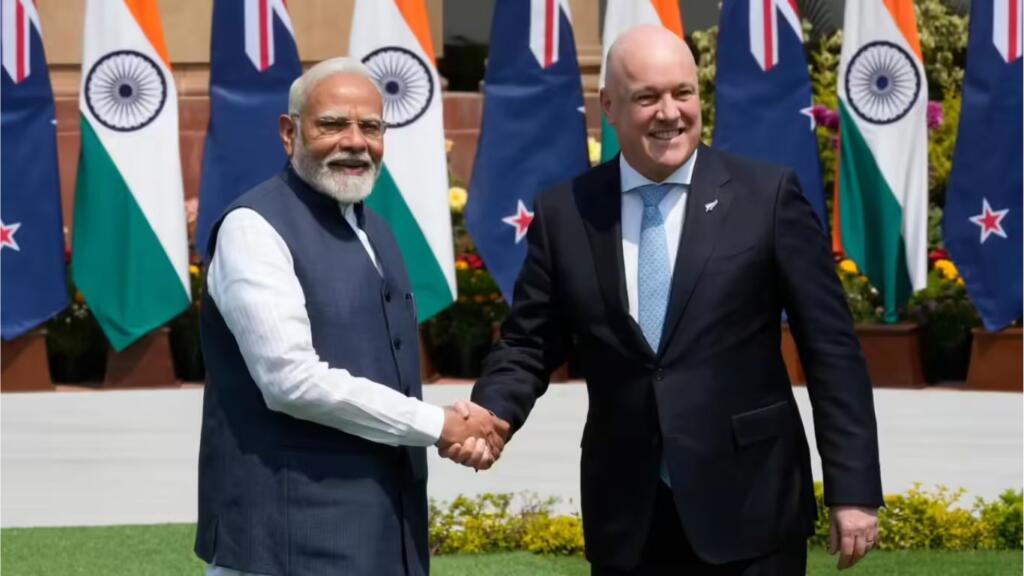
The past few years have marked a notable shift in India’s trade policy, with the government actively embracing free trade agreements (FTAs) to integrate more deeply with global markets. Within this year alone, India has concluded three major trade deals—first with the UK, then with Oman a few days ago, and now with New Zealand.
Knowing the current trade scenarios, where nations are becoming inward and protecting their indigenous product, bilateral trade agreements are the need of the hour, and India knows it well.
Earlier, the India–EFTA trade agreement—covering Iceland, Liechtenstein, Norway, and Switzerland—was signed in March last year and came into effect on October 1. These agreements follow similar deals inked with the UAE and Australia, collectively underscoring India’s renewed push towards trade liberalisation.
The India–New Zealand trade agreement is particularly noteworthy. It provides duty-free access for all Indian exports to New Zealand, while also securing commitments in key sectors such as IT services, education, and financial services. Importantly, the deal opens new pathways for skilled Indian professionals through a facility for Temporary Employment Entry Visas.
For New Zealand, the agreement offers tariff liberalisation on 70% of tariff lines, covering nearly 95% of bilateral trade. However, mindful of domestic political sensitivities, India has ensured that dairy products are excluded from market access commitments. Agriculture and allied sectors have similarly been major sticking points in India’s ongoing trade negotiations with countries such as the US.
Beyond tariffs, the agreement places strong emphasis on addressing non-tariff barriers. It seeks to do so through enhanced regulatory cooperation, greater transparency, and streamlined customs, sanitary, and phytosanitary measures—an essential component for ensuring meaningful market access rather than merely notional tariff cuts.
Also Read: India, the EU FTA and the Art of Trade as Power
The two countries have also aimed to deepen their investment relationship. New Zealand has agreed to facilitate investments worth $20 billion into India over the next 15 years, adding a long-term strategic dimension to the partnership.
In parallel, India is negotiating similar trade agreements with countries like Israel and Peru. While these efforts are welcome and will improve market access for Indian exports, the overall gains may be limited due to the relatively smaller size of these economies. Therefore, alongside such agreements, India’s focus must also remain on concluding the long-pending trade deals with the world’s largest markets—the United States and the European Union.
The world is not the same after President Trump became the President of the US. Tariffs and trade barriers have become norms in international politics. Hence, diversification of trade is one of the solutions for these unprecedented problems, where nations are diversifying their trade with other nations in different parts of the world. Indian FTAs and bilateral trade agreements are part of this diversification.
At the beginning, it may hurt India, but in the long term, it will serve the purpose. India will not be dependent on a few nations to sell or buy the products. Hence, nations will fail to pressure us. Diverse and robust trade with several nations will provide more options to our foreign policy decisions, and strategic autonomy will be more visible in future.