



















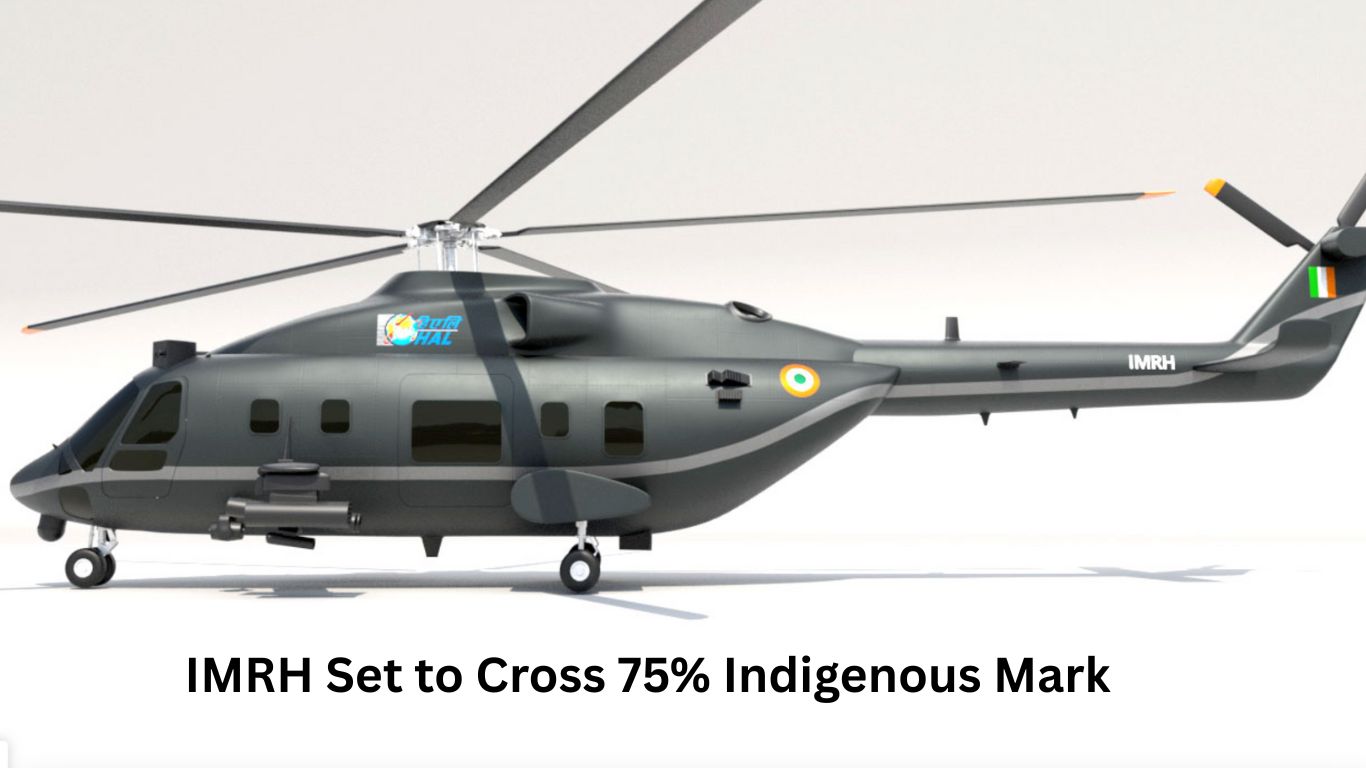
As India is moving towards Indigenization, a major boost to India’s defence self-reliance drive, the upcoming Indian Multi-Role Helicopter (IMRH) is being designed to achieve over 75% indigenous systems before it enters full-scale production.
Notably, this will be the first Indian-designed helicopter to cross the psychologically important 70% indigenisation threshold, marking a turning point for India’s aerospace manufacturing ecosystem.
Until now, no HAL-built helicopter has reached this level of indigenous content at the design stage. Therefore, the IMRH represents not just another platform, but a step change in how India approaches the development of complex rotorcraft. Moreover, it reflects growing confidence in domestic suppliers, private-sector participation, and system-level integration within the country.
According to reports, the 12.5-tonne, twin-engine IMRH is being jointly developed by Hindustan Aeronautics Limited (HAL) under a Special Purpose Vehicle (SPV) model, along with key private-sector partners. Importantly, the helicopter is intended to replace ageing Mi-17 and Mi-17V5 fleets currently operated by the Indian Air Force, Army, Navy, and Coast Guard. With over 550 helicopters planned for production in the first decade, the programme is being positioned as the flag-bearer of Atmanirbhar Bharat in the rotorcraft domain.
From Incremental Gains to a Clean-Sheet Indigenous Push
Historically, India’s helicopter programmes have followed a gradual path toward indigenisation. For instance, the Advanced Light Helicopter (ALH) Dhruv began with only about 45% indigenous content. Over time, however, HAL steadily improved this figure through upgrades and local sourcing.
Similarly, the Light Combat Helicopter (LCH), currently in its Limited Series Production phase, has an indigenous content level of around 45%. Nevertheless, there are plans to push this beyond 55% as production stabilises and domestic capabilities expand.
In contrast, the IMRH marks a clear shift in strategy. Instead of increasing indigenisation retrospectively, HAL and the Indian armed forces are building the helicopter from the ground up with a strong focus on domestic systems. As a result, dependence on foreign vendors is being reduced at the design and architecture level itself.
Key systems targeted for indigenisation include mission avionics, cockpit electronics, communication and navigation suites, hydraulic and flight control systems, core mechanical assemblies, and electrical power distribution networks. In addition, major emphasis is being placed on airframe structures and composite components, areas where Indian industry has matured significantly in recent years.
Backbone of India’s Medium-Lift Fleet for the Next 40 Years
Looking ahead, the IMRH is expected to become the primary medium-lift helicopter of India’s armed forces for the next four decades. With a payload capacity of 4–5 tonnes, it will support multiple roles. It includs troop transport, assault operations, logistics, VIP movement, and search and rescue missions. Consequently, it will form the backbone of India’s medium-lift aviation capability as legacy Soviet-origin platforms are phased out.
Crucially, with more than 75% indigenous systems planned from the outset, the IMRH is on track to become the most self-reliant helicopter ever built in India. It comfortably surpasses the ALH Dhruv and LCH in terms of local content, both in scale and ambition.
Ultimately, the IMRH programme is about more than replacing the Mi-17 fleet. Rather, it represents a major technological and industrial leap forward. As India strengthens its defence aerospace base, the IMRH could also position the country as a competitive global manufacturer in the medium-lift helicopter segment.