
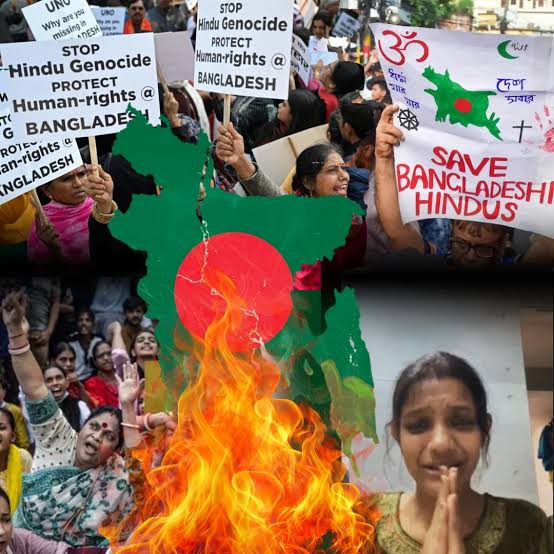
A deeply disturbing revelation from Bangladesh has once again shaken confidence in the safety of religious minorities in the country. In the Raozan upazila of Chattogram district, a poster detailing an alleged plan of Hindu Genocide, to exterminate Hindu and Buddhist communities has surfaced, triggering widespread fear and outrage. The contents of the poster, reportedly recovered by the police, point towards a chillingly organised conspiracy that goes far beyond sporadic violence and suggests a calculated attempt at ethnic and religious cleansing.
According to reports published by The Sunday Guardian, the poster explicitly claimed that a plan of Hindu Genocide had been devised to kill nearly two lakh Hindus and Buddhists on December 13, 2025. Even more alarming was the assertion that funds had already been arranged to execute this mass killing, indicating preparation, coordination and intent. The message left little room for ambiguity, stating that no sign of the Hindu and Buddhist communities would be allowed to remain in Raozan. Such language evokes some of the darkest chapters of human history and raises urgent questions about the present condition of minority rights in Bangladesh.
Kushal Barun Chakraborty, a representative of the Bangladeshi Sammilita Sanatani Jagran Jote, confirmed that the poster was removed by the police after it was discovered. Quoting its contents, he stated that the banner openly spoke of Hindu Genocide, a planned massacre and the total erasure of Hindu and Buddhist presence from the area. The fact that such a message could be displayed publicly reflects either extraordinary audacity on the part of the perpetrators or a belief that they would not be immediately challenged.
The language of the poster is significant because it does not hint at random violence or isolated hatred. Instead, it reflects the desire of Hindu Genocide, an intention to systematically target entire communities. Chakraborty has stressed that this is not an abstract fear but one grounded in recent events. The locality where the poster was found has already witnessed attacks on Hindu homes, with several houses set ablaze. During investigations, police reportedly recovered kerosene soaked cloth pieces from the sites of arson, further strengthening the suspicion of a coordinated campaign.
Handwritten notes as regards imminent Hindu Genocide recovered from the area have added another troubling layer to the case. These notes reportedly contained names and mobile numbers of political leaders and administrative officials. While the exact significance of these details is still under investigation, their presence raises serious concerns about possible networks of support, influence or intimidation. Minority groups fear that such information could be used either to plan attacks or to exert pressure that ensures silence and inaction.
Chakraborty also drew attention to a broader pattern of violence against Hindus in Bangladesh. He referred to the lynching of Dipu Chandra Das in Mymensingh and the recent killing of another Hindu youth, Amrit Mondal. In Mondal’s case, the official narrative has described him as a criminal. However, Chakraborty questioned how a Muslim man arrested in the same context remained alive while Mondal was killed. Such incidents, he argued, deepen mistrust in the justice process and reinforce the belief that minorities are being treated unequally.
For Hindu and Buddhist communities in Raozan and beyond, the discovery of this poster has intensified an already pervasive sense of vulnerability. Many families now fear that what is written may translate into real violence if swift and decisive action is not taken. Memories of past episodes of communal unrest in Bangladesh make these fears particularly acute. History has shown that warnings on Hindu Genocide ignored can quickly turn into tragedies remembered too late.
The police have stated that they have seized the poster and related materials and initiated an investigation to verify the claims and identify those responsible. While this step is necessary, minority groups and civil society voices are demanding more than routine assurances. They are calling for a fair, transparent and independent investigation that inspires confidence and leads to concrete accountability. Given the scale of the threat described, anything less would appear grossly inadequate.
This incident also places a spotlight on the Bangladeshi state’s responsibility to uphold its constitutional promise of equality and protection for all citizens regardless of faith. Bangladesh was founded on ideals of pluralism and cultural coexistence. Allowing extremist threats to fester unchecked undermines not only minority safety but also the moral and democratic foundations of the nation.
The conspiracy of Hindu Genocide exposed in Chattogram is not merely a local law and order issue. It is a test of Bangladesh’s commitment to human rights, rule of law and communal harmony. The fear gripping Hindu and Buddhist communities will only subside when words are matched with firm action. Justice delivered visibly and impartially is the only antidote to the terror such threats are designed to create.