














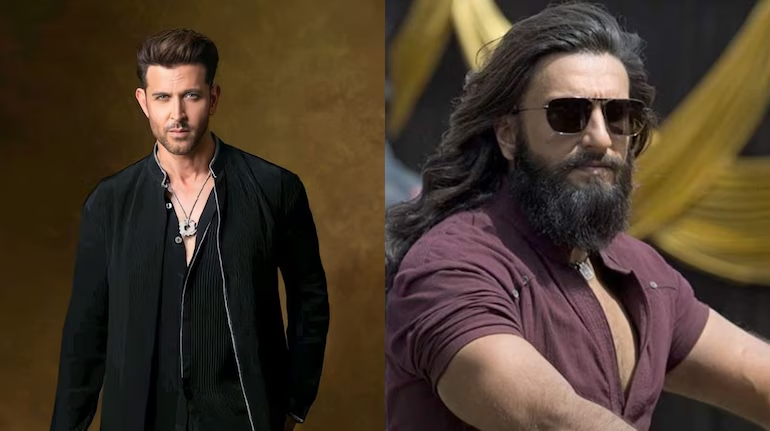
Hrithik Roshan, known for his candid presence on social media, found himself at the centre of controversy after sharing his thoughts on Ranveer Singh’s latest release, Dhurandhar. The actor had posted the film’s poster on Instagram, accompanied by a heartfelt note appreciating its cinematic craft.
“I love cinema, I love people who climb into a vortex and let the story take control, spin them, shake them until what they want to say is purged out of them onto that screen. DHURANDAR is an example of that. Loved the storytelling. It’s cinema,” he wrote.
However, it was the next part of his message that triggered a storm. Hrithik added, “I may disagree with the politics of it, and argue about the responsibilities us filmmakers should bear as citizens of the world. Nevertheless, can’t ignore how loved and learnt from this one as a student of cinema. Amazing.”
His remark about disagreeing with the “politics” of the film immediately drew sharp reactions online. Several social media users, many of them self-proclaimed fans flocked to the comments section demanding clarity on which aspects of the film’s political portrayal he found objectionable.
Some questioned his own choices as an actor, especially his association with YRF’s War franchise. Critics argued that movies like War and War 2 glamorise the world of intelligence operations while staying distant from real-world consequences.
A user challenged him directly and said, “Since when exposing Pakistan’s terrorism becomes ‘politics’ or are you trying to say what Pakistan has done with India is not an act of terrorism!!?”
Another wrote, “You disagree with the politics? The film showed terrorism exactly as it is. If that bothers you, maybe the problem isn’t the film’s politics but your interpretation.”
“You starred in Fighter and spewed the most corrbish jingoistic dialogues ever. Still you have the temerity to lecture others about politics and responsibility as film maker lol. Just shows you are insecure that someone else made a 1000 times better movie,” lashed out another user.
A Critical Perspective: Cinema, Sensitivity and Selective Framing
Hrithik Roshan’s remarks on Dhurandhar reignited debate around how Bollywood’s biggest stars portray and discuss terrorism. His comments may have been well-intentioned, but they raise important questions about responsibility, consistency and memory, especially given his own cinematic history.
While defending the idea that those who commit violent acts may be “misguided” or “manipulated,” Hrithik seems to overlook the portrayals he himself has participated in—portrayals that, at the time, drew both praise and critique for their simplification of terrorism and militancy.
Mission Kashmir (2000)
In Mission Kashmir, Hrithik Roshan plays Altaaf, a young boy who grows into a militant. The film repeatedly positions him within a narrative of victimhood shaped by personal trauma, but ultimately reduces a complex sociopolitical conflict to melodrama.
Critics argued that instead of genuinely exploring the radicalisation process, the film relied on spectacle—gunfights, emotional excess and stylised violence—to package militancy as cinematic drama rather than confronting its realities with nuance.
Fiza (2000)
In Fiza, Hrithik plays Amaan, who disappears and later returns as a man associated with extremist groups. The film attempts sympathy, suggesting circumstances “forced” him into violence. But again, the storyline wavers between justification and condemnation, offering neither a rigorous understanding of how radicalisation happens nor a responsible portrayal of its consequences.
Ironically, these very roles leaned heavily into the “misguided, brainwashed youth” trope that Hrithik now invokes publicly—except that, in film, such framing served commercial dramatic arcs rather than meaningful introspection.
When Reality Strikes: The 2000 Attack on Rakesh Roshan
Any discussion on Hrithik Roshan’s views on violent extremism cannot ignore a deeply personal and documented episode. In January 2000, his father, filmmaker Rakesh Roshan, survived an armed attack carried out by members of the Mumbai underworld.
This was not a theoretical debate on radicalisation; it was a real attempt on a family member’s life—an act of coercive violence by criminals who used intimidation and force as instruments of power.
Given this history, Hrithik’s eagerness to publicly soften or generalize motives behind violent actors—without simultaneously addressing accountability, victims or the impact on families—feels incomplete and, to some, insensitive.
Selective Sympathies and Public Responsibility
Hrithik Roshan, as a major public figure, holds significant influence. When he speaks about those who commit violence, his words must carry balance—acknowledging structural causes and the suffering endured by victims.
- Terrorism and extremist violence are not only the result of manipulation;
- They create permanent scars on communities, families and nations;
- And empathy must never dilute accountability.
When an actor who has portrayed militants on screen—and whose own family has been directly affected by violent crime—chooses to spotlight only the “misguided youth” narrative, it raises the question—Where is the equal empathy for victims?
Critiquing Hrithik Roshan is not an attack on his intentions. It is a call for consistency and depth—for recognition that discussions on extremism cannot be reduced to one-dimensional sympathy, whether in cinema or public discourse.
His lived experiences, his family history, and the influential stories he has told on screen give him the authority to speak—but they also demand that he speak responsibly, completely and with sensitivity to all sides of the issue.
Amid the online uproar, Hrithik returned to Instagram with a fresh appreciation post for Dhurandhar. This time, the actor highlighted the performances and creative contributions of Akshaye Khanna, Ranveer Singh, R Madhavan, and director Aditya Dhar, offering high praise for the film’s team.
While the new post was seen as an attempt to refocus the conversation on cinema rather than politics, the debate continues to swirl—with fans and critics alike dissecting both his words and the wider expectations placed on public figures in the age of social media.
Meanwhile, Dhurandhar has emerged as a refreshing and unapologetically bold entrant in Bollywood’s espionage genre, rejecting the glossy, larger-than-life formula that defined many of its predecessors.
Where earlier blockbusters leaned heavily on spectacle and glamour, Dhurandhar dives into the murky realism of intelligence work, crafting a narrative that feels grounded, tense, and psychologically layered.
The film does not rely on exaggerated heroism or romantic escapades to drive the story forward. Instead, it presents espionage as a world built on secrecy, sacrifice, and moral ambiguity, setting itself apart from the mainstream thrillers that dominated the decade.
Perhaps Dhurandhar’s most significant achievement lies in its refusal to underestimate its audience. Earlier spy blockbusters often overwhelmed viewers with style but underdelivered on substance. Dhurandhar instead trusts the audience’s ability to appreciate complexity, tension, and emotional nuance without needing constant bursts of glamour.
It’s storytelling respects the logic of espionage, the weight of geopolitical conflicts, and the psychological demands placed upon operatives. By grounding its story in these realities, it offers a more mature and resonant depiction of intelligence work.