
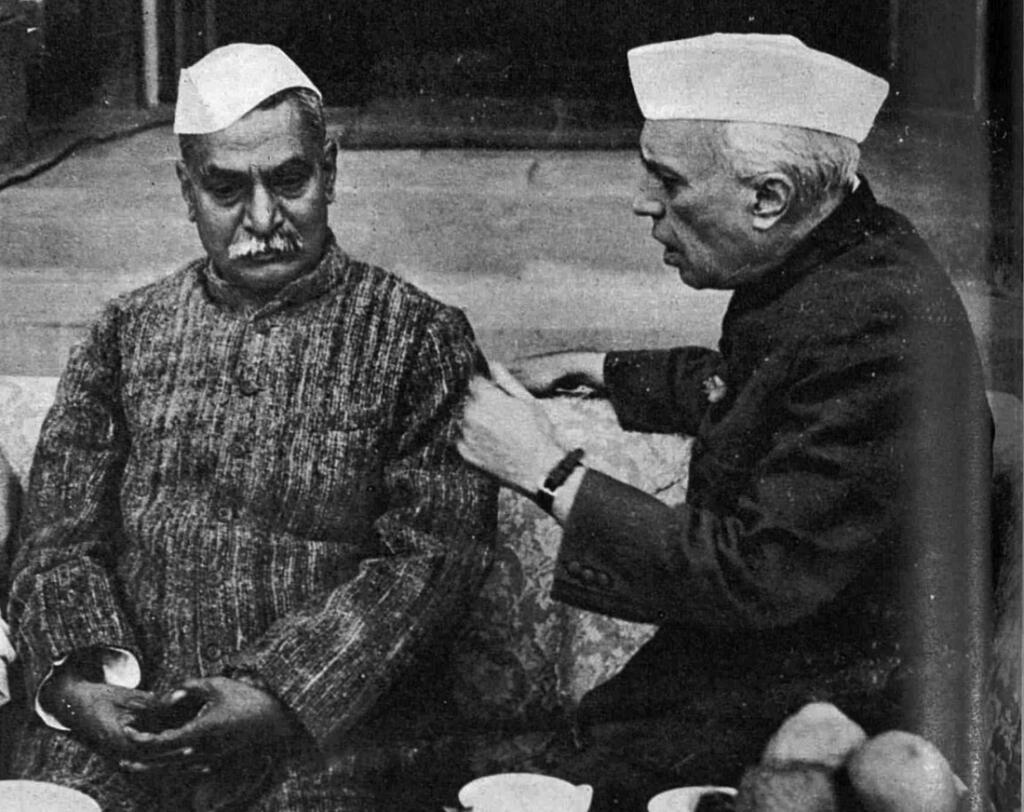
The birth anniversary of former President Dr Rajendra Prasad sparked a word of words between the ruling BJP and opposition Congress.
In such a situation, it becomes crucial to examine these claims carefully and present the truth before the public. Dr. Rajendra Prasad was not only the Chairman of the Constituent Assembly but also went on to become the first President of India — serving two consecutive terms
His contribution to India’s freedom and the shaping of a new nation is therefore undeniable. Yet, much like in the case of Sardar Patel, whenever the differences between him and Jawaharlal Nehru—particularly on matters of religion, culture, and civilizational identity—come to the surface, the Congress tends to bury or downplay them.
Was Nehru uneasy with leaders like Dr. Rajendra Prasad who refused to simply endorse his views and instead held an independent, principled stand?
Leaders whose understanding of religion and secularism was rooted not in Nehru’s ideological framework, but in India’s own cultural and democratic ethos?
The answers to all these questions emerge clearly in an interview given by Dr. Rajendra Prasad’s granddaughter Dr Tara- where she revealed how Pandit Nehru allegedly opposed Dr Rajendra Prasad becoming the President of India and his re-election.
“Dr Rajendra Prasad becoming the President of India is proof of that inherent strength of Indian democracy which, on several occasions, pushed back Nehru’s personal preferences and biases. In 1950, when he was chosen as interim President (and later for the first full term), Nehru was openly opposed to him.
Pressure was even exerted on Rajendra Babu to make him write a letter stating that he would not contest the election. But the firm support of senior Congress leaders and especially Sardar Patel foiled Nehru’s attempt.
Patel said clearly: “When the majority wants Rajendra Babu, why should one man’s stubbornness prevail?”
History repeated itself in 1957. This time Nehru wanted Dr. Radhakrishnan to become President and he tried to forcibly turn the matter into a North–South political issue. But leaders from the South too rejected that argument, saying: “This is a question of merit and stability, not of region.”
In the end, both times what happened is what the nation wanted—not what Nehru wanted.
The election of Rajendra Prasad shows that Nehru’s personal preferences could not always override national consensus. ”Nehru was against Dr Rajendra Prasad attending the Pran Pratishtha (consecration) ceremony of the Somnath Temple. “The ancient Somnath Temple was repeatedly destroyed during the invasions of Mahmud Ghazni, but after independence, Sardar Patel took a solemn vow to rebuild it, taking seawater in his hand as a symbol of his pledge. Mahatma Gandhi said that this temple should be built with public donations, not with government money. Accordingly, the Somnath Trust was formed, whose chairman was Kanhaiyalal Maneklal Munshi (K.M. Munshi).
By the time the temple was nearing completion and ready for consecration, Sardar Patel had already passed away. Now there was a need for a person who symbolized equality of all religions (sarva-dharma-sambhava) and could give the inauguration national dignity and prestige. There could have been no better face than Dr. Rajendra Prasad for this.
Munshi wrote him a letter, and Rajendra Babu gave a clear reply: “If I give my word, I will certainly come.” But this very decision was unacceptable to Jawaharlal Nehru. He formally raised an objection in writing, asking why the President of a “secular state” should attend such a programme. Nehru saw it in terms of “Hindu revivalism.” Yet Dr. Rajendra Prasad stood firm. His position was: “I visit churches, I visit mosques, I visit gurdwaras. Going to Somnath is no exception.”
In fact The temple had been built with public money, the Trust was independent, and two ministers of the central government were also members of that Trust. Therefore, Rajendra Babu clearly said: “There is no justification for this objection.”
Nehru even tried to suppress Rajendra Babu’s speech at the inauguration; no press note was issued and it was not allowed to be made public. In the same way, an attempt was made to prevent the publication of his famous speech.
This entire episode shows that the reconstruction of Somnath Temple was the result of the people’s faith, Sardar Patel’s resolve, and Dr. Rajendra Prasad’s steadfastness, not of Nehru’s wish or approval.”
Dr Tara also shared that in 1961, when Dr Prasad was seriously ill, Nehru even raised objections to the possible location of his samadhi (memorial), next to Raj Ghat.
“When Dr. Rajendra Prasad fell seriously ill, Nehru’s greatest worry was that he might pass away in Delhi—because if that happened, his samadhi (memorial) would have to be built right next to Mahatma Gandhi’s Raj Ghat, and Nehru absolutely did not want that.
Therefore, officials were instructed to select a location far from Delhi where his last rites could be performed. The site that was eventually chosen later became the place where Lal Bahadur Shastri’s last rites were also performed—today’s Vijay Ghat.
Even in Rashtrapati Bhavan, Rajendra Babu removed British-style customs and established Indianness—Indian food, Indian art, and Indian traditions. However, when he arranged for an aarti to be performed to welcome American President Dwight D. Eisenhower, the Prime Minister’s Office put a stop to the aarti. Rajendra Babu strongly objected, and in the end, the aarti was performed after all.
Dr. Rajendra Prasad was a symbol of the free Indian soul, and Nehru is often seen trying-on several occasions-to suppress that very soul.”
It is painful to hear these facts, but it is necessary to share them because the sense of entitlement that we see in the Gandhi family today had its beginnings in the Nehru era itself, and the Congress party has repeatedly insulted our constitutional positions and institutions.
Tuhin Amar Sinha is a national spokesperson of the Bharatiya Janata Party (BJP) and an Indian author known for his political thrillers, romance novels, and non-fiction books.