
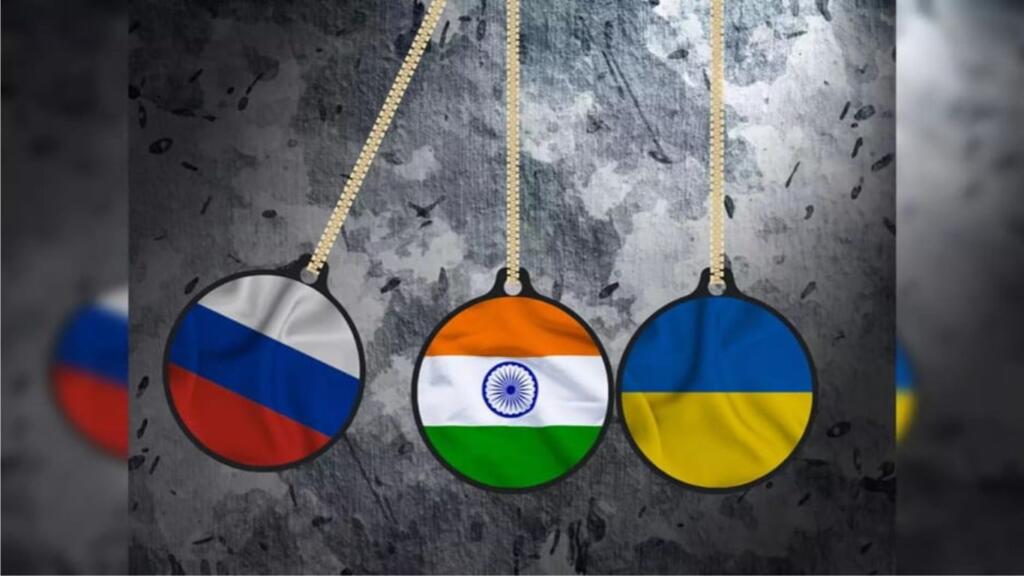
The West tried to turn India into an anti-China proxy using NGOs, media, opposition parties, retired officials, academics and economic coercion—the same playbook that captured Ukraine. But India’s civilizational nationalism, strong leadership and strategic autonomy smashed this operation. Unlike Western-manipulated proxies, India refused subordination and emerged as an independent geopolitical pole the West cannot control.
For more than a century, Western powers have built and deployed a massive geopolitical machinery designed to create proxies, buffer states, and frontline warriors to fight their strategic battles. From Latin America to the Middle East, from Africa to Eastern Europe, the United States and Europe have repeatedly used psychological conditioning, money, NGOs, media, international institutions, military aid, and diplomatic coercion to manufacture compliant governments and weaponise them against rival powers.
In Asia, the West expected India—given its border challenges with China, rising global status, and economic dependencies—to become an ideal instrument in a renewed Cold War. Yet India did something extraordinary: it refused, resisted, and ultimately dismantled the Western attempt to convert it into a geopolitical pawn. This essay examines how the West creates proxies, why India became the exception, and what this reveals about civilizational resilience in global politics.
I. The Western Architecture of Proxy Creation: A Century of Patterned Interventions
The West’s proxy-making system has operated in a predictable, repeatable pattern across continents. This architecture relies on six primary tools:
1. Psychological Manipulation and Narrative Engineering
Western strategic planners understand that political shift begins with mental occupation, not military force. The pattern includes:
- shaping elite opinion through Western academia, scholarships, conferences;
- infiltrating media with “democracy promotion” narratives;
- producing documentaries, reports, and editorials framing desired political outcomes as moral imperatives;
- amplifying grievances to weaken nationalist leaders and promote Western-friendly figures.
This psychological ecosystem was central to operations in:
- Iran (1953)—media campaigns branded Mossadegh “incompetent”;
- Chile (1973)—Allende was framed as authoritarian through press manipulation;
- Ukraine (2004 & 2014)—Western-funded media and NGOs mobilised protests and delegitimized elected governments;
- Serbia (2000)—the OTPOR movement, funded and trained by Western foundations, was used to unseat Milošević.
2. Money, Election Financing, and NGO Penetration
Billions of dollars flow every year from USAID, NED, Open Society Foundations, European political foundations, and missionary-linked NGOs. These shape:
- opposition ecosystems,
- civil society mobilization,
- academic research,
- activist groups,
- legal warfare through PILs,
- environmental activism used to block strategic national projects.
In Ukraine alone, over $5 billion (as acknowledged by U.S. Assistant Secretary Victoria Nuland) was spent on “civil society strengthening” before the 2014 Maidan.
3. Military Aid, Alliances, and Defense Dependency
Military entanglement is a classic method of control:
- NATO expanded into Eastern Europe, turning Poland, Romania, Baltic states into frontline deployment zones.
- Pakistan became a U.S. proxy during the Soviet–Afghan war.
- South Korea and Japan were locked into long-term U.S. military dependence.
- Ukraine received training, weapons, and doctrinal conditioning, making it increasingly aligned with U.S.-NATO military thinking.
4. Economic Lures and Debt Entrapment
The IMF, World Bank, WTO, and Western credit-rating agencies form a powerful coercive bloc. Their tools include:
- structural adjustment programs forcing policy alignment;
- debt conditionalities demanding privatization, deregulation, and Western corporate entry;
- currency downgrades to destabilize stubborn governments;
- trade sanctions to punish geopolitical non-alignment.
Latin America, Africa, and Eastern Europe suffered these pressures repeatedly from the 1960s to the 2000s.
5. Corrupting Local Elites
Western intelligence and diplomatic circles historically cultivated:
- pliant bureaucrats,
- military officers,
- judges,
- journalists,
- academics,
- religious leaders,
- business oligarchs,
often through:
- overseas fellowships,
- financial incentives,
- foreign real estate or bank accounts,
- influence-peddling networks,
- and political consulting firms.
Many coups in Africa and South America succeeded because generals and judges received Western backing.
6. Use of International Institutions as Weapons
The West’s dominance in global institutions turns them into tools of coercion:
- UN resolutions target non-Western adversaries.
- ICJ judgments routinely favour Western allies.
- IMF/WB loans enforce policy alignment.
- WTO disputes weaken non-Western industrial growth.
All these mechanisms are used to pressure governments into becoming submissive partners.
II. How These Tools Worked in Ukraine—But Failed in India
The contrast between Ukraine and India reveals the limits of Western influence.
A. Ukraine: A Textbook Western Proxy
Ukraine’s institutions were penetrated by Western NGOs, media networks, and foreign-funded civil society for nearly 25 years.
- Western advisors shaped economic policies.
- NATO trained military structures.
- Media promoted Euro-Atlantic identity.
- Opposition movements received Western funding.
- IMF loans dictated reforms.
By 2022, Ukraine had been transformed into a strategic forward operating buffer—a frontline proxy in the U.S.-Russia confrontation. Russia’s invasion was brutal and unjustifiable, but the environment that led to war was heavily engineered by Western influence.
III. India: The Civilizational State That Broke the Western Playbook
1. A Nationalist Government That Reads Western Intentions Clearly
India’s leadership—political, diplomatic, and strategic—correctly interpreted Western goals:
- pull India into an anti-China containment architecture,
- use India as the Asian Ukraine,
- weaken India’s ties with Russia,
- and subordinate Indian foreign policy under Western ideological frameworks.
Instead, India:
- refused anti-China military alliances,
- refused sanctions on Russia,
- refused NATO-like structures,
- refused Western pressure tactics,
- refused to abandon economic autonomy.
2. India’s Political Maturity and Electoral Stability
Unlike Ukraine’s volatile politics, India has:
- strong majority governments,
- stable leadership,
- a 70-year-old constitutional tradition,
- a 10,000-year civilizational memory.
This makes psychological penetration extremely difficult.
3. Resistance from Indian Society and Civilizational Identity
India’s society is not culturally engineered by Western frameworks. It has:
- deeply rooted nationalist sentiment,
- civilizational pride,
- skepticism of Western moral superiority,
- cultural memory of colonialism.
This immunizes the population against Western ideological manipulation.
4. Regulatory Walls Against NGO and Religious Interference
The Indian state correctly identified foreign-funded NGOs as political instruments.
FCRA enforcement cut off thousands of Western influence nodes:
- political NGOs,
- environmental disruptors,
- religious conversion networks,
- rights lobbies aligned with foreign states.
This closed the very channels that toppled governments elsewhere.
5. Neutralising Western-Aligned Domestic Actors
India faced:
- opposition parties seeking Western validation,
- retired bureaucrats acting as NGO advisors,
- Western-trained academics hostile to Indian nationalism,
- activist judges,
- media outlets echoing Western lines.
But none of these groups had the institutional leverage to sabotage national strategy. Public distrust of Western narratives further insulated India.
6. Strategic Autonomy as a National Doctrine
India’s refusal to join military blocs dates back to 1947.
This tradition—non-alignment, multipolarity, self-interest—continues under:
- Vajpayee,
- Manmohan Singh,
- Narendra Modi.
India plays all sides:
- partners with the U.S.,
- buys weapons from Russia,
- manages competition with China,
- works with the Gulf,
- integrates with Africa and ASEAN,
- leads the Global South.
This independence is impossible to penetrate.
IV. Conclusion: India as the Anti-Proxy State
The Western proxy machine—which successfully converted dozens of states into buffers, pawns, and frontline warriors—hit a civilizational wall in India.
Neither NGOs, nor media, nor academic influence, nor economic threats, nor diplomatic coercion worked. India did not fracture, did not submit, and did not become a subcontractor for Western hegemonic calculations.
Instead, India emerged as a sovereign geopolitical pole—courted by all sides, controlled by none.
Where other nations became proxies, India became a civilizational counterweight to the West’s psychological, institutional, and geopolitical manipulation.