
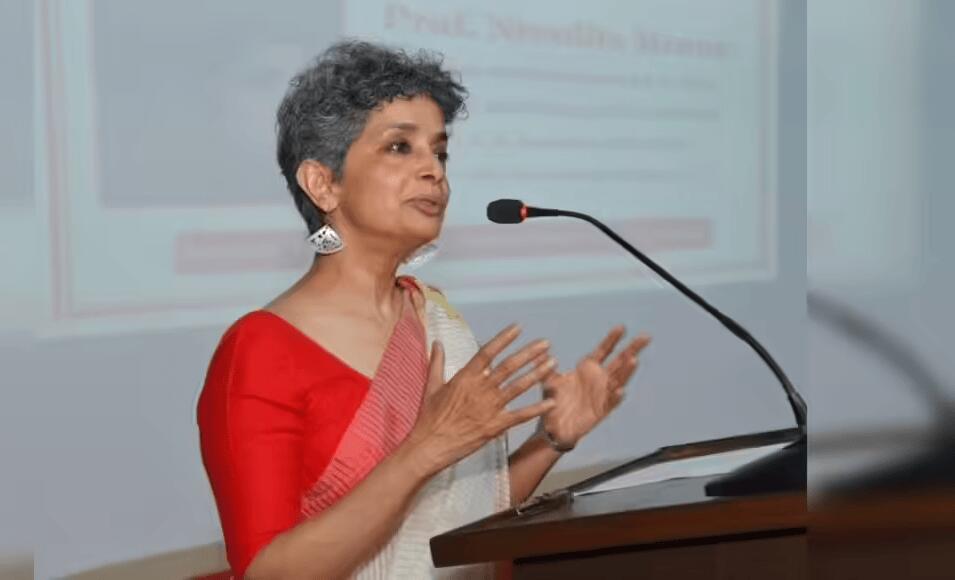
Nivedita Menon, a Communist professor from Jawaharlal Nehru University (JNU), has always been a contentious figure, known for her vocal antagonism towards the Indian state, particularly her inflammatory claim that India “illegally occupies Kashmir.” Recently, this staunch ideologue retired and was met with an emotional farewell from like-minded Comrade students who see her as a champion of their cause. The celebration of such a divisive personality raises serious questions about patriotism, academic responsibility, and the boundary between dissent and outright betrayal.
The core issue is stark and simple. How can a professor who openly supports the secessionist narrative on Kashmir—an integral and legally undisputed part of India—be honored so lavishly within a prestigious institution? This is not mere academic freedom or an expression of dissent; it is an outright attack on national unity. By stating that India “illegally occupies Kashmir,” Nivedita Menon contradicts the constitutional fabric and sovereignty of India. Yet, she is embraced and celebrated by students who evidently align with her dangerous ideology, glorifying separatism and undermining national integrity.
Academic platforms like JNU have earned a reputation for nurturing free thought, but there is a critical difference between fostering critical inquiry and promoting anti-national rhetoric. Menon’s views do not qualify as intellectual debate; they cross the line into treasonous propaganda. Her ideology is a direct challenge to India’s territorial sovereignty and fuels separatist sentiments that have long caused conflict, suffering, and instability in Kashmir and beyond. The fact that she received an emotionally charged farewell from students echoes how deep these extremist beliefs have penetrated the academic culture.
It is alarming that an educational institution, funded largely by the nation and meant to cultivate responsible citizens, allows itself to become a breeding ground for secessionist propaganda masquerading as scholarship. Instead of fostering knowledge that strengthens the nation, professors like Nivedita Menon use their platforms to legitimize narratives that seek to fragment the country. This scenario undermines the very purpose of education and breeds a dangerous culture where disloyalty and antipathy toward the nation is applauded rather than condemned.
Further, the emotional farewell lavished on Nivedita Menon by Comrade students highlights the normalization of radical left-wing ideologies that celebrate anti-nationalism under the guise of “academic freedom.” This is nothing but ideological indoctrination masked as student solidarity. Instead of being held accountable for advancing divisive propaganda, such figures are rewarded and lionized. This environment encourages young impressionable minds to adopt extremist positions that threaten social cohesion and fuel internal strife.
The question also arises about the responsibility of universities and the government in such a scenario. Should institutions that openly glorify treason and secessionism be allowed to thrive unchecked within India’s higher education system? The government and university authorities must take a firm stand against the creeping acceptance of narratives that delegitimize India’s sovereignty. The emotional farewell to Nivedita Menon was not just a celebration of a retiring professor but a blatant endorsement of anti-national ideology. This must be challenged decisively lest it become a larger cancer within India’s academic institutions.
India’s Kashmir policy and territorial integrity are legally and historically sound. The Constitution of India explicitly includes Kashmir as an inseparable part of the nation. To deny this is to deny the rule of law, the democratic framework, and the sacrifices made by countless individuals for the unity of India. Professors and intellectuals have an obligation to uphold these principles, not undermine them. Nivedita Menon’s rhetoric is far from intellectual rigor; it is destructive activism aimed at destabilizing the country.
It is crucial that public discourse recognizes the difference between genuine criticism and seditious speech. While dissent is essential in any democracy, it must operate within the domain of patriotism and constructive engagement. Writing off Kashmir as “occupied” territory is not criticism; it is a call to fracture the nation that is nothing less than sedition. Celebrating Menon’s retirement thus sends a dangerous message to society and students that treason disguised as academic opinion is acceptable.
The farewell of Nivedita Menon, therefore, should be seen as a wake-up call to the citizens and authorities of India. How can a person who distorts facts, promotes divisiveness, and supports separatism be glorified while genuine patriots face constant scrutiny? It is a reflection of a troubling rift in the country’s academic and intellectual landscape where loyalty to India is becoming secondary to political ideology. This trend must be reversed with firm policies, clear academic codes of conduct, and uncompromising rejection of anti-national narratives.
In conclusion, the emotional send-off for Nivedita Menon, a professor who perpetuates the false narrative of Kashmir’s illegal occupation by India, represents a dangerous celebration of treason within our universities. It exposes how extremist ideologies are gaining traction in academic spaces meant to protect India’s unity and sovereignty. The time has come for institutions, governments, and civil society to reject glorifying such subversive views and ensure that education fosters patriotism, critical thinking aligned with national interest, and respect for constitutional integrity.
India cannot afford to give a platform or applause to those who undermine its territorial sovereignty and national pride. The farewell given to Nivedita Menon is not only inappropriate but a national embarrassment. True academic freedom lies in strengthening the nation, not betraying it under the banner of ideological dogma. Only with such clarity can India sustain its unity and integrity in challenging times.