
























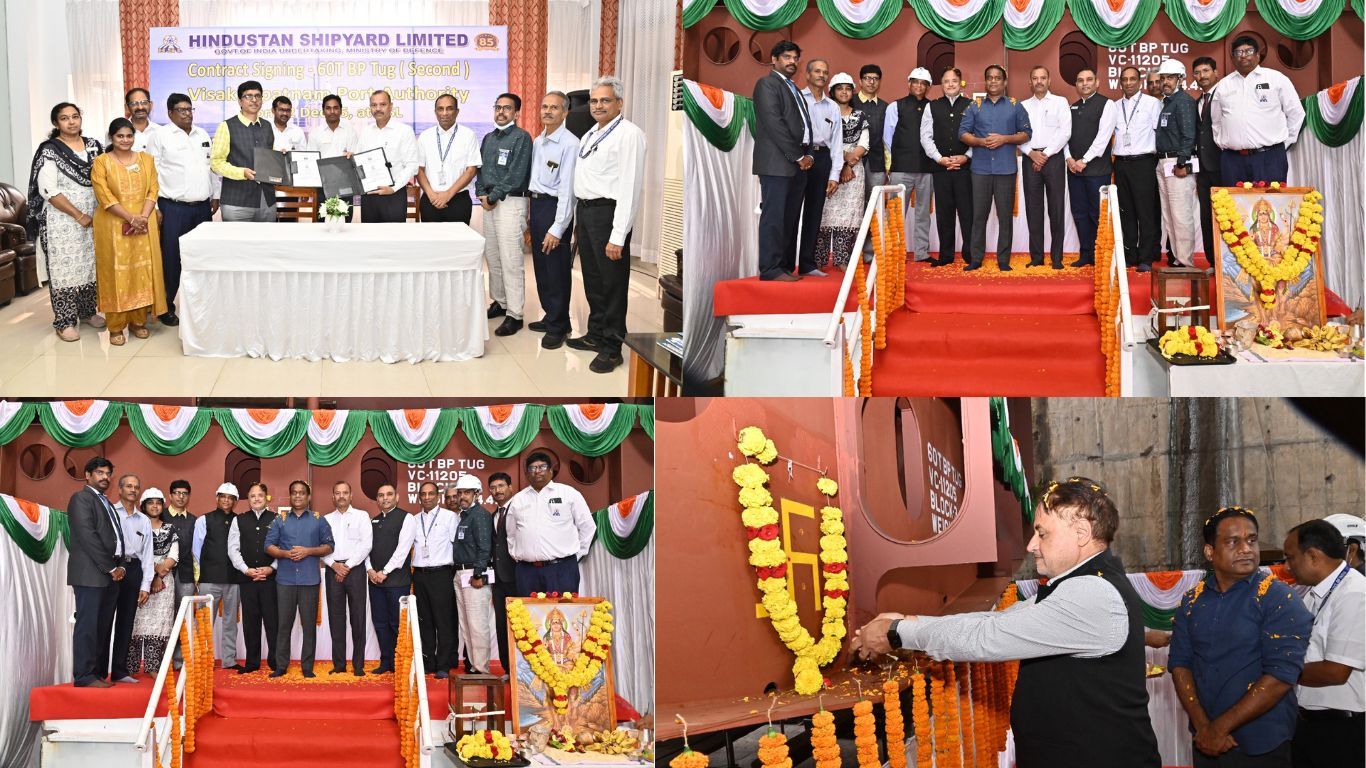
Hindustan Shipyard Limited (HSL) on Monday (December 22) marked two significant milestones in an indigenous harbour craft programme for the Visakhapatnam Port Authority, emphasising the growing role of domestic shipyards in strengthening India’s maritime infrastructure.
The developments included the keel laying of the first 60-ton Bollard Pull (BP) tug and the signing of a contract for a second vessel of the same class. Both tugs are being designed and built in India at HSL’s Visakhapatnam facility, reinforcing the shipyard’s position in specialised support vessels that are critical to port operations but often remain outside public attention.
Harbour tugs form the backbone of daily port activity. They assist large commercial vessels during berthing and unberthing, provide towing support within confined harbour limits, and play a key role in emergency response. As vessel sizes increase and traffic density rises at major ports, the demand for high-capacity tugs has grown steadily.
The 60T BP tug, with an overall length of 32.5 metres, has been designed for demanding operational conditions. Higher bollard pull enables greater control over ship movement, particularly during adverse weather or peak congestion. Port-sector professionals note that such capabilities directly affect safety margins, berth utilisation, and vessel turnaround time.
For Visakhapatnam Port, one of India’s key gateways on the eastern seaboard, fleet modernisation has become closely linked to future growth. Officials have indicated that, alongside investments in terminals and connectivity, attention is increasingly turning to auxiliary marine assets that enable smooth and safe port functioning.
Addressing the gathering, Visakhapatnam Port Authority Chairperson Dr Madhaiyaan Angamuthu emphasised the importance of timely execution and consistent quality in sustaining institutional partnerships. He indicated that with cargo volumes expected to grow further, modern support vessels would be essential to meeting operational targets while maintaining safety standards.
From the shipyard’s perspective, the twin milestones were presented as evidence of HSL’s technical capability, delivery performance, and project management strength. The shipyard also acknowledged the contributions of its technology partners, Vedam and Solas Marine, to the tug programme.
Beyond operational outcomes, harbour craft projects carry wider strategic relevance. For public sector shipyards, such programmes provide continuity of work between larger naval contracts, support skilled employment, and sustain domestic vendor ecosystems, including MSMEs. They also reduce reliance on imported designs in a segment that is operationally critical for ports.
The tug programme aligns with broader national objectives of strengthening indigenous maritime capability under Maritime India Vision 2030 and the self-reliance push under Aatmanirbhar Bharat.
As India’s ports prepare for higher traffic and more complex operations, projects such as these point to a quieter but essential layer of maritime capacity-building—one where indigenous shipbuilding directly supports national logistics and trade resilience.





