
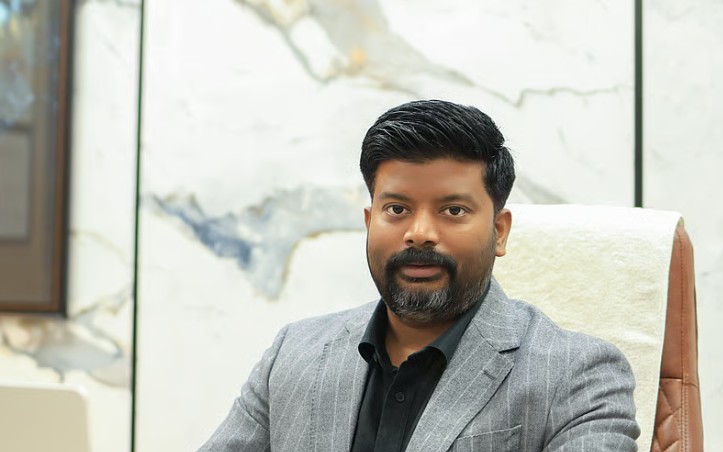
The story of Shravan Kumar Vishwakarma does not begin in boardrooms or business schools. It begins on the streets of Kanpur, in a middle-class household where life unfolded quickly and choices were shaped more by circumstance than planning. His journey from driving tempos to founding an airline is not just about business growth, but about instinct, faith, and perseverance.
A Beginning Far from Classrooms
Shravan Kumar Vishwakarma’s formal education was brief. Friends, surroundings, and a lack of interest in academics pulled him away from school at a young age. Work came early, and with it, responsibility.
Through an acquaintance, he began driving a tempo. Travelling across cities by bicycle, bus, train, and truck exposed him to the realities of everyday India. Those years, he says, became his real education, shaping his understanding of people, struggle, and opportunity.
Shravan shared about his early life with PTI, and said, “My formal schooling was very brief—partly because of my friends and partly because I wasn’t very interested at that time. Through an acquaintance, I began driving a tempo, and later tried a few businesses with friends, though those didn’t work out. Around 2014, I entered the cement sector, followed by TMT steel and mining. Transport came next, and today that journey has grown into a fleet of around 400 to 450 trucks. People kept coming into my life, and the journey kept taking shape—I never realised when, where, or how it all happened. It was God’s plan that everything aligned. None of this was planned or pre-decided.”
“Moving into aviation started as a thought. I strongly believe aviation will see significant growth in the near future, which is why I chose this path. One of the biggest strengths of this business is that cashflow remains well managed, as there is no dependence on lending or borrowing. In my view, many businesses struggle because excessive credit disrupts cashflow. Another advantage is the relatively low level of competition, which improves your chances of survival—though ultimately, success depends on how you execute and on your mindset and long-term vision,” he said.
Early Failures and Hard Lessons
His first attempts at business, started alongside friends, were unsuccessful. The failures were disappointing, but not defining. Instead of retreating, Vishwakarma chose to recalibrate.
Around 2014, he entered the cement business. This was followed by TMT steel, mining, and eventually transportation. Each move was organic, driven by opportunity rather than a rigid plan. One venture led naturally into another, slowly building momentum.
“Log milte gaye, karwaan banta gaya. Pata hi nahi chala log kab, kahan, kaise mile. Sab bhagwan ka plan tha,” he reflected.
Building a Transport Empire
What remained constant through his growth was discipline, especially around cashflow. Vishwakarma believes that many businesses struggle not due to lack of demand, but because excessive lending and borrowing disrupt financial stability.
His focus on maintaining clean cashflow allowed his ventures to scale steadily. Over time, his transport operations expanded into a fleet of nearly 400 to 450 trucks, establishing him as a major logistics and materials entrepreneur in Uttar Pradesh.
The Idea that took Flight
A few years ago, as his core businesses stabilized, Vishwakarma began looking ahead. He wanted to enter a sector with long-term growth and relevance. Aviation stood out.
With rising incomes and increasing time sensitivity among travellers, flying was becoming a necessity rather than a luxury. Yet during his own travels, he noticed a lack of reliable and affordable airline options for middle-class passengers, particularly from Tier-2 and Tier-3 cities.
“I felt aviation will be big in the near future,” he says. “There was a clear gap, and that’s where the idea started.”
The Birth of Shankh Air
That insight led to the creation of Shankh Air. In a major milestone, the airline recently received a No Objection Certificate from the Ministry of Civil Aviation, becoming the first new airline to receive approval under the government’s current expansion initiative.
Civil Aviation Minister K. Rammohan Naidu confirmed the development following meetings with aspiring airline operators, including Al Hind Air and FlyExpress, both of which have also secured approvals. The move comes at a time when India’s aviation market is witnessing rapid growth, alongside concerns over limited competition.
Who Owns Shankh Air
Shankh Air is owned and founded by Shravan Kumar Vishwakarma, who serves as the Chairman and Managing Director of Shankh Aviation Private Limited. He is also the owner of Shankh Agencies Private Limited, incorporated in 2022, with interests spanning building materials, ceramics, concrete, and wholesale trade.
His expansion into aviation marks a significant shift from traditional industries into one of India’s fastest-growing sectors, backed by operational experience and financial discipline.
Preparing for Takeoff
Flight operations for Shankh Air are expected to begin in the first quarter of 2026. Aircraft are currently undergoing technical evaluations and delivery preparations. The airline plans to operate out of Lucknow, Jewar Airport in Noida, and New Delhi, positioning itself as Uttar Pradesh’s first home-grown airline.
The leadership team includes directors Anurag Chhabra and Kaushik Sengupta, adding depth to its strategic and operational planning.
Challenging a Duopoly
India’s domestic aviation market is currently dominated by IndiGo and the Air India Group, which together control over ninety per cent of the market. While this dominance has limited competition, it has also opened doors for focused, region-centric carriers.
“There is less competition in this business,” Vishwakarma observes. “That increases your chances of survival. But in the end, it depends on your mindset, vision, and how you execute.”
Shankh Air aims to position itself as an affordable, region-focused airline, competing with established players such as IndiGo and SpiceJet while improving connectivity across underserved routes.
A Symbol of Aspirational India
From driving tempos in Kanpur to preparing an airline for takeoff, Shravan Kumar Vishwakarma’s journey reflects the changing face of Indian entrepreneurship. It is a story shaped by persistence rather than privilege, and by belief rather than planning.
As Shankh Air prepares to enter Indian skies in 2026, it stands as more than just a business venture. It stands as proof that with vision, discipline, and faith, even the most modest beginnings can rise to extraordinary heights.