
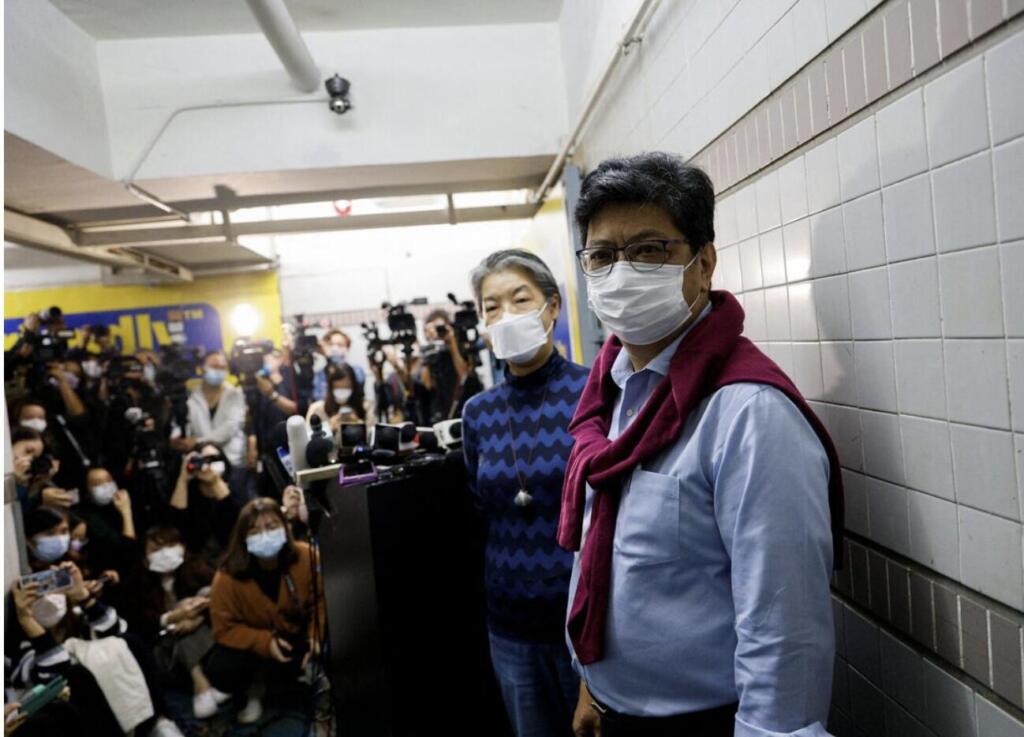
In late December 2021, Stand News disappeared from the internet in a matter of hours. Police officers had raided its newsroom, arrested senior staff, seized journalistic material and frozen its assets. By the end of the day, the site’s archives were gone, its social media erased, its operations terminated.
Four years on, the immediate shock has faded, although the consequences have not.
What followed the closure of Stand News was not a dramatic wave of new arrests or an explicit ban on journalism. Instead, Hong Kong’s media environment entered a quieter phase—one defined less by confrontation than by retreat. The most lasting effect of the crackdown has been the absence it produced: of voices, of investigations, of the kind of reporting that once distinguished the city from the rest of China.
In the days after Stand News shut down, Citizen News, another independent outlet, announced it would close voluntarily. Others recalibrated. Some scaled back political coverage. Some softened language. Some abandoned investigative work altogether. None needed to be told to do so. The message had already been delivered.
The chilling effect did not arrive through new regulations alone. It emerged through example. The Stand News case showed how quickly an outlet could be dismantled using arrests, asset freezes and legal uncertainty. It demonstrated that professional conduct, non-profit status and years of public-facing journalism offered no protection once political red lines were deemed crossed.
For journalists still working in Hong Kong, that lesson has shaped daily decisions ever since. Editors speak of weighing not just the public value of a story, but its potential legal and personal cost. Reporters describe narrowing their focus, avoiding certain topics, and limiting contact with sensitive sources. Stories that might once have been pursued now die at the pitch stage.
This is not censorship in the traditional sense. There are no daily lists of forbidden headlines. Instead, uncertainty does the work. The boundaries of permissible reporting are deliberately vague, defined retrospectively rather than in advance. When enforcement is swift and penalties severe, caution becomes rational.
The impact is visible in the media landscape itself. Over the past four years, Hong Kong has lost much of the diversity that once characterised its press. Independent outlets have closed or fallen silent. Remaining publications operate in a tighter corridor, where commentary is carefully calibrated and investigative reporting is rare. International press freedom rankings reflect this transformation, charting a steep decline from the city’s earlier standing as a regional media hub.
Also Read: London is benefitting at Hong Kong’s expense as Hongkongers flock to buy properties in the city
Officials continue to insist that press freedom remains protected under the law, provided it is not abused. But the lived reality for journalists suggests a different equilibrium. Freedom exists formally, but is exercised sparingly. The risk of miscalculation is too high.
What makes the Stand News episode enduring is not only what it removed, but what it replaced. In place of open debate, there is restraint. In place of pluralism, uniformity. In place of a press that tested power, one that increasingly avoids it.
Four years later, the most striking feature of Hong Kong’s media environment is not the presence of repression, but the normalisation of fear. It has been absorbed into newsroom routines and editorial judgements. It shapes what is written, and more importantly, what is not.
The closure of Stand News marked a turning point not because it was the first such action, but because it clarified the direction of travel. It showed that independent journalism could be extinguished without prolonged legal battles or explicit bans, and that the resulting silence would largely sustain itself.
Time has not softened that lesson. If anything, it has entrenched it. Four years on, Hong Kong’s newsrooms still operate under its shadow— quieter, narrower, and more cautious than before.