



















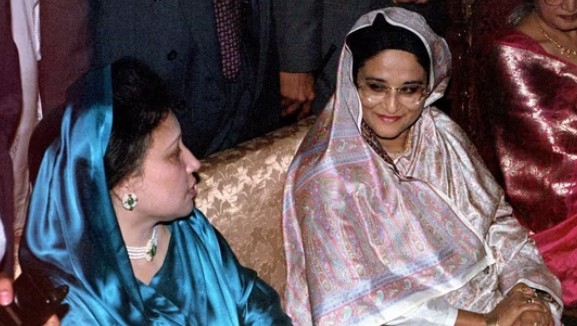
Former Bangladesh Prime Minister Sheikh Hasina has expressed deep sorrow over the passing of BNP Chairperson and former Prime Minister Begum Khaleda Zia, calling her death a significant loss to the nation’s political life.
Describing her passing as a profound loss for both Bangladesh’s political landscape and the Bangladesh Nationalist Party, Sheikh Hasina prayed for the eternal peace and forgiveness of the departed leader’s soul.
In a post on X, the Awami League said, “Sheikh Hasina expresses condolences on the passing of Begum Khaleda Zia. I extend my deepest condolences on the passing of BNP Chairperson and former Prime Minister Begum Khaleda Zia. As the first woman Prime Minister of Bangladesh, and for her role in the struggle to establish democracy, her contributions to the nation were significant and will be remembered. Her passing represents a profound loss for Bangladesh’s political life and for the leadership of the Bangladesh Nationalist Party.”
She also extended her sincere condolences to Khaleda Zia’s son, Tarique Rahman, her bereaved family members, and the wider BNP fraternity. Sheikh Hasina expressed hope that Almighty Allah grants them patience, strength and comfort during this difficult time.
“I pray for the eternal peace and forgiveness of Begum Khaleda Zia’s soul. I convey my sincere sympathies to her son, Tarique Rahman, and to the members of her bereaved family. I also extend my condolences to the wider BNP family. I hope that Almighty Allah grants them patience, strength, and comfort to endure this difficult time,” she added.
Bangladesh Mourns for Khaleda Zia
Bangladesh is observing a period of mourning following the death of former Prime Minister and BNP Chairperson Begum Khaleda Zia. The Bangladesh Nationalist Party (BNP) has announced seven days of official mourning, during which black flags will be flown at its central office in Nayapaltan, Dhaka, as well as at party offices across the country.
Party leaders, workers and supporters will wear black badges, while doa mahfils (prayer gatherings) and Quran recitations are being organised at BNP offices and other locations nationwide. Condolence books have been opened at the party’s central office, Khaleda Zia’s Gulshan residence in Dhaka, and district-level offices, allowing members of the public to pay their respects.
The End of the “Battle of the Begums”
For more than three decades, Bangladesh’s political landscape was dominated by an intense and deeply personal rivalry between Sheikh Hasina of the Awami League and Khaleda Zia of the BNP—a confrontation widely known as the “Battle of the Begums.”
Both leaders inherited powerful political legacies shaped by tragedy. Sheikh Hasina emerged from the Awami League founded by her father, Sheikh Mujibur Rahman, who was assassinated in 1975.
Khaleda Zia led the BNP, established by her husband, President Ziaur Rahman, who was assassinated in 1981. Their rivalry came to define Bangladesh’s politics, often polarising the nation and shaping its governance for decades.
Bangladesh Under Khaleda Zia’s Leadership
Khaleda Zia became Bangladesh’s first female Prime Minister in 1991 after the BNP won the national elections. During her two major tenures—from 1991 to 1996 and from 2001 to 2006—her governments introduced significant reforms.
These included restoring the parliamentary system in place of presidential rule, liberalising the economy by easing restrictions on foreign investment, and prioritising education through free and compulsory primary schooling, with special emphasis on expanding access to education for girls.
These policies contributed to rising literacy rates, increased participation of women in the workforce—particularly in the garment sector—and overall economic growth. However, her later years in office were marred by allegations of widespread corruption, the rise of Islamist extremism, and escalating political violence, according to multiple reports.
Final Years and a Changing Political Landscape
Born in 1945, Khaleda Zia battled multiple serious health conditions for years, including liver cirrhosis, diabetes, heart disease and lung complications. During Sheikh Hasina’s tenure, she spent extended periods under house arrest or in prison on corruption charges.
She was released after Hasina fled to India in August 2024 but eventually succumbed to her illnesses on December 30, 2025, at the age of 80.
With Sheikh Hasina now living in exile in India—after being sentenced to death in absentia for crimes against humanity related to the 2024 crackdown—and Khaleda Zia’s passing, the long chapter of the “Battle of the Begums” has come to an end.
Bangladesh now finds itself at a pivotal moment, governed by an interim administration tasked with navigating political reforms and economic pressures. As the country mourns one of its most influential leaders, it also confronts the challenge of moving beyond decades of polarised leadership toward a more inclusive and stable democratic future.





