
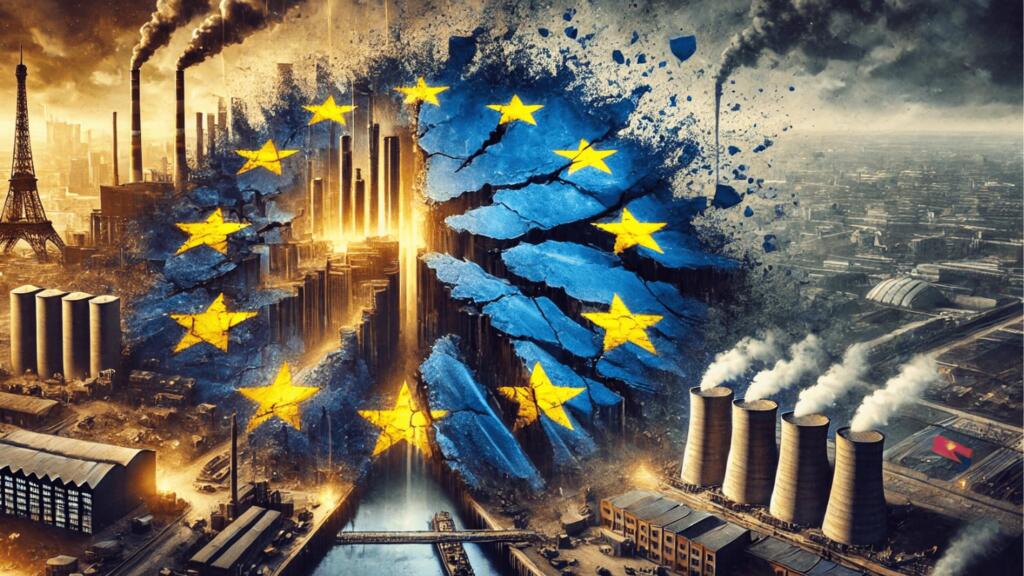
Europe once stood at the centre of global power, its wealth built on colonial extraction, industrial strength and favourable trade dynamics. But by 2025, many of those historic pillars are weakening. As the residual advantages of colonial-era accumulation fade, and geopolitical realignments reshape global markets, the European Union finds itself adopting policies that strain — rather than support — its economic and strategic foundations. A slow, structural decline is unfolding across the continent.
Shock That Remade Europe’s Economy
For decades, Europe’s industrial engine ran on the reliability of inexpensive Russian gas. The pipelines feeding its factories and households formed the backbone of a stable energy architecture. That framework fractured in 2022. Sweeping EU bans on Russian energy cut imports from a level once exceeding 40% to barely 4–11% by 2023.
The bloc has committed to ending Russian gas imports entirely by 2027, replacing pipeline supplies with costlier liquefied natural gas from the United States, along with increased imports from Norway and North Africa. The shift has forced both households and industries into an era of higher energy costs. With more than half of the EU’s energy consumption still dependent on imports, the consequences have been severe.
Energy-intensive sectors such as chemicals, steel and manufacturing face shrinking profit margins, delayed investments and job relocations. Governments are under pressure to subsidise energy bills, straining public finances already stretched by post-pandemic demands.
A Supply Chain Model Under Strain
Europe’s development model relied on importing inexpensive raw materials and exporting high-value finished products. That formula is under unprecedented strain. Resource nationalism, shifting global alliances and competition for critical minerals have narrowed Europe’s access to affordable inputs.
The EU’s response — through the Critical Raw Materials Act and the Re-Source Europe strategy — highlights the continent’s growing anxiety over supply vulnerabilities. But supplier countries are now insisting on higher prices, local processing and new trade conditions that challenge Europe’s traditional role as a global processing and manufacturing hub. No longer able to leverage the old patterns of influence and extraction, Europe finds itself negotiating from a weaker position.
Fiscal Stress and the Hollowing of the European Core
Economic pressures are visible across eurozone finances. Public deficits are projected to rise from around 3.1% to 3.4% of GDP by 2027. Debt levels, which briefly fell after the pandemic, are climbing again in many countries, approaching or exceeding 90% of GDP.
Defence spending has surged in response to geopolitical tensions, forcing governments to redirect funds away from welfare and public investment. Meanwhile, industrial slowdowns — particularly in Germany, the continent’s manufacturing anchor — threaten Europe’s export capacity. The combination of rising welfare burdens, shrinking industrial output and persistent debt signals not a temporary slump but a structural weakening of the economic core.
Social Unrest as a Barometer of Discontent
Across Europe, public anger is spilling onto the streets. Farmers, factory workers and small business owners have staged protests in France, Germany, Czech Republic, Poland and beyond, driven by rising energy costs, inflation and what they view as suffocating regulation.
In Greece, demonstrations have erupted over subsidy scandals and agricultural distress. Bulgaria has seen repeated protests over taxation and governance issues tied to economic slowdown. These movements underscore a growing sense of insecurity among Europeans who once assumed a stable upward trajectory. For many, the prosperity of previous decades feels increasingly out of reach.
The Demographic Weight Dragging Europe Down
Europe’s population crisis compounds its economic troubles. Ageing societies, low birth rates and limited immigration have created demographic imbalances that strain pension systems and labour markets. A shrinking workforce must support a growing number of retirees, fuelling anxieties about future welfare sustainability.
Younger Europeans face stagnant wages, rising living costs and fewer opportunities for advancement. Without substantial demographic renewal, Europe risks losing its innovative capacity, productivity potential and social cohesion — elements that once underpinned its economic dynamism.
Waning Influence in a Reordered Global System
For centuries, Europe held sway over global finance and trade, shaping rules and standards far beyond its borders. That influence is receding. Shifts toward regional trade blocs, de-dollarisation efforts and the assertion of sovereignty by resource-rich countries are diminishing Europe’s ability to set global terms.
With high production costs, strict regulations and fragile supply lines, European exports increasingly struggle to compete. The continent’s traditional leverage over parts of Asia, Africa and Latin America is eroding, leaving it more exposed in a world where influence increasingly follows economic muscle rather than historical prestige.