



















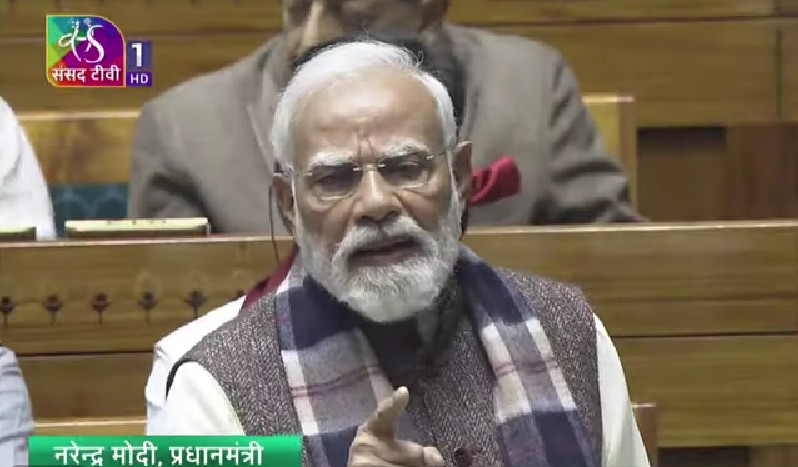
Prime Minister Narendra Modi on Monday launched a sharp attack on Jawaharlal Nehru and the Congress Party, alleging “injustice” to the national song Vande Mataram.
After opening a debate on the song in the Lok Sabha, the Prime Minister said the Congress had compromised on Vande Mataram, adding that former Prime Minister Jawaharlala Nehru had felt its promotion might upset Muslims.
PM Modi called this alleged compromise “the biggest misfortune of the nation,” asserting that the Congress “bowed down before the Muslim League.”
“It is unfortunate for the country that Congress compromised on Vande Mataram. They bowed to the Muslim League and decided to fragment Vande Mataram,” PM Modi said.
Vande Mataram as Symbol of Sacrifice
Describing Vande Mataram as a powerful force during the struggle for independence, the Prime Minister said the song was a source of inspiration and sacrifice.
“Vande Mataram is a mantra, a slogan which gave energy, inspiration, and showed the path for sacrifice and penance to the freedom movement. It is a matter of pride that we are becoming witnesses to 150 years of Vande Mataram,” he said.
PM Modi noted that the country was commemorating several historical milestones, including 75 years of the Constitution and the birth anniversaries of Sardar Patel and Birsa Munda. “We are also celebrating the 350th martyrdom day of Guru Teg Bahadur ji. Now we are celebrating 150 years of Vande Mataram,” he added.
Swipe at Congress over Emergency
Without directly naming the Congress, PM Modi said that when Vande Mataram completed 100 years, the nation was “in the clutches of Emergency.”
“When Vande Mataram completed 50 years, India was under British rule. When Vande Mataram completed 100 years, India was in the clutches of Emergency… At that time, the patriots were imprisoned. When the song that inspired our freedom movement, unfortunately, India was witnessing a black period…. 150 years of Vande Mataram is an opportunity to reinstate that pride and that great part of our past… This song inspired us to attain freedom in 1947,” he said.
Standing Firm during Partition of Bengal
The Prime Minister also recalled the 1905 partition of Bengal, saying Vande Mataram became a rallying force for unity when the British pursued their divide-and-rule strategy.
“The British divided Bengal in 1905, but Vande Mataram stood like a rock and inspired unity,” he said, crediting Bengal’s intellectual leadership with guiding the nation through that period.
“The British understood that it was difficult for them to control India after 1857… They opted for divide and rule, making Bengal their experimental centre. Those were the days when Bengal’s intellectual power guided the country,” he said.
Call for Renewed National Unity
Hailing the national song, PM Modi said the country must collectively acknowledge its debt to Vande Mataram.
“There is no leadership and opposition here. We are here to appreciate and accept the debt of Vande Mataram collectively. It is because of this song that we are all here together,” he said.
Calling it a unifying force across regions, he added, “It united the nation from North to South and from East to West. The time has come to unite again and move together with everyone. This song should inspire and energise us to fulfil the dreams of our freedom fighters. We need to reiterate the resolve to make our nation self-reliant and developed by 2047,” he said.
150 Years of National Song
Vande Mataram, in India’s history is not merely a song, it is a pulse, an emotion, and a wave of awakening. As this year marks 150 years since its composition, we reminisce that the lines capture the spirit of the Indian freedom struggle that spanned over two centuries and honour the countless bravehearts who sacrificed everything for the motherland.
Vande Mataram is not just a song, it is the declaration of India’s soul. From the sanyasi resistance to the Partition of Bengal, from the 1857 uprising to the final freedom struggle, and even today, Vande Mataram remains the deepest voice of India’s national consciousness.
And yet, the ideology that once divided this song — and divided India — still survives, and continues to oppose it.





