









RSS Sarsanghchalak Dr Mohan Bhagwat delivered a firm message on nationalism and civic responsibility, stating that India is meant to live and progress, not to be torn apart by divisive thinking. He underlined that patriotism cannot be confined to any single group; rather, every citizen carries a responsibility towards the nation.
At the same time, he rejected slogans and language that advocate fragmentation (Bharat Tere Tukde Honge), asserting that such expressions have no place in India’s public or ideological space. According to him, while dissent is integral to democracy, anti-national rhetoric cannot be legitimised under the guise of free speech. He stressed that nationalism is about positive contribution, social harmony and constructive action, not hatred or violence.
Youth Energy Must Be Channelled for Nation-Building
Dr Bhagwat placed particular emphasis on the role of youth, describing them as India’s core strength. He said their energy should be directed towards nation-building, self-reliance and social cohesion, instead of anger, confusion or polarising politics. Concluding his remarks, he noted that India’s future depends on citizens standing with the country, not with ideologies that seek to divide it.
Shah Marks 115 Years of Savarkar’s Poem
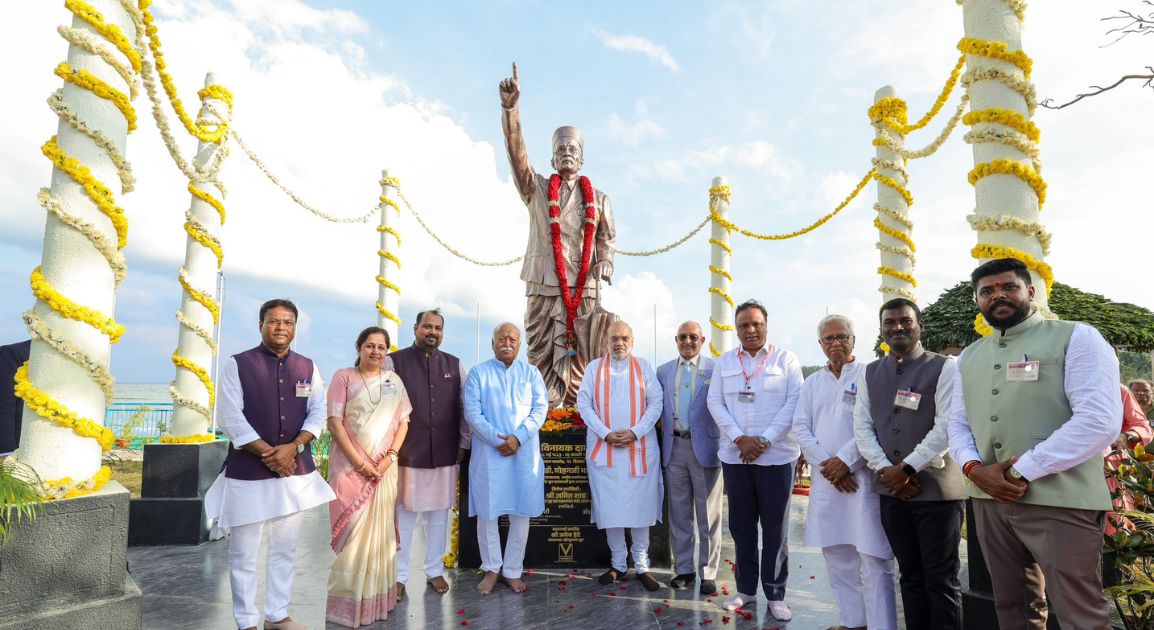
Meanwhile, Union Home Minister and Minister of Cooperation Amit Shah addressed a cultural programme in Sri Vijayapuram to commemorate 115 years of Swatantryaveer Vinayak Damodar Savarkar’s poem Sagara Pran Talamalala. The event was attended by Dr Bhagwat and Andaman and Nicobar Islands Lieutenant Governor, Admiral (Retd.) D. K. Joshi.
During the programme, a life-size statue of Savarkar was unveiled, a moment Shah described as deeply significant, noting that the RSS has carried forward Savarkar’s ideological legacy.
Andaman’s Historic Role in Freedom Struggle
Shah highlighted that the Andaman and Nicobar Islands have emerged as a national pilgrimage site because Savarkar endured some of the harshest years of his life there. He also recalled the islands’ historical connection with Subhas Chandra Bose and the Azad Hind Fauj, noting that Bose had proposed naming the islands ‘Shaheed’ and ‘Swaraj’—a vision realised during Prime Minister Narendra Modi’s tenure.
वीर सावरकर जी का जीवन मातृभूमि के प्रति अथाह प्रेम और राष्ट्र के लिए प्राण न्योछावर करने की प्रेरणा देता है। अंडमान और निकोबार की भूमि वीर सावरकर जी सहित अनेक स्वतंत्रता सेनानियों के त्याग, समर्पण एवं साहस की साक्षी रही है।
आज इस पावन भूमि पर राष्ट्रीय स्वयंसेवक संघ के… pic.twitter.com/Y1M8zp85Id
— Amit Shah (@AmitShah) December 12, 2025
Savarkar’s Legacy and Cultural Nationalism
According to Shah, the newly unveiled statue will serve as a lasting reminder of Savarkar’s sacrifice and devotion, inspiring future generations. He described Sagara Pran Talamalala as a powerful expression of patriotism and reflected on Savarkar’s belief that courage lies in overcoming fear, not in the absence of it.
The Home Minister also released a coffee table book on Savarkar, observing that his personality—shaped by patriotism, social reform, scholarship and a warrior spirit—was too expansive to be captured in a single work. He added that Savarkar’s ideas were rooted in cultural nationalism, which continues to influence India’s national direction.
From Social Reform to 2047 Vision
Shah noted Savarkar’s role in challenging social discrimination and pointed to his literary contributions, including the addition of more than 600 words to Indian languages. He also recalled Savarkar’s interpretation of the 1857 uprising as the first War of Independence, which helped reshape national consciousness under colonial rule.
Referring to India’s progress over the past 12 years, Shah cited the Panch Pran announced during the 75th year of independence, emphasising the resolve to shed colonial-era mindsets. Looking ahead, he said India aims to become a global leader by 2047, driven by the collective effort of 140 crore citizens.
He concluded by stating that Savarkar’s vision would be fulfilled when the youth commit themselves to national unity and prosperity, adding that the title “Veer” was not conferred by any government but earned through the respect of the people.