






















Bangladesh has once again revealed its true face—a nation cocooned in Islamic terror, where anti-India sentiment is not just tolerated but actively cultivated by radical groups and emboldened by a state that fails to uphold basic diplomatic norms. The recent wave of violent protests targeting Indian missions and the closure of two Indian visa centres underscore the dangerous reality: Bangladesh is no longer a safe haven for its minorities or a reliable neighbor for India. Instead, it is a breeding ground for extremism, where radical Islamists dictate the national agenda and target anyone perceived as an enemy of their ideology.
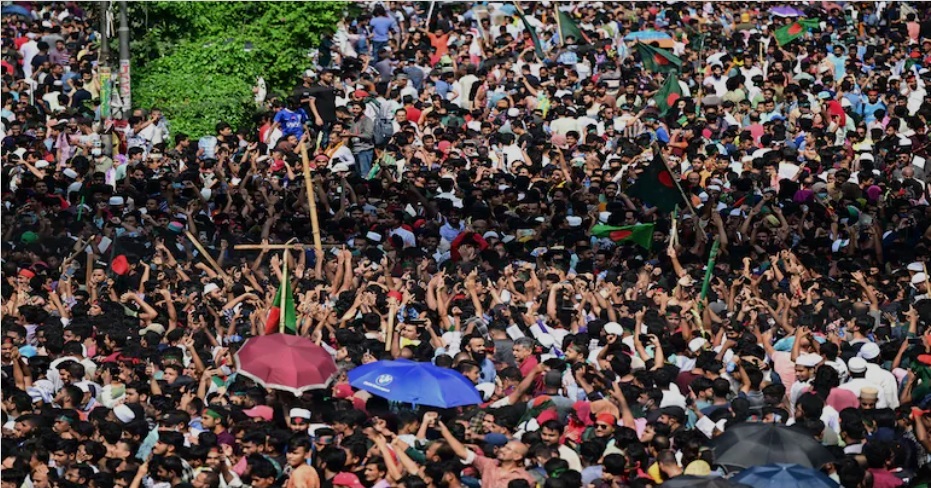
The latest incidents, orchestrated by the so-called July Unity (July Oikya) front, saw thousands of protesters marching toward the Indian High Commission in Dhaka and attempting to storm diplomatic facilities in Rajshahi and Khulna. These are not spontaneous outbursts of public anger but carefully planned attacks of Islamic terror, by extremist factions with clear anti-India motives. The protestors chanted slogans demanding the extradition of deposed Prime Minister Sheikh Hasina and accused India of conspiring against Bangladesh, painting a picture of a nation consumed by paranoia and religious hatred.
The security situation in Bangladesh has deteriorated to such an extent that India was forced to close its visa application centres in multiple cities, a move that highlights the complete breakdown of law and order. Police barricades and confrontations with demonstrators have become routine, as radical groups openly threaten violence against Indian diplomatic personnel and facilities. The Indian Ministry of External Affairs has summoned the Bangladesh envoy to express strong concerns of Islamic terror, warning that the interim government must ensure the safety of its missions in line with international diplomatic obligations.
Bangladesh’s descent into chaos is not a recent phenomenon but the culmination of years of appeasement towards Islamist radicals, precisely self-proclaimed guardians of Islamic terror. The ousting of Sheikh Hasina in the July Uprising of 2024, followed by the rise of extremist student groups, has only accelerated this trend. The new leadership, far from curbing radicalism, appears to be complicit in allowing anti-India rhetoric to flourish. The death penalty handed down to Hasina by a special tribunal, while she remains in India, is a stark reminder of the judicial kangaroo courts that now operate under the shadow of mob rule.
The targeting of Indian diplomatic missions is symptomatic of a broader pattern of Islamic terror that has gripped Bangladesh. Radical groups, emboldened by the state’s inability or unwillingness to act, have turned the country into a sanctuary for extremists. The recent shooting of Sharif Osman Hadi, a frontline protest leader, and the open threats against key figures further illustrate the lawlessness that prevails. The message is clear: anyone who opposes the radical Islamist agenda is not safe in Bangladesh.
Bangladesh’s transformation into a cocoon of Islamic terror has dire implications for regional stability. The country’s proximity to India makes it a potential launchpad for terrorist activities, and the failure of the Bangladeshi government to rein in extremist elements poses a direct threat to India’s security. The recent protests and attacks on Indian missions are not isolated incidents but part of a larger strategy to undermine India’s influence in the region and advance the cause of radical Islam.
The radicalization of Bangladesh’s youth is particularly alarming. Student groups, once seen as a force for positive change, have now become the vanguard of extremist movements. These groups openly call for violence, glorify terrorism, and seek to impose their ideology on society. The lack of effective countermeasures by the government has allowed these groups to flourish, turning campuses into hotbeds of radicalism.
The international community must take note of Bangladesh’s descent into chaos. The country’s inability to protect diplomatic missions and its tolerance for Islamic terror undermine the principles of international law and threaten regional peace. The recent incidents should serve as a wake-up call for India and its allies to reassess their relationship with Bangladesh and take steps to safeguard their interests.
Bangladesh’s transformation into a cocoon of Islamic terror is not just a threat to India but to the entire region. The country’s radicalization has created a dangerous precedent, where extremist groups can operate with impunity and the state is powerless or unwilling to act. The recent protests and attacks on Indian missions are a stark reminder of the challenges posed by radical Islam and the urgent need for a coordinated response.
In conclusion, Bangladesh has become a haven for Islamic terror, where radical groups operate with impunity and the state turns a blind eye to violence and extremism. The recent anti-India protests and attacks on diplomatic missions are a wake-up call for India and the international community. Bangladesh must be held accountable for its failure to protect diplomatic missions and for allowing its soil to be used as a base for terrorism. The cocoon of Islamic terror must be broken before it engulfs the entire region.





