
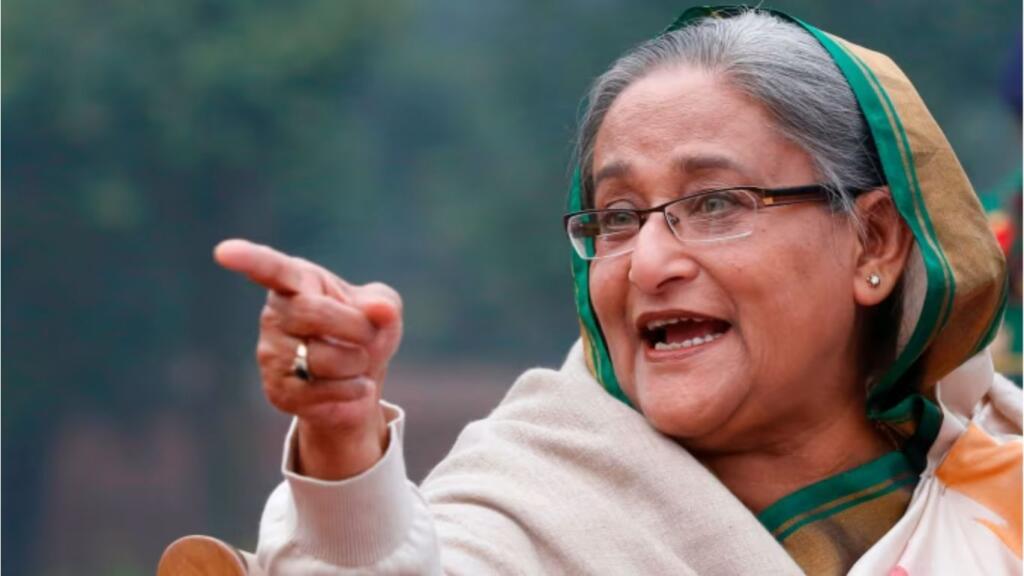
Former Bangladesh Prime Minister Sheikh Hasina reacted strongly to the killing of student leader Sharif Usman Hadi. She accused the Muhammad Yunus-led interim government of allowing lawlessness to spread and said governance has collapsed since her removal.
In an email interview with ANI, Hasina said the killing underlines a growing culture of violence under the interim administration. She warned that the situation is destabilising Bangladesh internally. Moreover, she said it is damaging relations with neighbouring countries, especially India.
According to Hasina, violence has become routine under Yunus’s leadership. She claimed the interim government either denies the problem or lacks the ability to control it. As a result, Bangladesh’s internal stability and international credibility are suffering. She added that India is closely watching the chaos, the persecution of minorities, and the destruction of bilateral gains built over decades.
In an email interview with ANI, former Prime Minister of Bangladesh Sheikh Hasina speaks on the death of Osman Hadi, “This tragic killing reflects the lawlessness that uprooted my government and has multiplied under Yunus. Violence has become the norm while the interim government… pic.twitter.com/6YbPHnKbpq
— ANI (@ANI) December 22, 2025
Her comments followed the death of Sharif Usman Hadi, a youth leader linked to the 2024 “July uprising” and a spokesperson of the political platform Inqilab Mancho.
Hasina also raised concern over the killing of a Hindu youth during the unrest. She linked this to what she described as the interim government’s failure to protect minorities and maintain law and order. Referring to the lynching of 27-year-old Dipu Chandra Das in Mymensingh, she held the Yunus administration responsible. Das was allegedly beaten to death by a mob over blasphemy accusations, and his body was later set on fire. The incident triggered nationwide outrage.
She said such incidents are increasing diplomatic tensions, particularly with India. In addition, she accused the interim government of letting extremist forces influence both domestic and foreign policy.
Hasina argued that the strain in India-Bangladesh relations is entirely due to Yunus’s actions. She said his government makes hostile statements against India, fails to protect religious minorities, and allows extremists to shape policy. Then, she added, it expresses surprise when tensions rise. She described India as Bangladesh’s most consistent friend and partner, and said bilateral ties are deep and long-lasting.
Also Read: Polls Amidst Chaos: How Violence and Radicalisation Shadow Bangladesh’s Elections
Furthermore, Hasina claimed that radical elements are deliberately fuelling anti-India sentiment. She pointed to attacks on diplomatic missions, media houses, and minority communities. According to her, extremists emboldened under the current regime have acted with impunity. She alleged that instead of prosecuting them, the interim government shields such actors and glorifies them.
She also warned about the growing influence of radical Islamist forces. Hasina claimed the interim administration has released convicted terrorists and allowed extremist-linked groups to enter public life. She said this threatens Bangladesh’s secular foundations. In her view, radicals are using Yunus as an acceptable face for the international community while quietly radicalising state institutions.
Separately, Hasina criticised the interim government’s approach towards Pakistan. She argued that major foreign policy shifts are being made without democratic legitimacy. While she acknowledged the need for stable relations with all countries, she said Yunus’s rapid outreach to Pakistan is inappropriate. According to her, after alienating traditional allies, the interim leadership appears desperate for international support.
In an email interview with ANI, former Prime Minister of Bangladesh Sheikh Hasina speaks on Pakistan–Bangladesh engagement, “Bangladesh has always believed in friendship to all, malice toward none. Of course it makes sense for our country to have a stable relationship with… pic.twitter.com/YDS54tKXLS
— ANI (@ANI) December 22, 2025
Finally, Hasina stressed that the interim government lacks the mandate to make long-term strategic decisions. She said Yunus was not elected and therefore has no right to reshape Bangladesh’s foreign policy. She added that once free elections are held, Bangladesh’s foreign policy will again reflect national interests. She concluded by saying that India-Bangladesh ties are fundamental and will endure beyond the interim government.