
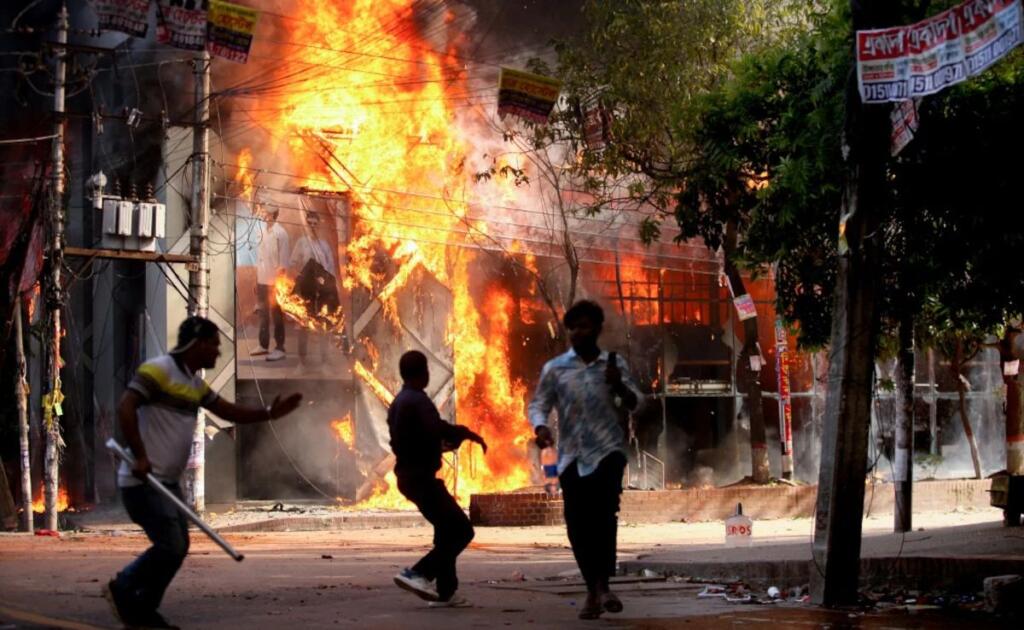
Bangladesh is once again witnessing a surge in political violence ahead of crucial national elections scheduled for February 12, 2026.
The unrest intensified after the killing of student leader Sharif Osman Hadi on December 11. Hadi was closely linked to the National Citizen Party (NCP), a relatively new political force born out of last year’s student-led uprising.
Since his death, the country has seen anti-India protests, attacks on newspaper offices, mob lynchings, vandalism, and street violence. On Monday, another student leader, Motaleb Shikder, was shot dead, further deepening fears of instability.
Why these elections matter
These will be Bangladesh’s first elections since the removal of Prime Minister Sheikh Hasina in August 2024, ending 15 years of Awami League rule. The polls are especially important because they will also include a referendum on the July Charter, a proposed set of constitutional reforms drafted by the Interim Government. The goal is not just to elect a new government, but to reshape the political system itself.
For all this to succeed, peace and stability are essential. Without them, free, fair and credible elections will be impossible.
A deeply uncertain electorate
Public mood remains uncertain. A limited voter survey by the BRAC Institute in August 2025 found that nearly 50% of voters were undecided, a sharp rise from October 2024. This reflects confusion, distrust, and a lack of clarity about new political choices.
Who wants what?
Different political players have very different interests as the polls approach:
National Citizen Party (NCP) and Jamaat-e-Islami: Both parties have repeatedly demanded that elections be postponed. The NCP, formed only in February 2025 by student leaders, believes it does not yet have enough time to build nationwide support. Street mobilisation and strong rhetoric suit it better than early elections.
Bangladesh Nationalist Party (BNP): The BNP, the only remaining traditional party with a strong grassroots base, wants elections as soon as possible. It hopes to take advantage of the vacuum left by Sheikh Hasina’s exit and its own strong organisational network. Having suffered under Hasina’s rule, the BNP wants power quickly to shape the new political system.
Interim Government: Led by Nobel laureate Muhammad Yunus, the Interim Government has two main tasks: carry out major reforms and ensure free, fair and secure elections. Progress on reforms has been slow, and all sides accuse it of bias. This makes the success of the election process critical to its credibility.
How Hadi’s killing changed everything
Sharif Osman Hadi’s death became a turning point. Declaring a day of mourning, Yunus said the killing was carried out by forces that do not want peaceful elections in Bangladesh. Regardless of who was directly responsible, the violence that followed shows how fragile the situation has become.
Arson, vandalism, and killings created a “chain reaction,” making it easier for political actors to mobilise mobs. For young NCP leaders, anti-India rhetoric has emerged as an easy tool to gain popularity. India has been blamed for sheltering Hadi’s alleged killers, while institutions and media houses seen as part of the “old system” — such as Prothom Alo and The Daily Star — have been targeted.
BNP’s delicate position
The violence comes just as BNP leader Tarique Rahman is expected to return to Bangladesh after 18 years in exile. The BNP, like the Interim Government, has a strong interest in restoring stability. However, it is increasingly portrayed by newer political forces as part of the old political establishment, despite leading in most pre-election surveys.
Who gains, who loses?
At present, the biggest losers are ordinary citizens, especially young people, who are caught between fear, uncertainty, and political manipulation. The gainers are those who benefit from chaos—actors who use inflammatory language, street power, and identity politics to build influence without accountability.
What happens next?
Bangladesh now shows classic signs of post-revolutionary instability, a pattern seen in many countries throughout history. With leaders officially calling the July 2024 uprising a “revolution,” predicting the next steps is difficult.
Much will depend on whether the Interim Government and the Bangladesh Army can prevent further violence and ensure order. For India, the most realistic approach is to remain patient, cautious, and watchful, while avoiding actions that could further inflame tensions.
The road to February 2026 is uncertain—and the choices made in the coming months will shape Bangladesh’s future for years to come.