
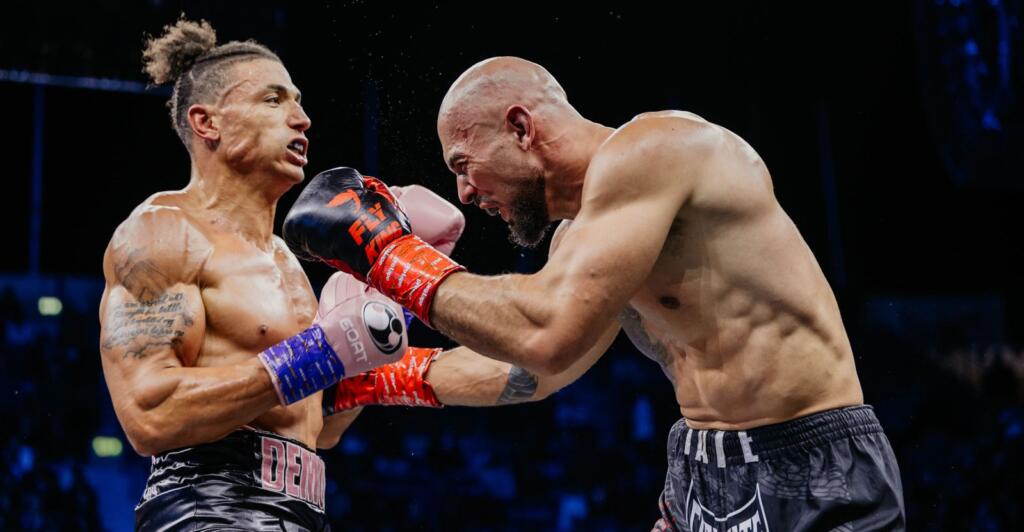
In a highly anticipated crossover bout billed as “The Fight Before Christmas” at Misfits Mania in Dubai, controversial influencer and former kickboxing champion Andrew Tate, long known for his self-styled “alpha male” persona and widely criticised for his misogynistic and sexist rhetoric was outboxed by reigning Misfits heavyweight champion Chase DeMoor.
Tate, making his professional boxing debut after a five-year layoff, failed to match the youth, stamina and against Chase DeMoor, a fighter who is hardly regarded as elite or technically refined.
For a man who has spent years projecting himself as physically superior, intellectually dominant and socially untouchable, often through his sexist-dominant beliefs about women, the performance was strikingly ordinary.
Tate talked up dominance and control, but inside the ring he looked uncomfortable, outworked and repeatedly caught by shots.
The contrast was hard to miss as a loud, self-proclaimed symbol of male supremacy struggling against an opponent with modest combat credentials.
The bout exposed the gap between Tate’s online bravado and real-world resilience, puncturing an image built more on provocation and posturing than proven substance.
Andrew Tate’s defeat was a brutal reality check for a man who has built an empire on selling physical dominance and masculine superiority. He handpicked an opponent widely viewed as technically limited and inexperienced, yet still failed to impose himself.
By every measurable logic of the fight, Andrew Tate’s loss was a dismantling of his own “alpha” narrative. Over six scrappy rounds, he failed to outwork or outlast Chase DeMoor — a fighter with limited boxing pedigree — and lost by majority decision (58–56, 58–56, 57–57) despite supposedly handpicking a favourable opponent.
Tate started with a few early jabs, but statistics of effort and control told a harsher story: DeMoor threw more, pressured more, and dictated the later rounds while Tate’s output and movement visibly collapsed. By Round 5, a single heavy uppercut left Tate hurt and clinging on, forcing him into survival mode rather than dominance.
The bout devolved into clinches largely because Tate lacked the conditioning to box at range, a glaring flaw for a former four-time kickboxing champion.
Since Romanian authorities arrested Andrew Tate and three others in late December 2023 on allegations of rape, human trafficking and forming an organised crime group, the global media has fixated on the hypermasculine influencer — though often in ways that miss the deeper significance of his rise and influence.
The allegations themselves did not come as a shock to critics, given Tate’s long record of online statements portraying women as male property, blaming women for sexual violence, and confining them to rigid domestic roles. Yet Tate and his brother Tristan represent more than just extreme misogyny.
Their popularity exposes a troubling transnational intersection of technology-enabled gender-based violence, economic anxieties, far-right ideological currents, and systemic failures by institutions and digital platforms to safeguard women’s rights and democratic values.
To fully grasp the phenomenon, Tate’s crude sexism must be examined beyond simplistic narratives of male resentment, and instead understood as part of a broader social, political and digital ecosystem that enables and amplifies such views.
A Privileged Beginning, a Convenient Myth
Andrew Tate’s rise is often framed by his supporters as a triumph of grit and self-made brilliance. The reality is less heroic. Born to Emory Tate Jr., a highly respected international chess master, Tate inherited not just competitive instincts but a deep admiration for dominance and hierarchy.
Yet rather than applying that legacy to discipline or intellectual rigour, Tate weaponised it into a crude worldview that celebrates power without responsibility.
Even in recounting his parents’ fractured marriage, Tate has repeatedly defended infidelity and male entitlement, normalising behaviour that left his mother raising the family alone while he later glorified the very conduct that broke his home.
From Athlete to Algorithm
Tate’s modest success as a kickboxer never translated into mainstream sporting relevance. His real breakthrough came when he realised outrage converts better than achievement.
After a brief and controversial stint on reality television, Tate pivoted to YouTube, podcasts and subscription platforms, where misogyny became his brand.
Women were no longer individuals but props in a performance—spoken of as property, liabilities or rewards. This was a calculated business model, designed to exploit algorithms, monetise resentment and hook young men searching for identity through grievance.
Misogyny as Content Strategy
Tate did not stumble into sexism—he built an empire on it. By repeatedly blaming women for sexual violence, dismissing their autonomy and reducing gender equality to a threat, he created a digital ecosystem where cruelty was reframed as “truth.”
Platforms eventually removed him not for being misunderstood, but for repeatedly violating policies meant to curb hate and harassment.
His influence, however, had already spread, embedding itself in online spaces where anger toward women is encouraged, rewarded and sold back as empowerment.
Cultural Disdain and Religious Provocation
Tate’s contempt has not been limited to women. He has repeatedly courted backlash for racially charged remarks and statements perceived as demeaning toward Indians, drawing accusations of stereotyping and cultural disrespect.
Similarly, comments interpreted as dismissive of Hindu beliefs have sparked anger, reinforcing the perception that Tate views cultures and religions not as identities to respect, but as tools for provocation.
His public conversion to Islam followed the same pattern. Rather than humility or spiritual reflection, the shift was framed through dominance, control and selective moralising—prompting criticism that faith was being instrumentalised to justify patriarchy rather than practiced with sincerity.
Religious scholars and observers have pointed out that Tate’s rhetoric often contradicts the ethical restraint and accountability central to the faith he claims to embrace.
Legal Trouble and the Collapse of the Persona
When Romanian authorities arrested Tate on allegations including rape, human trafficking and organised criminal activity, the charges did not arrive in isolation—they aligned disturbingly well with the world he had been advertising.
While legal proceedings remain ongoing and guilt is for courts to decide, the case shattered the illusion that Tate’s behaviour was merely “online talk.” It forced a reckoning between performance and consequence, between rhetoric and reality.
More Than a Man, a Symptom
Andrew Tate is not dangerous because he is loud; he is dangerous because he is lucrative. His success exposes how digital platforms reward extremity, how institutions fail to intervene early, and how misogyny, racism and religious disrespect can be repackaged as motivation.
Tate is not an alpha male undone by criticsism, he is a carefully constructed product, built on contempt, sustained by outrage and collapsing under the weight of its own contradictions.