













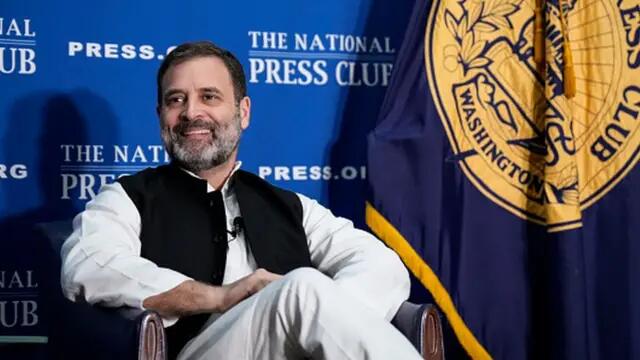
Congress leader Rahul Gandhi’s repeated engagements in the United States including interactions with individuals and organisations linked to controversial Islamist networks have once again come under scrutiny. His June 2023 US tour, where he was seen sharing platforms with activists and lawmakers associated with groups such as the Council on American-Islamic Relations (CAIR), has raised questions about the ideological ecosystem he is choosing to align with. These interactions now appear even more significant in light of a new political flashpoint: Texas Governor Greg Abbott’s official designation of CAIR as a Foreign Terrorist Organisation and a Transnational Criminal Organisation under state law on 18 November 2025.
Abbott’s proclamation, which groups CAIR alongside the Muslim Brotherhood described as its “successor organisation” imposes serious penalties, including restrictions on land acquisition and enhanced criminal liabilities for anyone aiding the organisation. This unprecedented state-level designation has intensified global conversations around CAIR’s history, its ideological posturing, its alleged proximity to extremist networks, and its political allies worldwide. In this context, Rahul Gandhi’s visible proximity to individuals with ties to CAIR and other Islamist advocacy circles becomes a matter of political relevance and public interest for India.
Beyond the U.S. political sphere, CAIR’s activities have also directly intersected with India. Over the years, the organisation has amplified Hinduphobic narratives, promoted anti-Hindu propaganda, and supported events such as the “Dismantling Global Hindutva” conference, notorious for peddling extremist anti-India narratives.
In January 2022, CAIR backed propaganda based on a report by controversial activist Rana Ayyub and demanded a ban on the Bollywood film Sooryavanshi, calling it “dangerous” and “fascist”. Its consistent campaigns include calling for the release of convicted Pakistani terrorist Aafia Siddiqui, who is serving 86 years for attacking U.S. Army and FBI personnel.
That same year, CAIR released a report titled Still Suspect, claiming the U.S. government systematically discriminates against Muslims. Yet its own record reveals consistent silence or hostility toward Hindu victims of terrorism. In December 2022, CAIR criticised a mobile billboard in New Jersey that merely displayed facts about the 26/11 Mumbai attacks, claiming the truthful display was “hate”.
The duality is stark: while CAIR frequently alleges Islamophobia in the U.S., it has aggressively nurtured Hinduphobia overseas, particularly in India.
Against this backdrop, Rahul Gandhi’s associations with activists connected to CAIR’s ideological orbit have not gone unnoticed.
During his 2023 tour, Gandhi participated in a public discussion with Sunita Vishwanath, co-founder of Hindus for Human Rights (HfHR), an aggressively Hinduphobic organisation known for hosting CAIR representatives and partnering with the Islamic Circle of North America (ICNA), another group frequently criticised for extremist sympathies.
Moreover, during his 2024 trip to the U.S., Rahul Gandhi met Ilhan Omar, the controversial U.S. Congresswoman known for minimising the 9/11 attacks as “some people did something” at a 2019 CAIR event. Omar has built a political identity around Islamist victimhood narratives, routinely criticising secular governments for actions against Islamist extremists while remaining muted about extremist violence itself.
Omar has consistently defended organisations like CAIR and has echoed narratives that align with their political agenda. For Rahul Gandhi, a leader positioning himself as a global torchbearer of liberalism, such engagements especially with figures who openly support or sympathise with Islamist organisations raise legitimate questions: Is his international outreach inadvertently legitimising groups that are openly hostile to India and Hindus?
The timing is important. Abbott’s proclamation has renewed international scrutiny on CAIR’s connections to Hamas, a designated terrorist organisation in the U.S., the EU, Japan, Canada, Australia, and the U.K. Gandhi’s association with individuals linked to CAIR’s ecosystem, therefore, becomes part of a broader debate on political judgement and ideological alignment.
Governor Abbott’s detailed proclamation highlights what he describes as a long-standing pattern of CAIR employing, elevating, or associating with individuals later convicted or exposed for terrorism-related offences. Among the most prominent names is Ghassan Elashi, a founding board member of CAIR’s Texas chapter and Treasurer of the Holy Land Foundation, who received a 65-year sentence in 2009 for financial terrorism.
The list continues with Abdurahman Alamoudi, who spoke at a CAIR-sponsored rally and openly supported Hamas and Hizballah before being convicted for funding Al Qaeda. Another figure, Randall Todd Royer, a former CAIR communications specialist, was sentenced to 20 years for conspiring to aid Al Qaeda and the Taliban.
Similarly, Bassem Khafagi, CAIR’s former community relations director, pleaded guilty to visa and bank fraud tied to extremist financing. CAIR fundraiser Rabih Haddad was deported for his role in the Global Relief Foundation, shut down by the U.S. Treasury for Al Qaeda links.
The proclamation also named Muthanna al-Hanooti, a Michigan-based CAIR director convicted for illegally accepting Iraqi oil from Saddam Hussein’s regime; Sami Al-Arian, a convicted Palestinian Islamic Jihad (PIJ) financier honoured by CAIR; and CAIR Executive Director Nihad Awad, who publicly expressed happiness over the 7 October 2023 Hamas attack on Israel.
CAIR responded aggressively, calling Abbott an “Israel First politician” and accusing him of fuelling anti-Muslim hysteria.
The Texas designation of CAIR as a Foreign Terrorist Organisation under state law has created a new global context in which political associations are being re-examined. For India, this raises a clear question: Why is Rahul Gandhi repeatedly engaging with individuals and groups embedded in or adjacent to an Islamist advocacy ecosystem that has a record of Hinduphobia and links to organisations now labelled terrorist by a major U.S. state?
As the global debate around extremist networks intensifies, and as CAIR faces unprecedented legal and political consequences in the U.S., Rahul Gandhi’s choices of companions and collaborators abroad will likely attract deeper scrutiny. Whether these interactions stem from ideological alignment, political calculation, or diplomatic misjudgement, the implications are significant not only for him, but for India’s broader political and security landscape.