
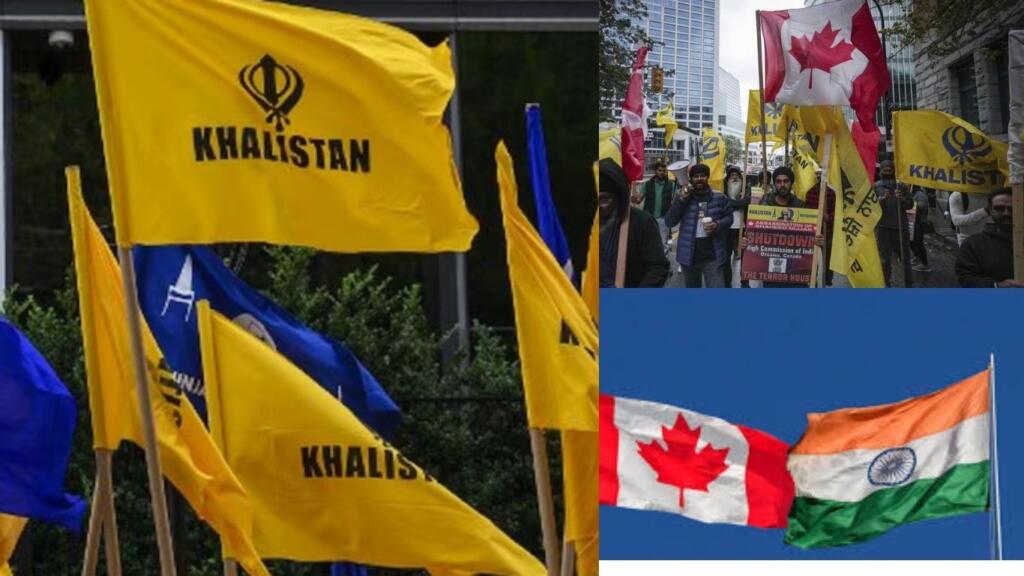
The diplomatic thaw between India and Canada is once again under strain after an unofficial “Khalistan Referendum” held in Ottawa witnessed shocking acts of provocation, including the desecration of the Indian national flag and the chanting of “kill” slogans targeting Indian leaders and officials. The referendum, organised by Sikhs for Justice (SFJ) a group banned in India under the Unlawful Activities (Prevention) Act (UAPA) drew thousands of Canadian Sikhs, many of whom queued for hours outside Ottawa’s McNabb Community Centre to participate. Footage circulating online sparked widespread outrage in India as uniformed police liaison officers were seen present at the venue but not intervening, even as inflammatory and violent slogans were raised.
The event has come at a sensitive moment. Just as New Delhi and Ottawa have taken steps to rebuild trust and resume cooperation after years of tension, particularly following the 2023 killing of Khalistan extremist Hardeep Singh Nijjar, this development threatens to reopen old wounds. The renewed wave of anti-India rhetoric, coupled with symbols of separatism on open display, has raised concerns in India about Canada’s continued inability or unwillingness to curb extremist elements operating from its soil.
According to SFJ, more than 53,000 Sikhs from Ontario, Alberta, British Columbia, and Quebec participated in the referendum. The organisation claimed the queues stretched nearly two kilometres and included families with children and elderly citizens who remained in line long past the scheduled 3 pm closing time.
However, the massive turnout was overshadowed by disturbing scenes. Videos posted online showed Khalistan supporters shouting aggressive slogans, including “kill,” directed at India and its representatives. Several participants were also seen insulting and desecrating the Indian national flag, an act that sparked outrage among Indian communities globally.
Footage captured by Alberta-based digital outlet Media Bezirgan showed large crowds outside the community centre, waving yellow Khalistan flags, with police present but not intervening. At the event, SFJ’s general counsel Gurpatwant Singh Pannun, officially designated as a terrorist by India, addressed attendees through a satellite message. Pannun also raised questions about Canadian Prime Minister Mark Carney’s meeting with Prime Minister Narendra Modi on the sidelines of the G20 Summit in Johannesburg that same day, calling the timing “suspicious.”
This referendum marked the seventh such vote held by SFJ in Canada since September 2022. Previous rounds in Brampton, Surrey, Mississauga, and Calgary have drawn large crowds as well, underscoring the organisation’s persistent attempts to mobilise support among the Sikh diaspora.
India’s response to the Ottawa referendum was swift and firm.
Dinesh Patnaik, India’s High Commissioner to Canada, described the event as a “farcical” exercise, emphasising that it had no legitimacy, political weight, or procedural authenticity.
In an interview with CBC News, Patnaik observed:
“Having a peaceful protest or asking for something is part of a political process. We have no problem with it. In India, there are political parties which ask for the formation of a Khalistani government. You people know what a referendum is. You have done referendums in the past. You know how farcical this is.”
He added that the issue becomes complicated when such activities are perceived in India as a form of external interference by Canada. At a time when New Delhi and Ottawa are working to repair ties, events like this add unnecessary friction.
India has repeatedly expressed concern over Canada’s permissive environment that allows extremist groups like SFJ to operate openly, hold public events, and disseminate anti-India propaganda.
What makes this particular referendum more sensitive is its timing.
The vote took place on the same day Canadian Prime Minister Mark Carney met Prime Minister Narendra Modi during the G20 Summit in Johannesburg, South Africa. This was a significant diplomatic engagement: the first high-level meeting after Canada’s political transition and a major step toward restoring trust after the turbulence of recent years.
When asked whether holding a Khalistan referendum on the same day as the meeting sends a contradictory diplomatic signal, Canadian Foreign Minister Anita Anand clarified that the timing was coincidental. She emphasised that the bilateral meeting had been scheduled well in advance and reiterated Canada’s commitment to focusing on law enforcement, public safety, and counter-terror concerns.
Despite these assurances, the optics of a highly provocative anti-India event occurring simultaneously with a key diplomatic engagement have not gone unnoticed in New Delhi.
In recent months, India and Canada have made a noticeable effort to mend relations damaged during former Prime Minister Justin Trudeau’s tenure, especially after his public allegation in 2023 linking India to the killing of Hardeep Singh Nijjar. The allegation severely strained ties, leading to the expulsion of diplomats, a pause in trade talks, and deep diplomatic distrust.
However, both governments had recently begun reversing this decline.
On the very day of the referendum, India and Canada announced the launch of negotiations on a Comprehensive Economic Partnership Agreement (CEPA)—an ambitious trade pact aimed at doubling bilateral trade to $50 billion by 2030. India’s Ministry of External Affairs also highlighted cooperation in civil nuclear energy and discussions on long-term uranium supply, indicating the rekindling of a strategic partnership.
But the Ottawa referendum, with its violent rhetoric and symbolic provocations, risks undermining this renewed goodwill. For India, the incident reinforces long-standing concerns that Canada remains a permissive environment for extremist separatist movements. For Canada, failing to address such activities could derail ongoing diplomatic and economic negotiations with one of the world’s fastest-growing major economies.
The unofficial “Khalistan Referendum” in Ottawa has once again brought the fragile nature of India–Canada ties into sharp focus. While Canada frames such events as exercises in free expression, India views them as dangerous provocations that embolden extremist elements and strain bilateral trust.
With trade talks restarting, high-level meetings resuming, and cooperation expanding into energy and security sectors, neither nation can afford a return to the hostilities of 2023. Yet incidents like the Ottawa referendum highlight unresolved tensions that continue to shadow the relationship.
For the diplomatic revival to succeed, Canada will need to confront the threat posed by extremist groups more seriously, while India must balance firmness with strategic engagement. The coming months will determine whether this moment becomes another setback or a turning point toward a more stable and mutually respectful partnership.