










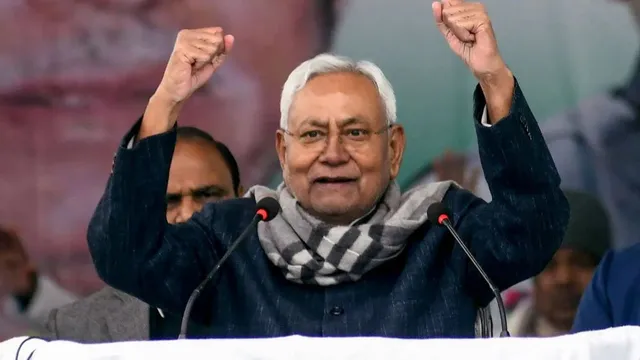
As the long election campaign concludes and vote counting begins, the early trends clearly indicate one thing the people of Bihar have once again endorsed Nitish Kumar’s return. This outcome is not a coincidence or a fluke. It is the result of a deep, village-level political and administrative ecosystem created by Nitish Kumar over nearly two decades.
To understand why JD(U) rarely suffers strong anti-incumbency, one must look at how Nitish built an extensive grassroots network made up of individuals whose livelihoods, dignity, and social mobility improved directly because of his governance. These people became not just beneficiaries but stakeholders in his political model.
Across every village and panchayat, Nitish Kumar built a chain of workers, assistants, and community representatives who served as intermediaries between the government and citizens. They include:
Mamta Didis
Vikas Mitras
Nyay Mitras
Talimi Markaz members
Shiksha Sevaks
Ratri Praharis
Swachhta Grahis
Sanitation Supervisors
Panchayat Rozgar Sewaks
Technical Assistants
Gram Kachahari Secretaries
Kisan Salahkars
Among these, the most influential groups have been the Shiksha Mitras and later the BPSC-appointed teachers, whose recruitment became one of the biggest employment drives in Bihar’s history under Nitish Kumar.
Similarly, before “Jeevika Didis” started receiving ₹10,000 assistance, Nitish played a key role in organising them into strong women-led self-help groups, enabling financial independence for lakhs of households.
Nitish Kumar also radically altered Bihar’s social and political landscape by giving constitutional protection and political representation to various Extremely Backward Class (EBC) communities. Groups such as:
Prajapati
Sharma (Carpenters)
Thakur
Chandravanshi
Chauhan
Bind
Kalwar
Noniya
Saw
Sahu
Jamadar
Vishwakarma
These communities struggled for decades both before and after the 1990s confined mostly to being loyal voters with no real representation. Under the Nitish model, they moved from being mere voters to becoming active participants in governance.
EBCs began holding influential positions such as:
Mukhiya
Panchayat Samiti member
Zila Parishad member
Pramukh
Mayor
Chairman
For many, this was a historic shift a movement from political invisibility to meaningful participation.
Women’s Empowerment: A Silent Revolution
In a state where women’s employment once felt like a distant dream, Nitish Kumar introduced sweeping reforms that directly uplifted female participation across sectors. From the Bihar Police to education and healthcare, women received unprecedented opportunities.
His administration also earned significant goodwill through:
Substantial increases in old-age pension
Direct financial assistance for girl students
₹50,000 for women completing graduation
₹25,000 for girls passing Class 12
₹10,000 for meritorious girls clearing Class 10
These measures built a powerful bond between Nitish Kumar and women voters, cutting across caste and community lines. It is this wide support base that often makes him a universally acceptable leader in Bihar.
The Rashtriya Janata Dal (RJD) still battles the baggage of its past — concerns about law and order and governance remain deeply embedded in Bihar’s collective memory.
Meanwhile, the BJP’s leadership in the state, despite strong efforts, has not yet become the natural or emotional choice for a large section of Bihar’s electorate.
Thus, even when the opposition performs well, Nitish Kumar often emerges as the single largest and most acceptable political force, thanks to his multi-layered social coalition.
Nitish Kumar’s success is not accidental. It is built on:
A vast network of grassroots workers
Massive employment drives
Transformative EBC empowerment
Strong women-centric schemes
A governance model that created millions of beneficiaries
This ecosystem ensures that Nitish Kumar does not face the kind of harsh anti-incumbency that governments often encounter.
As vote trends show yet another tilt in his favour, one thing remains clear in Bihar’s complex political arithmetic, Nitish Kumar continues to be the permanent X-factor.