
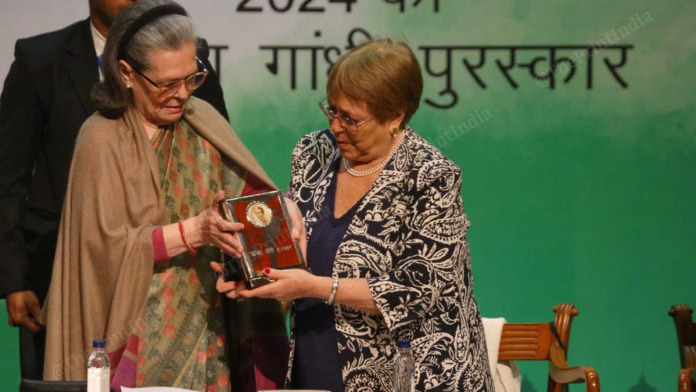
The Congress Party’s decision to award the 2024 Indira Gandhi Prize for Peace, Disarmament and Development to Michelle Bachelet, former UN High Commissioner for Human Rights and ex-President of Chile, has stirred a significant political storm. Presented by Sonia Gandhi on November 19 in the presence of 1984 anti-Sikh riots accused Jagdish Tytler, the ceremony invited immediate criticism from the Bharatiya Janata Party. For many, this moment was symbolic not of honouring global statesmanship, but of the Congress Party once again embracing voices that have repeatedly undermined India on international platforms.
During her tenure as UN human rights chief, Bachelet became a central figure in global discourse on Kashmir, NRC, CAA, and “minority rights,” often echoing narratives crafted by Pakistan, the Organization of Islamic Cooperation (OIC), and other groups that have consistently targeted India. Her presence at a Congress stage was therefore seen by critics as an endorsement of her anti-India rhetoric. Yet, Sonia Gandhi chose to praise her life story including oppression, exile, and political struggles drawing parallels between Bachelet and Indira Gandhi. Bachelet, in turn, emphasised multilateralism and global human rights, asserting that harmony among nations is essential for prosperity. But her words rekindled an old debate: can someone who repeatedly misrepresented India’s internal affairs truly be celebrated for promoting peace and development?
Bachelet’s Persistent Interference in Kashmir: A Pattern of Political Targeting
Michelle Bachelet’s strained relationship with India began almost immediately after she took office in 2018. In her very first statement as UN rights chief, she highlighted Kashmir, claiming that the UN report on the region had not been followed by “meaningful improvements.” Without acknowledging Pakistan-sponsored terrorism or the complex historical background of the region, she focused solely on alleged Indian excesses. India responded firmly, stressing that human rights questions must be addressed in a manner consistent with national sovereignty.
Matters escalated after the abrogation of Article 370 in August 2019 a constitutional amendment that ended a discriminatory provision manipulated by political elites, separatists, and vested interests. While the decision brought unprecedented developmental reforms and was supported domestically, Bachelet expressed deep concern over restrictions and detentions in the Valley. She urged India to lift curbs and “consult Kashmiris” an argument that aligned neatly with Pakistan’s narrative. Unsurprisingly, then Pakistan Prime Minister Imran Khan applauded her remarks and demanded a UN probe, showcasing how her comments were weaponised by anti-India forces.
Bachelet consistently overlooked Pakistan Occupied Kashmir, where genuine and chronic human rights abuses from political repression to routine persecution are reported by independent observers. Yet, her office focused almost exclusively on India. In 2020, after meeting the OIC contact group on Kashmir, she alleged worsening conditions, citing “excessive force,” “pellet guns,” and “demographic engineering” claims rooted more in activist rhetoric than verified facts. Even as Kashmir underwent profound transformation post-2019 with reduced terrorism, economic revival, and long-denied rights being restored Bachelet remained fixated on selective narratives, ignoring the region’s complex security dynamics.
Targeting India on NRC and Internal Security: Ignoring Cross-Border Realities
Bachelet’s opposition extended beyond Kashmir. She criticised the National Register of Citizens (NRC) process in Assam, expressing concern over the exclusion of 1.9 million individuals and warning against “statelessness.” But she disregarded a fundamental reality: the NRC was ordered by the Supreme Court to identify illegal migrants who had infiltrated India over decades, primarily from Bangladesh. These infiltrations have significantly altered local demographics, strained resources, and contributed to security threats.
By urging India to avoid deportation and detention of illegal entrants, Bachelet essentially legitimised demographic changes caused by uncontrolled migration. Her criticism aligned with the demands of groups that oppose any attempt to protect India’s borders or stabilise sensitive regions like Assam. Even when India refined appeal mechanisms and adopted a humanitarian approach, Bachelet’s narrative remained unchanged.
Her rhetoric escalated after the 2019 Pulwama terror attack, when she warned of Muslims being “under threat” due to India’s response. Rather than condemning Pakistan-backed terrorism, she chose to lecture India once again reflecting selective outrage that benefitted those seeking to discredit New Delhi.
While India worked to strengthen oversight on NGOs through the Foreign Contribution Regulation Act (FCRA), Bachelet claimed that the law was being used to “stifle voices.” The irony, however, was stark. The FCRA amended to enhance transparency and prevent misuse of foreign funds was originally enacted under the Congress government itself in 2010. Many NGOs opposed to the law were found funnelling foreign money into political agitation, mass conversions, or activities detrimental to India’s developmental priorities.
Bachelet ignored this context and portrayed these groups as victims of state suppression. When the Indian government pointed out that violations of law cannot be justified under the pretext of human rights, she did not acknowledge the broader picture. India also reminded her office of its robust institutions: a free judiciary, strong democratic framework, independent human rights bodies, and effective grievance redressal mechanisms. Yet, her statements continued to paint India as a violator of freedoms, while often overlooking genuine violations in authoritarian regimes.
Her remarks on minorities also followed a predictable pattern. In 2019, she spoke of “increasing harassment of Muslims, Dalits and Adivasis,” basing her claims on selectively curated reports. But she repeatedly ignored violence and repression of minorities in nations like Pakistan, Bangladesh, Afghanistan, China, and Gulf countries. This selective morality raised serious questions about her ideological leanings and the political motivations behind her interventions.
Michelle Bachelet’s most controversial move came in 2020 when her office sought to intervene legally in India’s Supreme Court case against the Citizenship Amendment Act (CAA). This unprecedented attempt to influence India’s internal legislative matters was criticised heavily by New Delhi. India made its stance clear: CAA is a sovereign act of Parliament, designed to offer refuge to persecuted minorities from three neighbouring Islamic states minorities who had suffered decades of institutional discrimination.
Yet, Bachelet argued that the law risked violating “international obligations,” ignoring the plight of Hindus, Sikhs, Buddhists, Christians, and Parsis who fled brutal persecution. Even more glaring was her silence when Saudi Arabia deported hundreds of Rohingyas a move that attracted almost no condemnation from her office. But when India deported five Rohingyas, she launched a full-scale critique. Such inconsistencies revealed a troubling double standard harsh judgement for India, and muted responses for powerful Islamic nations or chronic human rights offenders.
Michelle Bachelet’s tenure at the United Nations was marked by selective scrutiny, political leaning, and a recurring focus on India through a distorted lens. Her interventions often reinforced propaganda pushed by Pakistan and OIC members while disregarding India’s democratic credentials, the complexity of its security challenges, and the suffering of persecuted minorities in neighbouring nations.
Her past association with global political influencers such as George Soros whom she honoured with Chile’s highest civilian award for foreigners adds further layers to her ideological profile. Soros’s long-running hostility toward India’s elected government is well known, making Congress’s celebration of Bachelet all the more questionable.
In choosing to honour someone who repeatedly misrepresented India on global platforms, Congress has once again shown a willingness to align itself with voices that undermine national interest. The BJP’s objections, therefore, are not merely political they reflect broader concerns about how India is portrayed globally and how domestic actors legitimise those who seek to weaken India’s image